
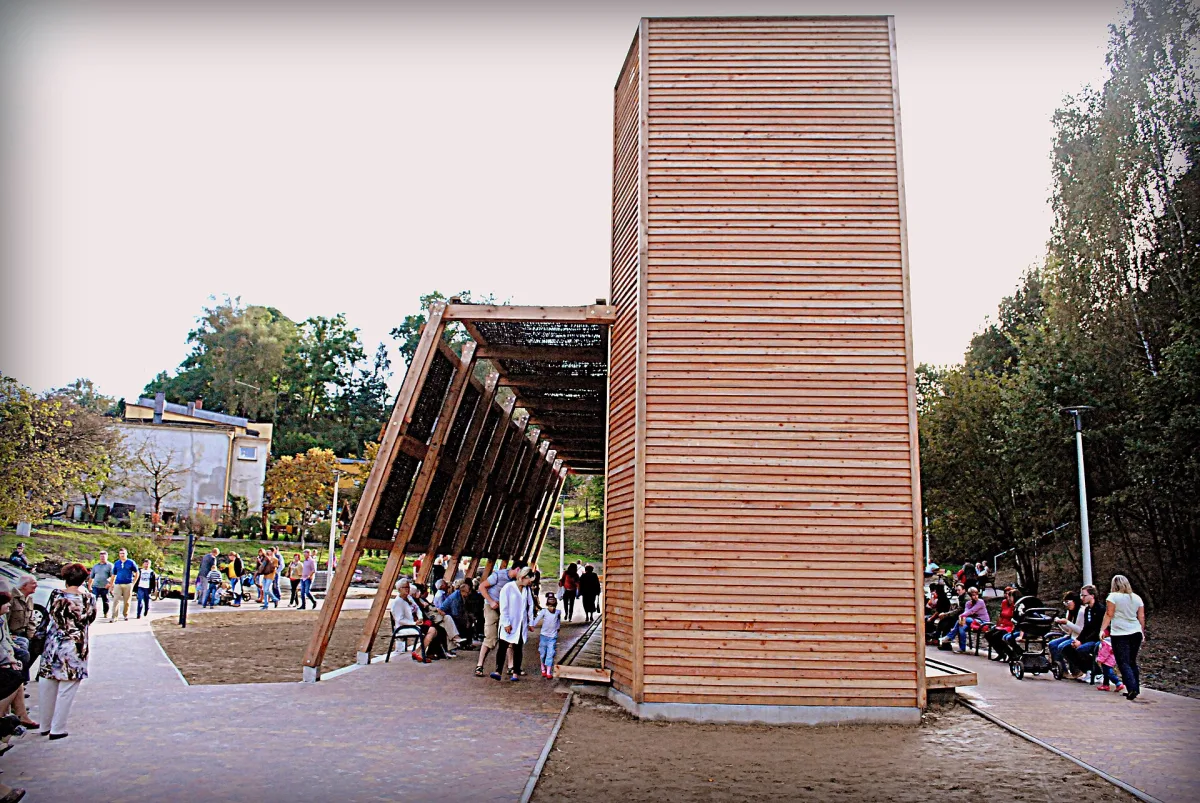
A brine graduation tower is a wooden structure down which brine trickles. From the damp branches, usually blackthorn, the water evaporates and an aerosol forms, with which the surrounding air is saturated. In Silesia such structures stand in city parks, on the grounds of sports centres and in former spa towns. Alongside them, pump rooms and spa parks have survived, that is traces of the time when the region took cures at its own springs. Below is an overview of places that have their own entries on the portal.
How a graduation tower works
This is described most precisely by the town of Radlin. The brine graduation tower in Radlin stands in the northern part of the town, on Wypandów street, right by the border with Rybnik. It was designed on a rectangular plan measuring 3.95 by 24 metres and 8.20 metres high. The structure is wooden, and brine pumped to the top flows down branches laid on it and evaporates naturally. According to the town, the intensity of the aerosol depends on the weather: the brine evaporates most intensely on a sunny and windy day, least during rain, and at night the process almost disappears. The town also notes that the tower works even when the brine is not visibly flowing down the outer branches, because it is enough for the interior to be damp.
Radlin presents its facility as the first graduation tower in the industrial area of Upper Silesia, brought into operation in 2014. The tower lies on the Emma and Marcel Trail and on the cycle route to the Rybnik Reservoir, so it is often the destination of a walk. In the area there are former mining sites: about 1.1 kilometres further on is the Ignacy Historic Mine, and next to the former Marcel mine stands the red-brick Emma Colony.
Graduation towers in towns and parks
In Rybnik the brine graduation tower stands in the Paruszowiec-Piaski district, on the site of a former swimming pool. It was built in April 2018 under the citizens' budget. Its heart is a structure of wood and blackthorn branches, and the whole is completed by shelters protecting from sun and rain and a surface of granite and concrete. Next to it lies a pond of 12.4 hectares on the Ruda river, with a renovated pier and footpaths and cycle paths.
In Mikołów the graduation tower on Małe Planty has operated since 2021, in a park right by the historic market square. It was chosen by residents in the Citizens' Budget vote in 2018, and according to the municipality construction began in September 2020. It was built in two stages: first the first module with installations and foundations for the second part, and after another spring the second module. Małe Planty was entered in the heritage register together with Duże Planty as one park complex, and in the park there is also an outdoor gym and a playground.
In Chorzów the graduation tower stands on Plac Hutników (Steelworkers' Square), next to the monument of Friedrich Wilhelm von Reden. It was built during the revitalisation of the square in 2018-2020. Nearby is the Teatr Rozrywki, so a short walk can be combined with a visit to the theatre or with a look at the former Prezydent shaft.
In Zawiercie the brine graduation tower lies on the grounds of the Sports and Recreation Centre on Sienkiewicza street. It was opened on 21 March 2021. Nearby is Tadeusz Kościuszko Park, and a synagogue has survived in the town.
Spa tradition: Jaworze, Goczałkowice, Ustroń, Jastrzębie
The graduation tower in Jaworze is shaped like a rotunda and was built in 2014 of wood. According to the municipality, the column of the tower has a brine tank for inhalation, and the brine comes from Zabłocie and contains, as the municipality states, up to 140 milligrams of iodine per litre. The municipality describes how a maritime microclimate forms around the tower as a result. The facility is sometimes switched off because of the weather, especially winter and wind, and because of maintenance work. Jaworze has a longer spa history behind it: it was approved as a spa by the Silesian Provincial Office in Opava in 1862, the town lost this status in 1906, and in 1927-1930 a new treatment facility was built, where Maria Dąbrowska and Julian Tuwim, among others, took their rest.
Goczałkowice-Zdrój has an even older tradition. In 1856 the Prussian mining authority was looking for salt there and at a depth of 616 metres struck a four per cent brine. The first treatment season began in June 1862, and among the facilities for patients was the spa park in Goczałkowice-Zdrój. From the former spa buildings, the old pump room and the Górnik and Wrzos pavilions, among others, were entered in the heritage register. Less than 300 metres from the park there is an inhalatorium with a brine graduation tower.
In Ustroń the pump room is in Zawodzie, the spa district on the slope of Równica, on Sanatoryjna street. In 1967-1990 17 modernist holiday buildings, known as pyramid blocks, were built here, designed by Henryk Buszko, Aleksander Franta and Tadeusz Szewczyk. The whole is sometimes assessed as one of the most interesting urban and architectural projects carried out in Poland after the Second World War. The sources do not say where the water in the pump room comes from.
Jastrzębie-Zdrój shows the other side of this story. The Spa Park covers 18 hectares and has been in the heritage register since 1993. The Spa House in the Swiss style was built in 1862 by Felix von Königsdorff, and the pump room operated from 1872 in a music pavilion from 1861. The pump room was demolished in 2011, spa activity ended in 1994, and in 2015 a brine inhalatorium was built in the complex. In the park grow species from different continents, among them ginkgo and Osage orange, and since 1928 there has been a bandstand here.
Brine in the Żywiec Beskids
In Sól, a village in the Rajcza municipality, the Solankowa Kraina (Brine Land) facility operates. Besides the graduation tower there is an indoor zone with a sauna, and the facility's website contains material on the composition of the brine water, the history of salt and the uses of inhalation, as well as the results of a water analysis. The rules of a visit, opening hours and the ban on entry with animals are given on the facility's website, so it needs to be checked before you travel.

Be the first! Add a comment.
You need to log in to add a comment.
Log in