
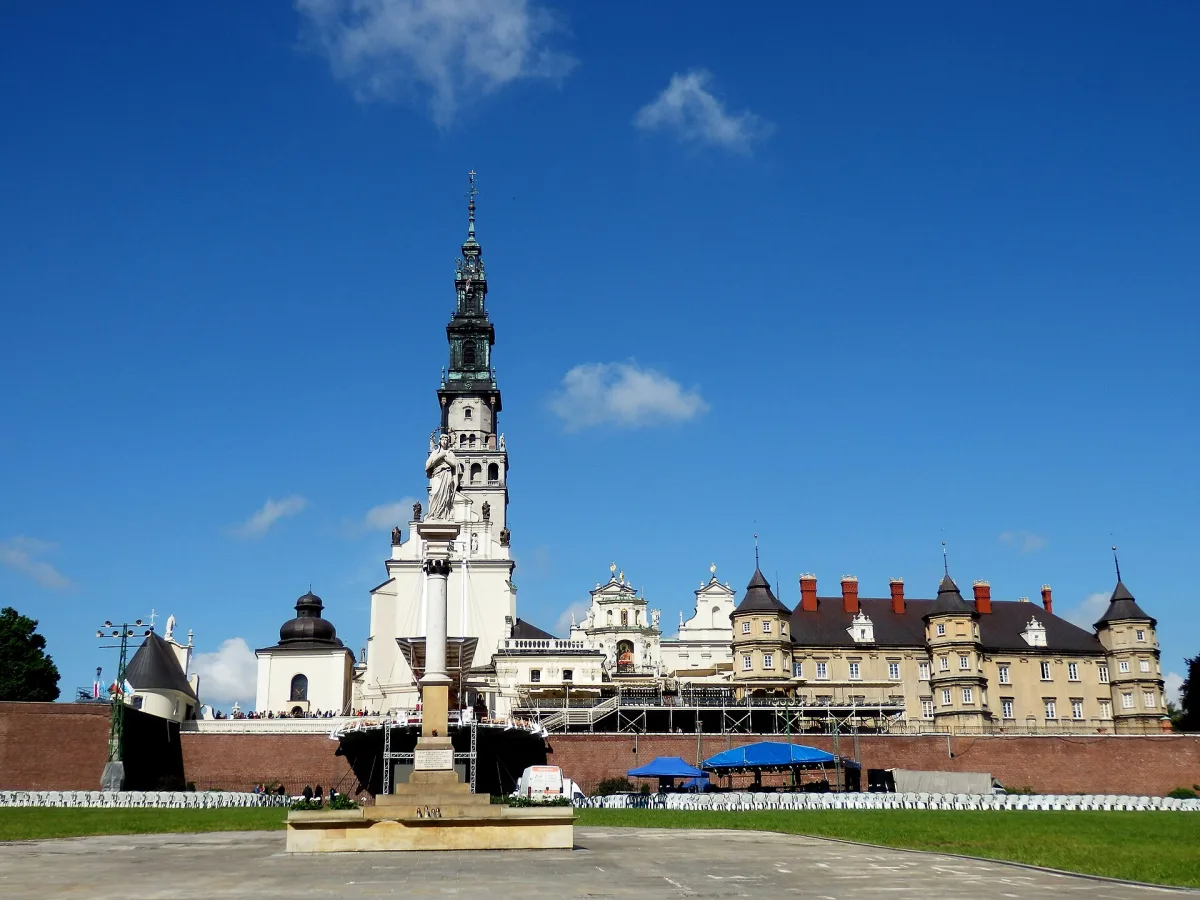
The hill with the Pauline monastery in Częstochowa is known above all as a shrine, but for almost two centuries it also served as a fortress. The walls, bastions and moat mentioned in the sources were built with defence in mind, and their greatest test came in November 1655. This text separates what is known about the fortifications themselves and the course of the siege from what was added later by chronicles, propaganda and the novel.
How a fortress came to stand on the monastery hill
Construction of the ramparts, known as the Marian Fortress (Latin: Fortalitium Marianum), began around 1620 on the initiative of King Sigismund III Vasa. He feared a threat from Protestants while unrest continued in the Empire, and decided to fortify the shrine. The design is attributed to the royal architect Andrea dell'Aqua, and the plan is a quadrilateral with bastions at the corners.
The work went on in stages. In 1621-1624 the walls with the entrance gate were built, in 1631 the eastern curtain wall with two bastions was raised, and two more bastions, which form the western curtain wall, were completed in the 1640s. At the time of the siege, at the end of 1655, the whole had the shape of a rectangle measuring 130 by 104 m, with a deep moat, earthen ramparts, casemates and masonry escarpments. It was a small fortress, whose strength lay in its walls, moat and armament rather than its size.
The supplies were in place, moreover. The monastery had been preparing for a siege since 6 August 1655: 60 muskets were bought, reinforcing an artillery of 24 guns, 12 of them heavy. The garrison had been raised to 160 soldiers three years earlier, in line with a resolution of the Sejm. A list of armament purchases, made mainly in Lower Silesia, has survived in the monastery library.
From letters to siege: November 1655
The Swedes were then at the height of their success in the war known as the Swedish Deluge. Prior Augustyn Kordecki sent a letter to King Charles Gustav on 7 November, and in the correspondence that followed he feigned submission and the monastery's weakness while refusing to admit a foreign garrison. Kordecki received from the Swedes a letter of protection, that is a salvaguardia guaranteeing the safety of the fortress, yet the Swedes still demanded that their garrison be admitted. The monks refused. The first attempt at a surprise, on 8 November, ended with the detachment withdrawing to Wieluń.
The siege began on 18 November, when the corps of General Burchard Müller approached the monastery. It ended in the night of 26 to 27 December 1655, that is after almost forty days.
How defenders and besiegers were counted: two versions of the figures
The sources do not agree on the strength of the forces. Some studies speak of about 4000 Swedish soldiers and 36 guns, and on the defenders' side of about 160 soldiers in the garrison, fewer than a hundred monks and a few noblemen. Others give different values: Müller's corps had about 2000 men and eight light guns at the start, and at its peak, after reinforcements, about 3200 soldiers and 17 guns. They put the garrison at the start of the siege at 250 people, after reinforcement by local nobles.
We do not decide here which version is more accurate. In both, the defenders were clearly outnumbered by the besiegers.
Sorties, a tunnel and heavy artillery
For the first weeks the Swedes had only light guns, which could not threaten the walls. On the night of 25 November the defenders under Piotr Czarniecki made a sortie, spiked two guns and cut down their crews. Only on 10 December did siege artillery reach Jasna Góra: two 24-pounder half-cannons and four 12-pounder quarter-cannons. The bombardment partly destroyed the walls on the north side and near the Holy Trinity bastion, but the besiegers lacked ammunition, and the monastery's artillery inflicted heavy losses on them.
The Swedes also tried to approach the walls by undermining them. On 20 December, at around one o'clock, the defenders under Jan Zamoyski made another sortie, spiked two guns and killed the miners from Olkusz who were digging the tunnel. At Christmas the Swedes bombarded the monastery from the north again, and the fire was so intense that their siege cannon burst. Müller received an order from the king to march to Prussia. He still demanded 60 thousand thalers to save face, and heard from Kordecki that the monastery would have paid at the start of the siege, but after the Swedish destruction it no longer could. On 27 December the siege was lifted.
What is fact and what is story
The facts confirmed in scholarly studies include the dates of the beginning and end of the siege, the refusal to admit a garrison, the sorties from the fortress and the superiority of the monastery's artillery. The story of these events, however, has a history of its own. Prior Kordecki described the defence in the work “Nova Gigantomachia”, published in 1658 while the war was still going on, and in 1659 Stanisław Kobierzycki's Latin work on the siege appeared. These texts were quickly put to use in propaganda against Swedish rule. They should be read as accounts by a participant and by authors committed to the cause, not as a neutral report.
Scholars assess the significance of the defence with caution. The entry on Jasna Góra states that it was above all a victory in the religious and symbolic dimension, and that the siege itself was not the turning point of the Deluge. The relief force from Greater Poland, led by Krzysztof Żegocki, arrived only after the Swedes had left. After news of the defence, the Tyszowce Confederation against the Swedes was formed on 29 December, and its act mentioned the siege of the monastery with indignation.
History must also be separated from the novel. Henryk Sienkiewicz in “The Deluge” fixed the image of the siege in collective memory but changed the facts: he made Piotr Czarniecki younger, increased the Swedish superiority, introduced the character of Andrzej Kmicic, whose prototype, Samuel Kmicic, was then in Podlasie, and added a culverin together with the way it was destroyed. Anyone reading the novel should treat it as literature.
The question of the Jasna Góra image, its removal to Silesia and the history of its cult is a separate subject, described in other texts on the portal. Here it is enough to know that in November 1655 the image left the monastery, and that the sources give different dates and locate the place where it was kept differently.
The later fate of the walls
Still during the war, in 1658, the Sejm allocated additional funds for expanding the fortress and maintaining a garrison of 120-150 people. An arsenal was built in the second half of the 17th century, and at the turn of the 17th and 18th centuries the fortress was greatly extended. In 1709 the outer edge of the moat was surrounded with a palisade of more than 15 thousand stakes, and in 1700-1721 all the bastions and curtain walls were rebuilt.
The walls were tested several more times. During the Bar Confederation confederates took refuge at Jasna Góra, among them Kazimierz Pułaski. The only Russian assault in the decisive siege, on the night of 8 to 9 January 1771, failed. The last siege was carried out in April 1813 by General Fabian Sacken: after the water supply was cut off and the walls breached, Colonel Antoni Górski surrendered the fortress on honourable terms. The walls were pulled down soon afterwards, according to some accounts as the execution of an order of Tsar Alexander I, who had commanded that the fortress be dismantled, according to others as the work of local peasants between 1 April and 15 July 1813. In 1842 Tsar Nicholas I permitted the walls to be rebuilt according to the original plans, but they served only a commemorative function.
Today the fortifications are part of the Jasna Góra shrine complex, inscribed on the list of Historic Monuments. In the St Roch bastion, uncovered during conservation work begun in 1991, the Treasury of National Memory exhibition was set up in 2006, and the arsenal building of 1660-1680 houses museum exhibitions.
Be the first! Add a comment.
You need to log in to add a comment.
Log in