
Two Saxon families on the Czarna Przemsza
In the second half of the 19th century the Lamprecht, Schön and Dietel families came to the Basin from Saxony. They were drawn to Sosnowice, a village by the new border station, by the railway and the border location. Two of these families left behind the best preserved traces: the Dietels on today's Żeromskiego Street, the Schöns on the Czarna Przemsza river, in Środula and in Sielec. Before starting a walk, a note on spelling is needed. Polish sources write Dietl, Dietlowie, and German ones Dietel. The same happens with Schön, also written Schoen.
Here too begins the first discrepancy in the sources, because Henryk Dietel, also called Heinrich, has two dates of birth. The palace's website gives 1838, other sources 1839. They agree on 1911 as the year of his death, and give the day as 24 June 1911.
The Dietels: a spinning mill and a palace in Pogoń
According to some sources the Dietels came to Sosnowice in September 1878, and according to the palace's website Henryk Dietel arrived in June 1878, at the Tsar's invitation. The sources thus differ on the month and agree on the year. Dietel founded the first worsted wool spinning mill in the Kingdom of Poland. The factory was completed in 1880 and production had begun as early as 1879. At that time the family lived in a modest building by the works, and in 1881 the first of five sons was born.
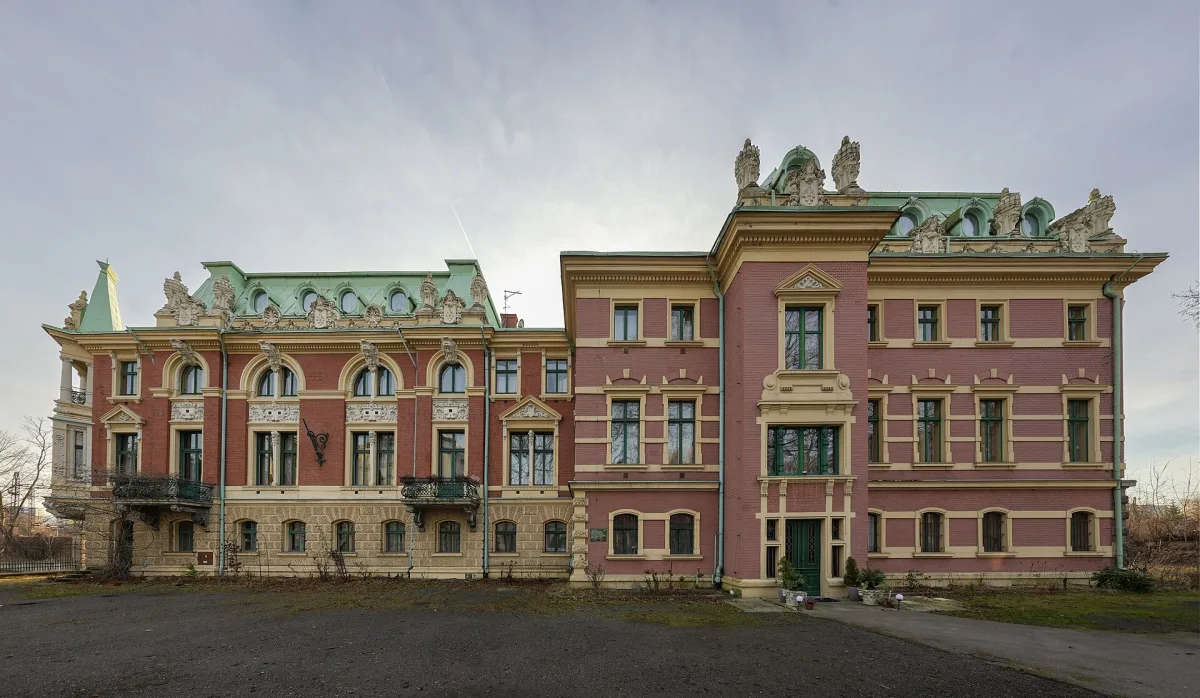
The history of the building of Dietel Palace also has two versions. The palace's website says that in the mid-1880s a small house was rebuilt into a one-storey building, to which a Neo-Renaissance block was added, and the last reconstruction at the turn of the 19th and 20th centuries unified the facades in a Neo-Baroque spirit. Other sources give the first plans from the 1880s, signed by Stanisław Waligórski, and the first extension design from 1890. According to yet another account the concepts took their final shape around 1890 and construction lasted until 1900. After a roof fire in 1900 the palace received a high roof with dormers and an attic with garlands and vases.
The palace became part of a patronage complex together with a park, the former factory, a workers' estate and a Lutheran church. The most important interior is the two-storey ballroom, added, according to the palace's website, together with the orangery in 1894. The oak decor of the dining room, called the Dutch room, with panels referring to Delft painting, and a Neo-Romanesque smoking room have also survived. In January 1945 the palace was taken over by the Soviet military commandant's office, and many parts of the building and its furnishings were destroyed. It then housed a music school, and since 1997 the building has been in private hands and its renovation is under way.
Beside the palace lies Dietel Park, laid out in 1901 in the Neo-Romantic style on 6.13 hectares. Dietel brought to it the German gardener Ernst Robert Pietsche and the architect Fritz Hanishem. Of the former structures a Neoclassical gloriette survived in almost unchanged form. The park was entered in the heritage register on 31 December 1998, together with the buildings of the former palace.
Dietel as the town's benefactor
Henryk was a public figure, and the list of his foundations is long and concrete. In 1886 he gave the Lutheran community a factory hall for a church, in 1894 he funded a wall around the Lutheran cemetery, co-financed two Orthodox churches in Sosnowiec and supported the building of the Catholic Church of St Thomas in Pogoń. The most important was education: a factory school in 1879, the Alexandrian School in 1889 and the Sosnowiec Realschule, the first secondary school in the town, opened in 1894. During the revolution of 1905 the Dietels closed the factory and left Sosnowiec for a time. After the war the enterprise operated as a state works until its liquidation in 1994.
The mausoleum in the Lutheran cemetery
After Henryk Dietel's death the Dietel family mausoleum was built for him and his family on Smutna Street, in the centre of the Lutheran (Evangelical-Augsburg) cemetery. It was built in 1912 to a design by Józef Pomian-Pomianowski. The circular building stands of volcanic tuff blocks and is modelled on ancient Roman tombs. The interior has two levels: at the top a cemetery chapel, in the crypt the resting place of Henryk and his wife Klara, née Jacob. In the crypt there are also twenty-two burial niches for descendants. The site was entered in the heritage register of the Silesian Voivodeship on 21 April 2008. The mausoleum is open to visitors only on selected days of the year. It is a burial place, so cemetery rules apply here.
The Schöns: two palaces, not one
There is a naming problem with the Schöns, because in Sosnowiec there are two palaces of this family and they are easily confused. The first, on Chemiczna Street, at the junction of Pogoń and Środula, was built by Ernst Schön and completed in 1885. It is a Neo-Baroque palace on a quadrangular plan with towers at the corners, also called the father's palace or the main one. Since 1985 it has housed the Museum in Sosnowiec, and since 1991 the ceremonial rooms of the registry office. The museum shows an exhibition on the history of the Schöns in Sosnowiec and a collection of contemporary Polish glass. The institution was established on 1 March 1985, and has operated independently since 1989.
The second is Franz Schön Palace at 1 Maja 19, also called the New Schön Palace. It was built in 1900-1903 in an eclectic style, with a Neo-Gothic tower in the English style. The heritage register dates the whole complex more broadly, to 1870-1880, and the completion of the palace to 1903. Some sources attribute the commission to Oskar Schön, and only after his death in 1905 was Franz supposed to have moved into the palace with his family. Hence the second name met with for the building: Oskar Schön Palace. It should also be remembered that in 1879 Franz founded a vicuña wool spinning mill on this site, and the plot by the river, previously belonging to Count Mortimer Tschischa, was bought by the Schön family in 1885.
In 1919, during the Silesian Uprising, the uprising's command was housed in this palace, and the heritage register adds that in 1921 the headquarters of the plebiscite defence was based here. Franz died in 1918, and the fire at the spinning mill in 1907, the war and his death worsened the family's financial situation. In 1923 the building was leased to the court, and in 1925 sold to the State Treasury. Since 1945 it has served as the seat of a court. The town plans to set up a second museum site in it, so the rules of entry should be checked before a visit.
The park, the river and other traces
Adjoining Franz's palace is Schön Park on the Czarna Przemsza, a remnant of the former palace park of 1875-1879. Today it covers about a hectare, and through its grounds runs a boulevard by the river, which links it with the Scouts' Park on the other side of the water. The former appearance, with a large pond, a hill and grottoes, is known among other things from the memoirs of Fanny Lamprecht, since it was she who left the first mention of the park.
The Sielec Castle also belongs to the same world of industrial fortunes. According to the site's entry, in 1856 Count Andrzej Renard bought it for his son Jan, and it later belonged to the company Gwarectwo "Hrabia Renard" and until the Second World War served as an office building. This list of names shows how densely industrialists from different parts stood next to one another in a small area: Saxons and Silesians.
How to plan a walk
Distances are short. From the Sosnowiec Główny station, which gave rise to the town as a border station of 1859, to Dietel Park it is, according to the entry, about a kilometre. Dietel Palace lies next to the park, and the Schön palaces in two different parts of the town: one in Środula, the other by the river. The Dietel mausoleum stands apart, in the cemetery on Smutna Street, so it is best treated as a separate item on the programme.
Be the first! Add a comment.
You need to log in to add a comment.
Log in