
Childhood in Sadzawki and school in Katowice
Wojciech Korfanty was born on 20 April 1873 in Sadzawki, which today is part of Siemianowice Śląskie. At baptism he was given the name Adalbert. His father Józef worked as a miner at the Fanny mine, and his mother Karolina came from the Klecha family. At home the Polish language, the Catholic faith and Silesian custom were cherished.
He began his schooling in 1879 at a German elementary school in Siemianowice, and from 1885 he studied at the Municipal Gymnasium in Katowice. He founded a secret circle there spreading Polish culture and literature. For unflattering words about Otto von Bismarck he was removed from the final-year class in August 1895, and he passed his school-leaving exam after the intervention of the Greater Poland deputy Józef Kościelski. He then studied in Charlottenburg, Wrocław and Berlin.
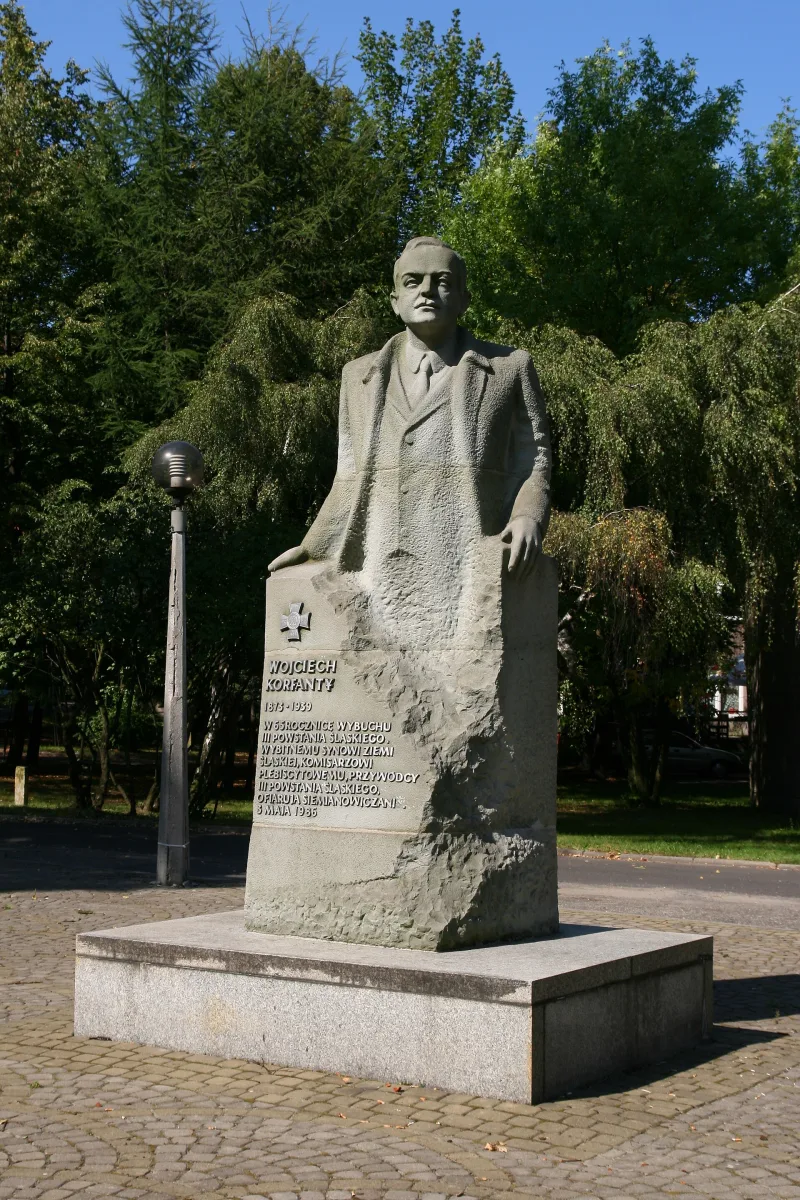
Today his home area is recalled by the monument in the centre of Siemianowice Śląskie, unveiled on 3 May 1986. It shows a bust emerging from a stone block, which is at the same time its plinth. The idea came from the Society of Friends of Siemianowice, and the money came from contributions by residents, workplaces and the town office.
Journalist, prisoner and deputy
At the beginning of the 20th century Korfanty became involved with the Polish press. From 1901 he headed the Katowice branch of the Poznań weekly “Praca”, and from the end of that year he edited “Górnoślązak”. For articles in “Praca” a Prussian court sentenced him to four months in prison, which he served in Wronki. He was released in May 1902.
In 1903 he became a deputy to the German Reichstag and the Prussian Landtag. There he joined the Polish Circle, whereas until then Polish deputies from Silesia had joined the club of the German Centre Party. He held his Reichstag seat until 1912, and after the by-election of June 1918 he returned to it once more. In 1905 he founded the newspaper “Polak” in Katowice.
In the same year, 1903, he was to marry in Bytom, but the parish priest made his consent conditional on an apology to the pro-German priests criticised by Korfanty. Korfanty refused. Cardinal Georg von Kopp forbade priests in Silesia to marry him, so the couple married on 5 October 1903 in Kraków, in the Church of the Holy Cross. They had four children.
From the Reichstag to the plebiscite commissariat
On 25 October 1918 Korfanty demanded in the Reichstag that the Polish lands of the Prussian partition and Upper Silesia be joined to the Polish state. Earlier, in 1918-1919, he had been a commissioner in the Supreme People's Council in Poznań.
He had doubts, however, about armed action in Upper Silesia. The Institute of National Remembrance (IPN) writes that in 1919 he was against the First Silesian Uprising. He feared the reaction of the Allies, and the Polish state, then fighting in the east, could not support the insurgents. Years later he rated highly the effort of that rising.
In 1920 he became the Polish Plebiscite Commissioner. His commissariat was based in Bytom, in the Lomnitz hotel. From the plebiscite campaign comes an anecdote about “Korfanty's cows”: he was supposedly to have promised every farmer a cow for a vote for Poland. We treat it as a story, not a proven fact.
On 19 August 1920 he issued the order to begin the Second Uprising, and after its aims were achieved he ordered it to end on 26 August. In the night of 2 to 3 May 1921, after the plebiscite of 20 March and disputes over the interpretation of its results, he proclaimed the Third Uprising and took command of it. In June 1921 some officers tried to remove him from command. They demanded that the fighting be extended beyond the so-called Korfanty Line, which he opposed, because it threatened direct German intervention.
Politician in the Sejm, the dispute with Sanacja and Brest
In 1922-1930 he was a deputy to the Sejm of the 1st and 2nd terms, associated with Christian democracy. In July 1922 a Sejm committee designated him prime minister, but after opposition from Józef Piłsudski and the threat of a general strike the nomination was withdrawn on 29 July. From October to December 1923 he was deputy prime minister in the government of Wincenty Witos. After the May Coup he belonged to the determined opposition to the Sanacja regime.
After the dissolution of the Silesian Sejm he was arrested on 26 September 1930 and, together with deputies of the Centrolew alliance, imprisoned in the Brest fortress. He was excluded from the Brest trial itself. After his release he returned to Upper Silesia, where as an opponent of Voivode Michał Grażyński he was constantly exposed to further arrest. In April 1935 he left for Czechoslovakia. In 1936 he co-organised the Morges Front, and a year later he became president of the main board of the Labour Party.
In 1938 he could not return to the country for the funeral of his son Witold, because the government refused him a safe-conduct. He returned to Poland in April 1939 and was arrested. He spent almost three months in Pawiak prison, and his health quickly deteriorated.
Death and burial on Francuska Street
The investigating judge released him on 20 July 1939, probably for fear that he would die in his cell. Korfanty was taken to St Joseph's Hospital on Hoża Street in Warsaw. An operation on 11 August brought no improvement, and on 17 August 1939 he died. A hypothesis of arsenic poisoning has appeared, which has never been confirmed or refuted.
He was buried on 20 August 1939 in the family tomb at the cemetery on Francuska Street in Katowice, in the main avenue. According to estimates, about a quarter of a million people attended the funeral. Twelve days later the war began. His widow Elżbieta returned to Poland in 1945, died in January 1966 and was laid to rest in the same tomb.
How Silesia remembers him
Posthumously he received the Order of the White Eagle, on 3 May 1997. By the Katowice monument on Silesian Sejm Square, unveiled on 19 June 1999, stands a plinth with his words about the loyalty of the Silesian people to Christian principles and their attachment to Poland. The author of the sculpture is Zygmunt Brachmański.
His name is borne by an avenue crossing Katowice and by squares and streets in many towns, and the Sejmik of the Silesian Voivodeship declared 2009 the Year of Korfanty. In the same year he became, posthumously, an honorary citizen of Siemianowice Śląskie. Family mementos bequeathed by his daughter Maria Ullman went to the collection of the Archdiocesan Museum in Katowice. Korfanty's profile can also be explored in the multimedia exhibition of the Upper Silesian Pantheon by the cathedral.
Be the first! Add a comment.
You need to log in to add a comment.
Log in