
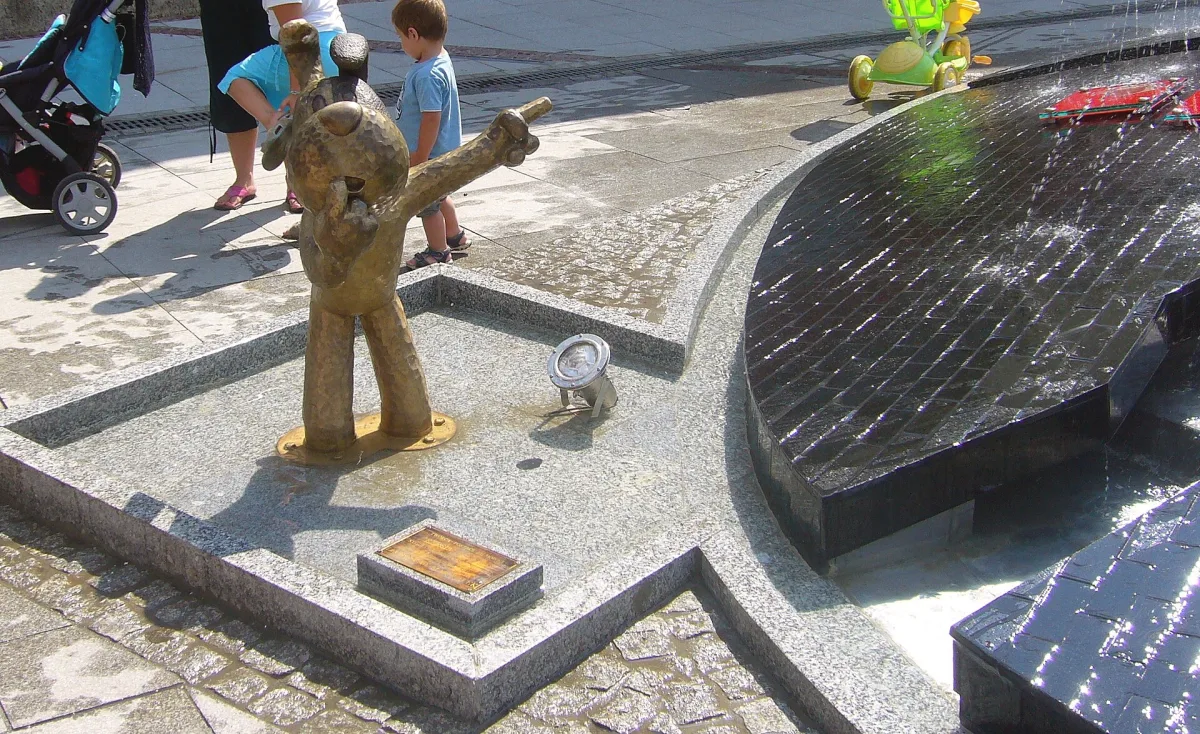
Bielsko-Biała is known in Poland for its cartoons: this is where Bolek and Lolek, Reksio and The Kidnapping of Baltazar Gąbka were made. Today the heroes of these films can be met on the streets in the form of bronze monuments, and the history of the studio can be seen in its former buildings. There is also a puppet theatre with a long tradition and a few sculptures that tell the story of the town differently from cartoons.
A studio that began in Katowice
The roots of the Cartoon Film Studio (Studio Filmów Rysunkowych) go back to 1 September 1947, when the Experimental Cartoon Film Studio was created at the Katowice editorial office of “Trybuna Robotnicza”. In 1948 the filmmakers moved to Wisła, and in November of the same year to Bielsko. Since 1952 they have had a permanent seat at Cieszyńska 24, in the Roth villa, and as an independent institution the studio has operated since 1 January 1956. Over the decades more than a thousand productions were made here.
The greatest fame came from two series. The first episode of Bolek and Lolek premiered in 1963, and the series kept growing: it has over 150 episodes and two feature films. Wielka podróż Bolka i Lolka (Bolek and Lolek's Great Journey) of 1977 was the first full-length animated film in Poland. The sources differ on the years of production: the studio's list gives 1963-1986, while another study of the series itself describes 23 years of work from an initiative of 1962, so the boundaries of the dates depend on what is counted as the beginning and the end.
Reksio was born when Lechosław Marszałek gave up further work on Bolek and Lolek, because he did not want films in which children play with weapons. The series, produced from 1967 and, according to the studio's list, until 1990, has 65 episodes. A study of Reksio divides it into two cycles: the first, of 52 episodes, ended in 1986, and the second, Reksio i ptaki (Reksio and the Birds), was made in 1987. Among the studio's other productions are Porwanie Baltazara Gąbki (The Kidnapping of Baltazar Gąbka) of 1969-1970 and Pampalini łowca zwierząt (Pampalini the Animal Hunter).
A trail of fairy-tale monuments
The heroes of these films now stand in the town centre, on the Bajkowe Bielsko-Biała (Fairy-Tale Bielsko-Biała) trail. The Reksio Monument was unveiled on 3 August 2009 in a small square between 11 Listopada and Stojałowskiego streets. The bronze dog stands on its hind legs and points to a fountain in the shape of an egg cut into four parts. According to the portal's page the author is Jerzy Mikler, and the sculpture was cast by Marek Barteczko.
The Bolek and Lolek Monument of 19 May 2011 stands in the courtyard on Mostowa street, next to a shopping centre. Two boys point their fingers at a globe with Bielsko-Biała marked on it. Characters from The Kidnapping of Baltazar Gąbka can also be seen: on Wojska Polskiego Square by the old town hall stand the Wawel Dragon, Bartolini Bartłomiej of the Green Parsley coat of arms, and the spy Don Pedro.
Behind the scenes of a cartoon
The history of the studio is shown by the OKO Centre of Fairy Tales and Animation, opened on 24 May 2024 in a new building connected to the Roth villa. The permanent exhibition occupies two floors and tells of the history of the studio, script writing, the creation of characters and backgrounds, animation techniques and work on sound. There is also the Kreska cinema, which replaced the Studio cinema that operated in 1999-2018. Individual visitors tour without a guide; guided tours are provided for organised groups.
Puppets and contemporary art
The second pillar of Bielsko's fairy-tale tradition is the Banialuka Puppet Theatre, founded in 1947 by the artists Jerzy Zitzman and Zenobiusz Zwolski. The company has performed in several dozen countries, and since 1966 it has organised the International Festival of Puppetry Art. The seat at Mickiewicza 20 was built in 1934 as the Jewish cultural centre named after Chaim Nachman Bialik, and on the site of the square in front of the theatre the Bielsko synagogue stood in 1881-1940.
Next to it is the Bielska BWA Gallery, built in 1960, also on the site of the destroyed synagogue. It was the gallery that, as part of the artistic residency “Incydenty 2009” (Incidents 2009), organised the creation of the sculpture Akrobata (Acrobat) in the park by the town hall: a four-metre steel man stands on his head on an open book. The sculpture is meant to symbolise the people who “stood on their heads” to develop the industry and technology of the town.
Other symbols of the town
Cartoons are not the only hallmarks. The Maluch, that is, the Polski Fiat 126p produced from 1971 at the Small Car Factory (Fabryka Samochodów Małolitrażowych), is, alongside the cartoons, another modern symbol of Bielsko-Biała. The private Fiat 126p Museum on Karpacka street collects mementoes of it, and a restored example from 1977 also stands in the exhibition at the Stara Fabryka (Old Factory). Another surprise is the Mermaid Monument of 1954, a fountain modelled on the Warsaw monument, which the Warsaw Reconstruction Social Fund (Fundusz Społeczny Odbudowy Warszawy) funded as thanks to the residents for their contribution to rebuilding the capital.
Be the first! Add a comment.
You need to log in to add a comment.
Log in