
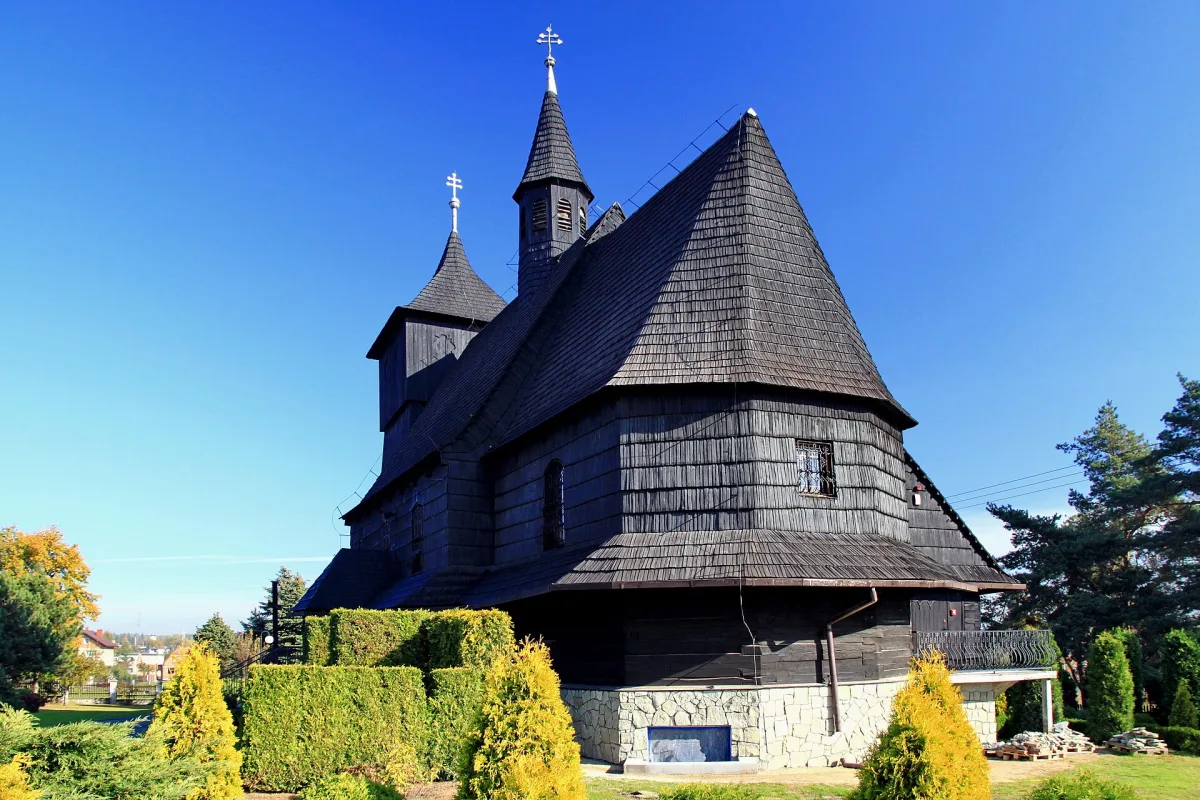
The Wooden Architecture Trail in the Silesian Voivodeship is 1,060 km long and includes 93 historic sites and complexes: churches, chapels, bell towers, cottages, inns, open-air museums and even a water mill. The main route is 326 km long, and alongside it run five loops: the Beskid, Pszczyna, Rybnik, Gliwice and Częstochowa loops. Below are the churches that best show how the region's wooden churches differ: in age, in painted interiors and in roofs with arcaded eaves.
How to read a wooden church: log walls, shingles and soboty
Most churches on this trail are of log construction, that is, with walls of horizontally laid logs joined at the corners. The tower is sometimes built differently, on posts, and added to the nave. The roofs are covered with shingles, and around the nave and chancel run the soboty: wooden arcaded galleries that protect the lower parts of the walls from rain. In the church in Jankowice Rybnickie the soboty probably also served pilgrims as shelter from the rain.
The second feature worth looking out for is the polychrome on the boards. In wooden churches paintings were applied directly on beams, boards and ceilings. Many paintings were discovered only during renovations, often beneath later layers of paint.
Some Silesian wooden churches do not stand where they were built. They were dismantled and reassembled in a new place, which is covered in a separate text about churches that moved. One mention will suffice here: among the churches with the oldest polychromes is the Church of St Catherine and Our Lady of the Rosary in Rybnik-Wielopole, built in 1534 in Gierałtowice and moved to its present site in 1976. Its late Gothic patron-saint polychrome, with the Piast eagle in a Gothic shield and an image of St Catherine, came to light during renovation in 1960-1961.
The oldest: Łaziska and Ćwiklice
Two buildings dispute the title of the oldest wooden church in the region, and the trail's own list states this cautiously. The churches in Sierota and Łaziska from the mid-15th century are regarded as the oldest on the trail, while according to dendrochronological research from 2011 the oldest is the church in Ćwiklice, dated to 1466.
For a long time the All Saints' Church in Łaziska was thought to be much younger. On a beam by the south entrance there is an inscription with the date 1579, and this was taken to be the year of construction. That changed in 1998, when during renovation a polychrome dated 1560 was discovered beneath a later layer on the beams of the log frame. A dendrochronological analysis from 2008 pushed the construction back even earlier: the timber for the church dates from 1466 or 1467. The oak sills under the chancel and the fir timber of the nave are original. The tower is slightly younger, from 1507, and in 1748 it received a belfry storey and a Baroque onion-shaped cupola. The nave ceiling was painted in 1948 by Ryszard Węglorz and Alojzy Chromik of Rybnik.
During the war, on 27 March 1942, the Germans looted from Łaziska two bells regarded as the oldest surviving in Silesia. The larger one now rings in a church in Ganderkesee in Germany, and the smaller one in a church near Nuremberg. The local community has been demanding their return for years.
The Church of St Martin in Ćwiklice was first mentioned in 1326. For a long time the present building was thought to have been built at the turn of the 16th and 17th centuries, but research on the timber of the roof truss pointed to the years 1464-1466, and the trail's list gives the year 1466. The heritage register says something different again and dates the building to 1460-1470. The interior furnishings date from the mid-18th century, in the side chapel stands a 15th-century triptych with the Madonna and Child, and the doors to the chapel have fittings and locks from the 16th century. A flood in 2010 destroyed the sills and the floor.
Polychromes: Rudziniec, Sierakowice, Żernica
Anyone looking for a church in which paintings cover the entire interior should start at Rudziniec. The Church of St Michael the Archangel was built in 1657, endowed by Wacław Pełka, then owner of the village. The date can be seen under the chancel window, and on a beam behind the altar a probable carpenter's signature has survived: “Ioan Joannes Machocsky”. The polychrome from the same year includes Passion scenes, the Last Judgement with a figure of the founder, the Nativity and portraits of the apostles on the parapet of the choir loft. It was conserved in 1961 and in 1999-2004. The bell tower was added in 1853, so the log walls of the nave and chancel have kept their 17th-century form.
The Church of St Catherine of Alexandria in Sierakowice stands in the village cemetery. The first mention of a church in this village dates from 1447, but that building was dismantled in 1673, and the present one was built in 1675 by the carpenter Joseph Jozek. In 2001 figural polychromes from the 17th century were discovered under later paint, executed in oil tempera directly on the wood. They were conserved in 2003-2010. They show scenes from the life of Christ, images of saints and personifications of virtues.
The Church of St Michael the Archangel in Żernica, from 1661, was built on the initiative of the abbot of Rudy, Andreas Emanuel Pospel, because the village had belonged to the Cistercians of Rudy since 1283. The bell tower is older than the church: its belfry storey dates from 1518. After a new church was built in 1970 the old one fell into decay, and in 1998-2008 it underwent thorough renovation. Polychromes from the 17th and 18th centuries cover almost all the walls and ceilings, and in the sacristy stand cupboards from 1691.
Churches in which history was written down
In Miasteczko Śląskie the wooden Church of St George from 1666 stands by the market square, and next to it rises the brick parish church of 1905-1908. The year of construction and the names of the founders, among them the mayor and councillors, are carved on the rood beam. Inside, inscriptions about the plague of 1707-1708 have also survived. The wooden bell tower from 1666 is built into the fence and serves as a gate.
In Wilcza the present Church of St Nicholas from 1755 is the third church in the village. The first, from around 1480, was destroyed by fire during the Thirty Years' War, and the second was built in 1657 and dismantled in 1755. Worth noting is a votive painting of Our Lady of Frýdek from 1709 with an inscription in Moravian.
The Church of St Roch in Zamarski has a tower older than the nave: it dates from the end of the 16th century, and the church was added to it in 1731, endowed by Henryk Fryderyk of the Wilczek family. It was originally dedicated to the Sacred Heart of Jesus, and received St Roch in 1981, when the parish was established. The Baroque side altars and the pulpit were bought after 1884 from the hospital church of St George in Cieszyn.
The Corpus Christi Church in Jankowice Rybnickie has differing dates in the sources: some say around 1670, others 1674, and the heritage register dates the building generally to the 18th century, so the year of construction should be treated as an approximation. The interior was painted in 1869 by Teodor Gajda, and two of his paintings refer to the local legend of the priest Walenty and the hiding of the Blessed Sacrament in a hollow tree. Since 2002 the church has been part of the Shrine of the Blessed Sacrament, together with the forest shrine in Studzienka.
The Church of St Nicholas in Truskolasy, from 1737, is also the shrine of Our Lady of Truskolasy. On the high altar hangs a painting in a silver dress, recognised as miraculous in 1686. According to legend the painting was handed over as a pledge to a blacksmith, and during the first Swedish invasion it was thrown under a bench and found thanks to the brightness surrounding it. This is a folk tale, not a historical fact. From the history of the building it is known that in 1881 the walls were clad with boards, and in 2006-2007 the shingles were restored.
Barbara of Mikuszowice and the small chapel in Ujejsce
The Church of St Barbara in Mikuszowice Krakowskie in Bielsko-Biała is the third church on this site. The first fell victim to a flood in the mid-15th century, the second burnt down after a lightning strike in 1687, and the present one was completed in 1690 by the carpenter Piotr Piotrowski from larch wood. In 1796 the church authorities put the building up for auction and it was bought by peasants from Mikuszowice and neighbouring villages. The interior is covered with a Baroque polychrome from 1723, the work of the Bielsko painter Johann Mentil: eight scenes from the legend of St Barbara, captioned in Latin and in the local dialect. On the altar stands a copy of a Gothic triptych from around 1470, the original of which went to the National Museum in Kraków in 1935.
Of an entirely different scale is the Chapel of St Catherine in Ujejsce in Dąbrowa Górnicza: a small wooden building on a rectangular plan, covered with shingles, with an openwork metal cross at the top and a Baroque altar inside. The founder in 1784 was W. Wichauser, and the chapel was rebuilt in 1793 and renovated in 1820.
Before you visit
All the churches described are active parish or branch churches, so the interiors can be viewed outside services, usually after arrangement with the parish. Some polychromes, as in Rudziniec, have to be seen precisely then. It is also better to plan the route by the loops of the trail than by individual sites: the Rybnik churches lie close to one another, while the Pszczyna and Gliwice ones require longer journeys.
Be the first! Add a comment.
You need to log in to add a comment.
Log in