
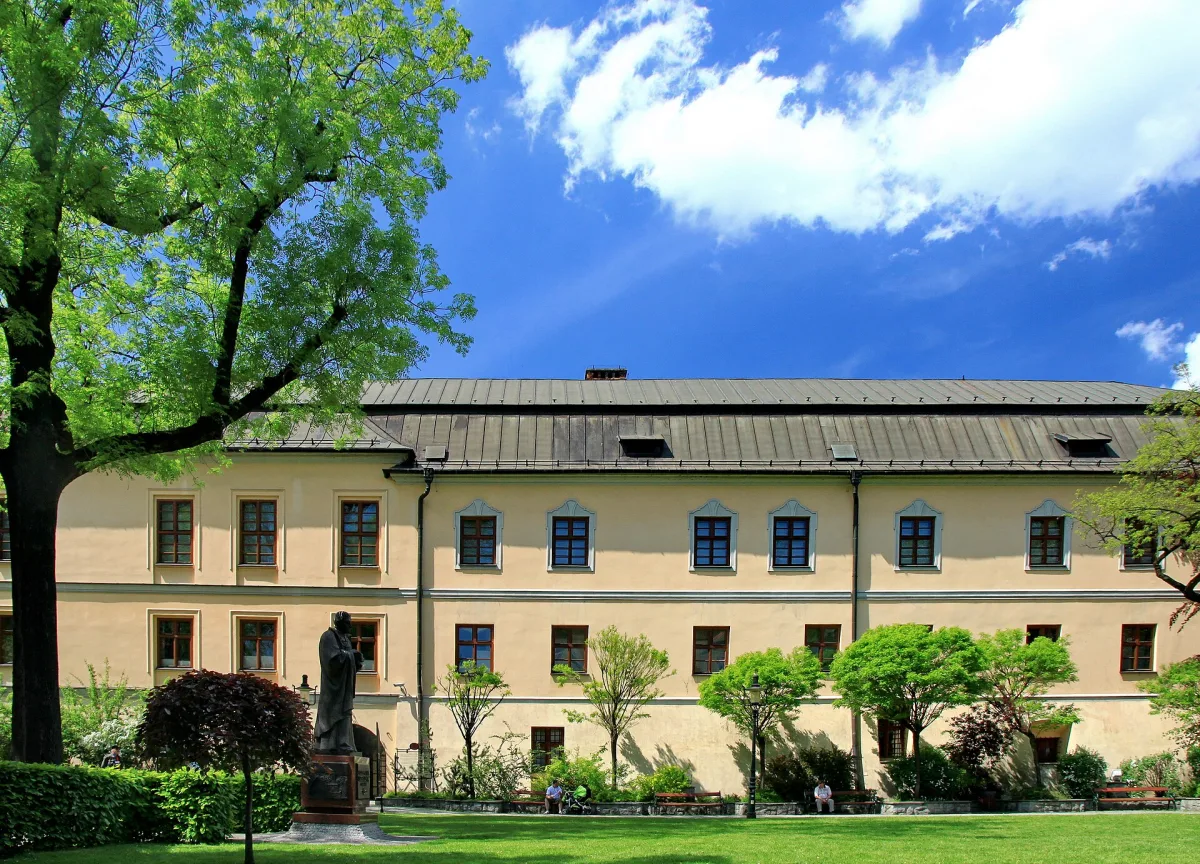
In Cieszyn two 18th-century collectors left the town their book collections. The first was a Protestant lawyer, Bogumił Rudolf Tschammer, the second a Catholic priest, Leopold Jan Szersznik. Both collections have survived to this day and can be seen in several places close to each other.
The lawyer's will: the Tschammer Library
The Tschammer Library was created on the basis of a bequest in the will of Bogumił Rudolf Tschammer (1711-1787). It is regarded as the oldest and largest historic Protestant library in Poland, and at the same time the first library in Cieszyn made available for public use. Since the 18th century it has been housed at the Jesus Church.
The collection incorporated whole libraries of Protestant clergy and lay people, among others Georg Greupner (d. 1717), Jerzy Fryderyk Bludowski (1655-1730), Rudolf Wrzecionko (1865-1946), Jan Stonawski (1870-1957) and Oskar Michejda (1885-1966). The books are in German, Polish and Czech, and most concern law, history and theology.
The scale of growth is shown by the catalogues. The one of 1786 listed 640 books, in 1829 the library had 3210 volumes, in 1848 3689. Today it holds over 23 thousand volumes, including 5 incunabula and just under 5000 early printed books, as well as 322 library manuscripts. The library's catalogues are incomplete, which makes it harder to use the collections.
Since 2009 the library has been part of the Museum of Protestantism - the B.R. Tschammer Library and Archive. Earlier, in 2007, it joined a project for the protection and conservation of Cieszyn's written heritage. The museum exhibition is arranged on the balcony of the church and includes documents, photographs, publications and liturgical vessels.
A museum from a private collection: Szersznik
Leopold Jan Szersznik (1747-1814) was born and died in Cieszyn. He was a Jesuit until the suppression of the order in 1773, then a secular priest, from 1777 a professor at the Cieszyn grammar school, and the following year its prefect. He worked on history, mathematics, botany and geology, and at the same time collected books, prints, maps and specimens.
After the suppression of the Jesuits he took over their library in Cieszyn. His own book collection grew to about 12 thousand items, including many incunabula, engravings and maps. The collections were partly open to the public from as early as 1782. In 1802 Szersznik bought the former grammar school building, and in 1808 in his will he founded a public library in Cieszyn.
It is the year 1802 that is given as the date of the museum's foundation. The Museum of Cieszyn Silesia is regarded as the oldest public museum in Poland and one of the oldest in Central Europe. Szersznik's collections are also seen as the beginnings of the first public museum within the borders of present-day Poland.
Where Szersznik's legacy lies today
Szersznik's collections, together with the bookcases, have for the most part survived to this day. The book collection went to the Cieszyn Library (Książnica Cieszyńska), and the museum collections to the Museum of Cieszyn Silesia. Since 21 June 1931 the museum has occupied the Larisch Palace, built in 1790-1796 after the great fire of the town in 1789. The new institution was then created from the collections of Szersznik's public museum, the ethnographic Silesian Museum, the municipal burgher museum and private collections.
Part of Szersznik's collection can be seen in the archaeology department: Roman coins, Lusatian culture vessels and painted vessels of ancient Greece and Rome. The palace, in turn, is notable for its interiors with Neoclassical polychrome decoration, among them the Chinese Cabinet and the Egyptian Room.
From the Jesus Church to the museum it is about 400 metres, so both collections are easy to see in one day. One shows the Protestant tradition of the book, the other the knowledge gathered by a Catholic priest.
Be the first! Add a comment.
You need to log in to add a comment.
Log in