
A society founded in Frýdek in 1893
Before Polish mountain huts and marked trails appeared in the Beskids, the mountains were taken up by a German society. The Beskidenverein, in Polish Towarzystwo Beskidzkie (the Beskid Society), was founded on 28 February 1893 in Frýdek. It is regarded as the first mountain tourism organisation operating in the Beskids that now lie in Poland. The Polish Tatra Society had existed since 1873, but for a long time it confined itself to the Tatras, and the Czech Pohorská jednota Radhošť operated on the other side of the present border. The model was the Austrian, and later all-German, Alpenverein.
The first chairman was Karl Richter, and the main promoters of the idea also included Johann Hadaszczok and Josef Matzura, teachers and activists from Ostrava. The seat was planned for Frýdek, was established in Moravian Ostrava, and was later moved to Cieszyn. The society consisted of independent sections. In 1909 there were thirteen of them, the strongest in Bielsko, Cieszyn and Vítkovice, and before the First World War Upper Silesian sections joined, among others from Racibórz, Katowice and Bytom. Membership grew from 1534 in the year of foundation to 4618 in 1909, and in 1915 it exceeded five thousand.
The statute of 1893 stated the aim: to develop the Beskids for tourism from Łysá hora in the west to Babia Góra in the east, by marking trails, improving roads and building footholds in the mountains. Money came from subscriptions, from German landowners, townspeople and manufacturers, and the society was also supported by the Habsburgs of Cieszyn. At the turn of the 19th and 20th centuries about 90 per cent of tourists in the Silesian Beskids were Germans, while Poles were estimated at only one per cent. The Beskidenverein was therefore a German organisation and operated with German-speaking walkers in mind, which from the start gave rise to disputes with Polish and Czech societies.
Trails with a coloured stripe
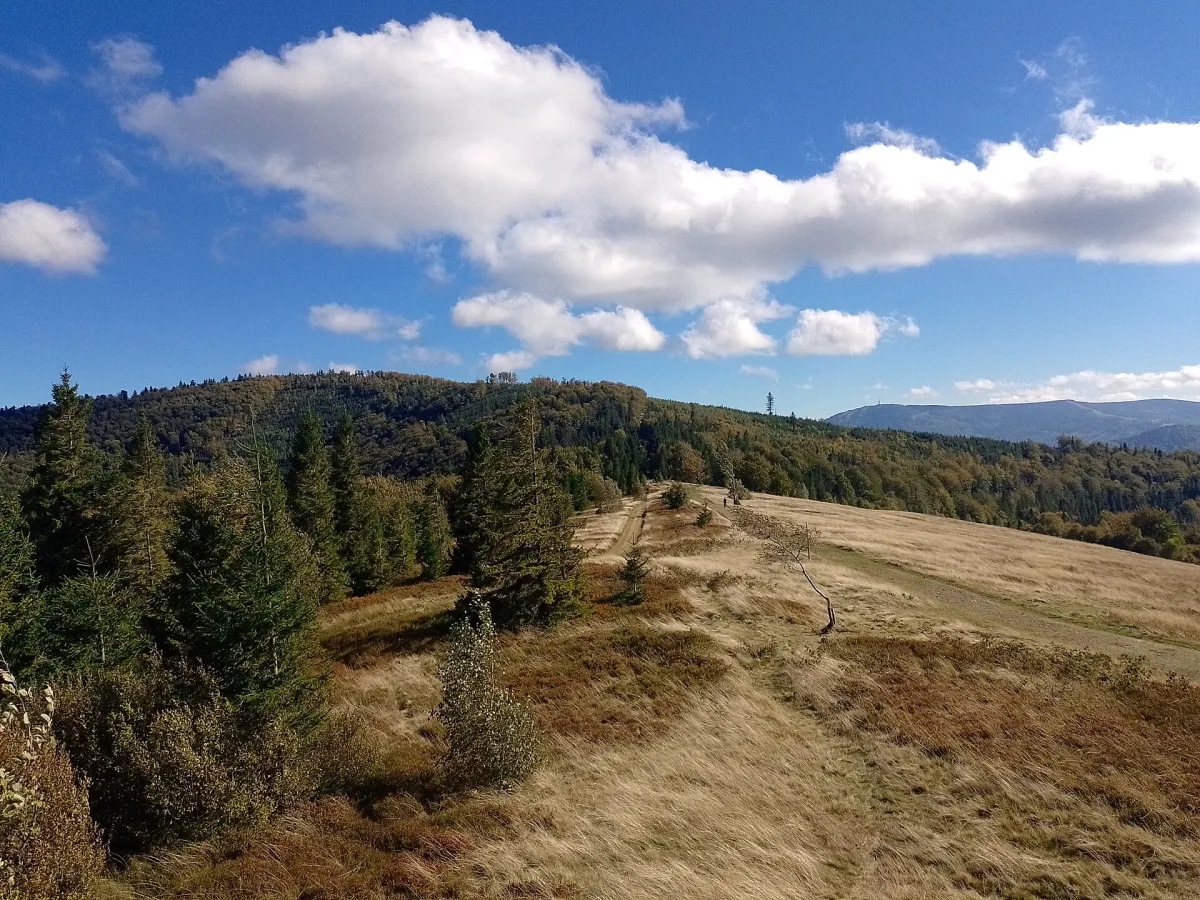
In the year of its foundation the society marked the first trails around Klimczok, Magura and Błatnia. The first precisely described trail concerns Babia Góra: on 11 June 1895 Wilhelm Schlesinger of the Bielsko section, having obtained the consent of the directorate of the Żywiec Estates, laid out a route through Zawoja Widły, Gruba Jodła and Markowe Szczawiny. The first Polish trail in this area appeared only in 1906. The signposts were in German only and pointed, for example, to the Teufelspitze, that is, Diablak.
By 1908 the society had marked about 300 kilometres of trails. The marking system, a coloured stripe between two white ones, was settled in 1897 and formally approved in 1899. It was later adopted in many countries, and was also used by the Polish Tatra Society. The Bielsko section published maps and guidebooks, and among the authors were Karl Kolbenheyer and Wilhelm Schlesinger, author of a special map of the Beskids. The bulletin Mitteilungen des Beskidenvereines appeared from 1904 to 1915.
All these routes were concentrated on the ridge above Bielsko-Biała. Today a trail leads from Jaworze to Błatnia and continues through Stołów and Trzy Kopce to Klimczok and Szyndzielnia. It should be noted, however, that the mountain hut on Błatnia was not the work of the Beskidenverein: it was built in 1925-1926 by the society Przyjaciele Przyrody (Friends of Nature) from Aleksandrowice. The difference matters, because in the same period several German organisations were active on one ridge.
The first mountain huts: Jaworowy, Szyndzielnia, Magurka
The Beskidenverein built the first real tourist huts in the Beskids. Overnight accommodation had existed earlier, but it served the aristocracy and hunting clubs, not tourists. The society's first hut was Jaworowy of April 1895, put up by the Cieszyn section. Only eight days after the opening the thousandth guest arrived. Jaworowy now lies on the Czech side of the border, as does the hut on Łysá hora of 1895, named after the late Archduke Albrecht.
On the Polish side the oldest is the PTTK mountain hut on Szyndzielnia. It is regarded as the first tourist hut in the part of the Beskids that now belongs to Poland. Construction began in 1896, and the opening took place in July 1897. The design was prepared by Wilhelm Schlesinger, and the building has a turret modelled on Alpine huts. In 1906 a botanical garden, called the alpinarium, was created next to it, on the idea of the Bielsko museum curator and naturalist Edward Schnack. 350 plants of 120 species were planted in it, and the garden still exists today. The peak itself is called Szyndzielnia, and the German name of the hut was Schutzhaus auf dem Kamitzerplatte.
On the neighbouring ridge stands the PTTK Klimczok mountain hut. Here the sources diverge. The record of the hut states that the first wooden hut, Klementynówka, was built in 1869, while other sources date it to 1872. The rest of the story does agree: the society extended the building in 1894-1895, but it burned down on the day of its opening, and then burned again in 1910 and 1913. For this reason a brick building was put up in 1914, and it stands to this day.
A similar fate befell the PTTK mountain hut on Magurka Wilkowicka. The first building was put up by the Bielsko section in 1903, and the present brick building dates from 1913. For the two fires the sources differ in their dates. Some speak of fires in 1907 and 1912, others of a fire after two years and a second in 1912. What is certain is that Magurka became a winter sports centre: in 1907 the Bielsko section founded a Winter Sports Club, and the clearings below the summit were used for competitions and ski courses.
Czantoria, Stefanka and big plans on Babia Góra
In 1904 the society opened a hut on Velká Čantoryje (Wielka Czantoria), named after its patroness, Isabella von Croÿ-Dülmen, wife of Archduke Frederick. Wielka Czantoria lies on the border, and the hut mentioned stands on the Czech side, which is confirmed by the entry on the Beskidenverein. The peak on the Polish side is Czantoria in Ustroń. On Babia Góra in 1905 the Schlesinger-Schutzhaus was built, until the 1930s the highest-lying hut in the Carpathians. After 1920 it found itself within the borders of Poland, in 1938 it was taken from the Germans, and after the war it was destroyed.
In independent Poland the society took over further buildings. The mountain hut on Kozia Góra, called Stefanka, was converted from a forest workers' cottage into a hut in 1912. The name comes from the Steffansruhe arbour, dedicated to Karl Steffan, president of the Beskidenverein and mayor of Bielsko. Here is another difference between sources: studies of the society give the year 1926, while the record of the hut speaks of its handover to the Beskidenverein in 1921 and an extension five years later. In 1924 a wooden ski shelter was built on Skrzyczne, which survived until the war.
The dispute with the Poles sharpened in 1928. The Beskidenverein wanted to extend the hut below Babia Góra, but the Nowy Targ district office forbade the work. The society then decided to build a new building on Hala Lipowska. The PTTK mountain hut on Hala Lipowska was begun in 1931 and opened on 6 August 1932. Today it belongs to PTTK, and the building has been rebuilt; it is this one that differs most from the original.
Polish responses and the end of the society
The Poles built their own network. The mountain hut on Stożek, brought into use in 1922, is regarded as the first hut built by Poles in the Polish Silesian Beskids. The Polish Tatra Society proposed to the Beskidenverein that it join its structure as a branch, but the society refused. Talks in Katowice in 1928 and in Cieszyn in 1929 set the scope of activity: the Little Beskids, the Klimczok group, the route to Skrzyczne and trails to Babia Góra and to the Salmopol Pass. In 1927 the Union of Beskid Societies in Poland (Związek Towarzystw Beskidzkich w Polsce) was created, with its seat in Bielsko. In the second half of the 1930s some activists drew closer to the Jungdeutsche Partei, which supported Hitler, and according to some studies some of them used the society's buildings for subversive and espionage purposes.
During the war the society was incorporated into German structures, and in June 1940 in Cieszyn a superior Main Beskid Union (Hauptverband Beskidenverein) was set up. Officially the Beskidenverein operated until 1945. After the war its property in Poland, often destroyed and looted, was taken over by the Polish Tatra Society, and then by PTTK. All the buildings are still in use today, except the hut on Babia Góra and the tourist station at the Salmopol Pass, although they have been rebuilt. Most of the members fled to Germany before the Red Army.
Be the first! Add a comment.
You need to log in to add a comment.
Log in