
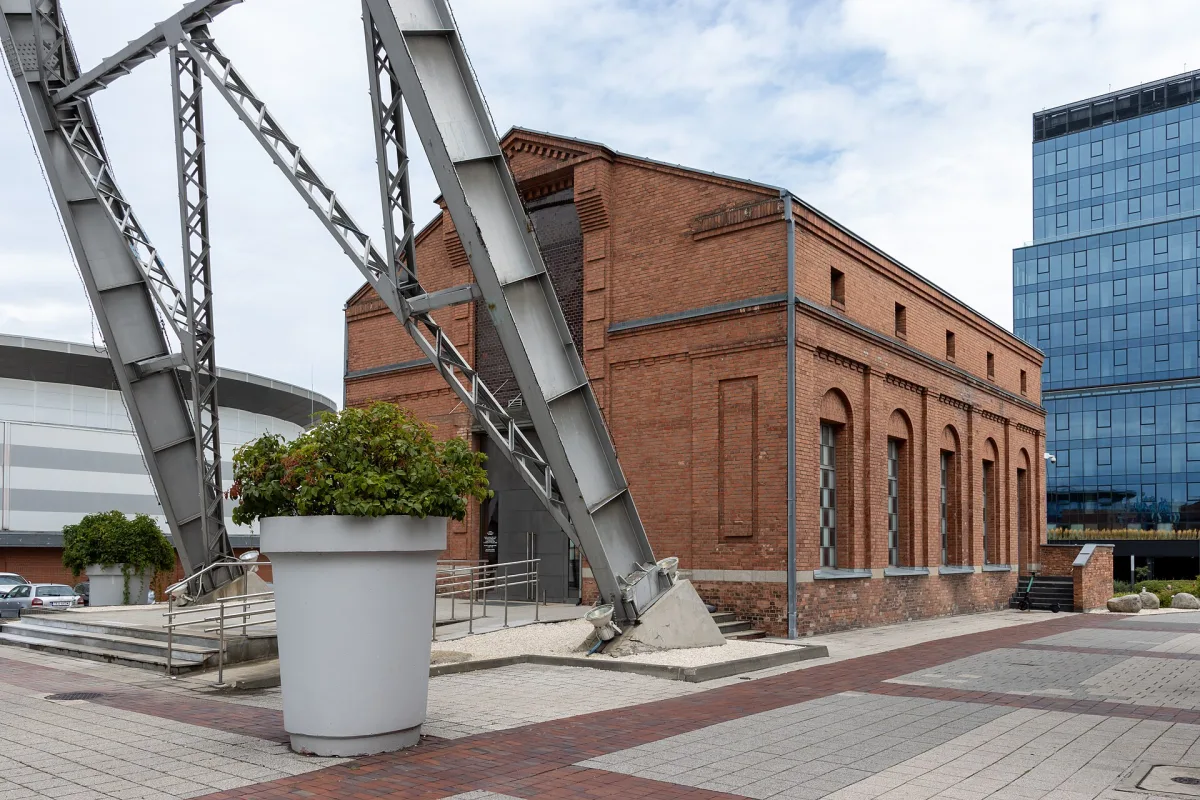
Barbórka (St Barbara's Day, miners' holiday), also called Miners' Day, falls on 4 December, the feast day of St Barbara of Nicomedia. It is the most important miners' holiday in Poland, and in Silesia, where mining shaped whole towns and housing estates, it has a special setting: from a morning Mass at the statue of the patron saint to bands marching through the familoki (workers' family houses). Some of the traditions that are now considered centuries old are, however, much younger than is generally believed.
St Barbara and her patronage
St Barbara is known solely from a medieval legend; she is mentioned neither by the ancient Church Fathers nor in the Martyrologium Hieronymianum. According to the legend she came from a pagan family in Heliopolis, learned about Christianity in Nicomedia, and her father, who demanded that she renounce her faith, handed her over to the persecutors. She was imprisoned in a tower and beheaded with a sword, probably around the year 305. Another legend says that while fleeing from her father she took refuge in a rock, which opened before her.
Barbara is the patron saint of a good death and of hard work: of miners, steelworkers, stonemasons, bell founders, soldiers, fishermen and many other trades, and an intercessor during storms and fires. She is also a co-patron of the Archdiocese of Katowice. In the Catholic Church her feast falls on 4 December, and this day sets the date of the miners' holiday.
St Barbara's Day is also linked with a custom unrelated to mines: on this day twigs of cherry or sour cherry are put into water, and they are supposed to blossom by Christmas.
What Barbórka looks like
In mining tradition the day begins with a solemn Mass in church or in the pithead building, at the statue of St Barbara. Then a miners' band marches, playing its anthem, through the estates inhabited by miners and their families, including the familoki, and past the houses of the management. There are formal ceremonies and meetings, concerts, artistic performances, parties and balls attended by mining families.
Traces of the patron saint can be seen in the landscape. The St Barbara Chapel by Silesia City Center in Katowice is housed in the former winding engine house of the Eminenz mine, and inside it stands the altar of St Barbara from the Kleofas mine and a figure of the miners' patron saint from the Gottwald mine. The first shaft of the Guido Mine in Zabrze was named Barbara, and the history of the trade is told by the Coal Mining Museum in Zabrze.
The beer tavern, a younger tradition
In the days before Barbórka, karczmy piwne (beer taverns) are held, attended by miners, retirees, employees of firms working with the mines, scientists from mining faculties and students of those subjects. Taverns for mining supervisory staff are organised by the Association of Mining Engineers and Technicians. The equivalent for women is the so-called combry babskie (women's combers).
The tavern has a fixed ritual. Participants sit at two long tables, the older ones (stare strzechy) and the younger ones (młode strzechy), divide into a left and a right board and compete for points. Order is kept by the High Presidium, and improper dress, for example badly matched socks, is punished by being put in the stocks or by drinking beer with salt. The tavern is opened by singing the miners' anthem, and during the feast people sing songs, tell jokes and reward those who have earned it with miners' swords. Miners must appear in uniform.
Contrary to popular opinion, beer taverns do not have a long tradition. They became established in the 1980s, and in the previous decade there were meetings of gwarkowie (miners) over beer. Before that Barbórka was a religious and family celebration. According to Dr Beata Piecha-van Schagen, the authorities of the Polish People's Republic, by organising secular events, wanted to weaken the religious character of the holiday. The women's combers in their present form date from the 1990s and have little in common with the original, which was a Shrovetide event.
The uniform and the leap over the leather
The miners' uniform has a pattern going back to the 18th century, when it was introduced in Germany, in the Ruhr. In Poland the first uniforms appeared in 1817 as work clothing modelled on the dress of the infantry of the Kingdom of Poland. Today's dress uniform is worn with an honorary miners' sword. The miners' shako has on the front an emblem with a pick and a hammer, and the colour of the plume indicates the group: black for miners, white for supervisors, green for directors, red for members of the band.
The best-known rite is skok przez skórę (the leap over the leather), that is, the admission of novices to the miners' estate. The skóra (leather) is a black leather apron worn at the back over the trousers of the uniform, which in time became a symbol of belonging to the miners. The novice takes an oath and jumps over the leather held by two seniors, and the master of ceremonies, called Lis Major, strikes him on the shoulder with a sword and fastens the leather on him. The custom reached Poland through graduates of the Mining Academy in Leoben, Austria: first to Galicia and Kraków, and after the Second World War to Silesia and the Silesian University of Technology. A similar ceremony is used when admitting people to the steelworkers' trade.
Barbórka in Tarnowskie Góry and tales of the patron of the underground
Mining tradition also has local variants. In Tarnowskie Góry, around 16 July, the anniversary of the discovery of ore in 1784, a summer Barbórka is held in Kunszt Park, around the spoil heap of the Rudolphine shaft. Figures of gwarkowie have been unveiled in the town since 2013, most often around 4 December. A separate story is the legend of Skarbnik (the spirit of the mine), the spirit of the underground who, according to the tales, looks after miners.
Be the first! Add a comment.
You need to log in to add a comment.
Log in