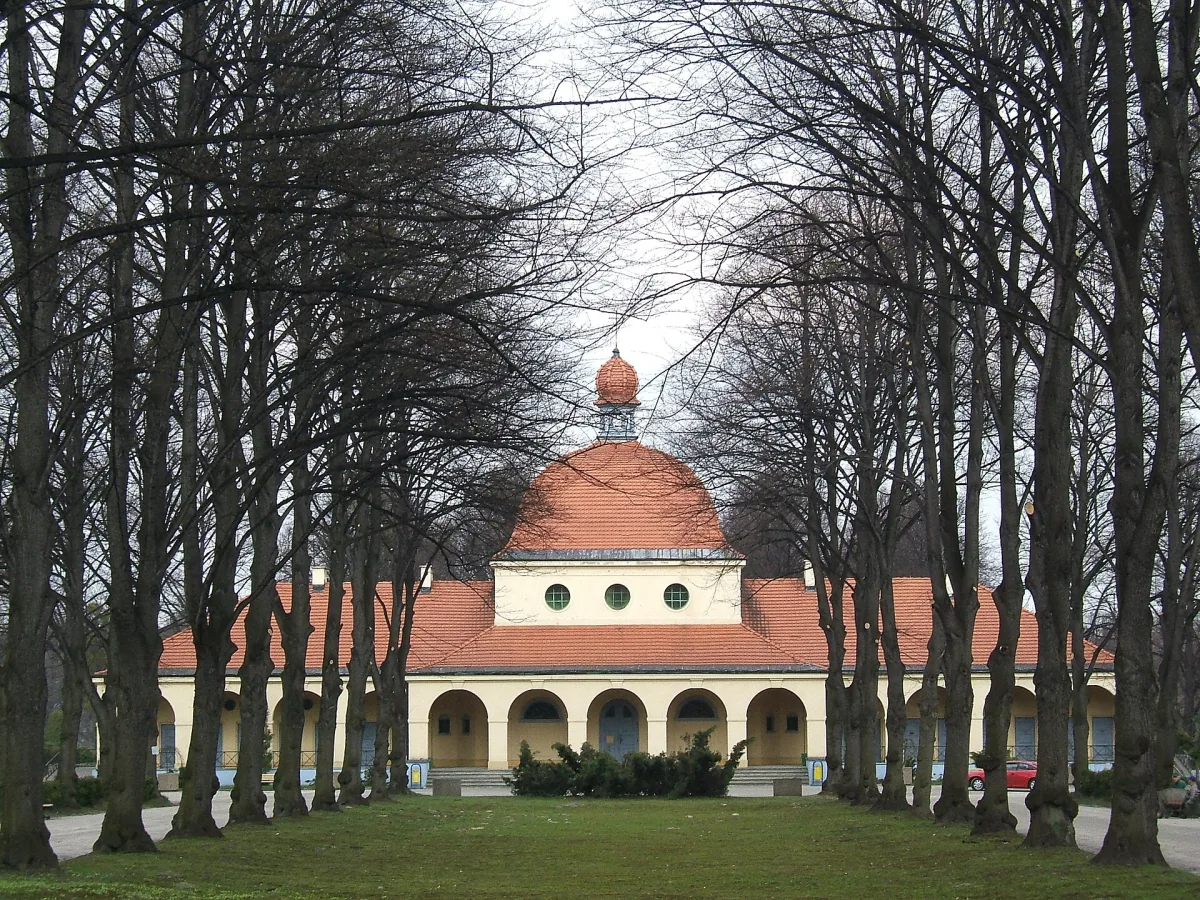
A municipal cemetery in Gliwice from 1920-1927, laid out in the shape of a Latin cross, with graves of death march victims.
The Central Cemetery in Gliwice lies on Kozielska Street, on the border of the Stare Gliwice and Wojska Polskiego districts. The necropolis, covering 22 ha, was created in 1920-1927 as a complex combining the function of a cemetery with a park.
The 1920 design was prepared by Gliwice’s municipal building inspector and architect Karl Schabik (plan and architectural décor) and the municipal gardening inspector Richard Riedel (greenery). The cemetery has the general plan of a Latin cross set in a rhombus. From each of the two monumental main gates an avenue 108 metres long leads inwards, and where they meet stands a pre-funeral house. Small architectural features were placed along the avenues, including fountains with sculptures. Among the outdoor sculptures, a figure of a monk reading a psalter, the work of Hanns Breitenbach, has survived, and next to the pre-funeral house stands a Crucifixion group by Paul Ondrusch. Among the trees, birches, Weymouth pines, Norway spruces and small-leaved limes predominate.
The first burials took place in 1924. After the Second World War 14 collective graves were set up in the cemetery with the ashes of soldiers of the Polish Army who died in captivity of their wounds. In 1948 eight collective graves were created in which people who died during the death march from Auschwitz-Birkenau were buried; earlier they had lain in scattered graves along the route of the march. The crematorium from 1937-1938 was demolished in 1945.

Be the first! Add a comment.
You need to log in to add a comment.
Log in