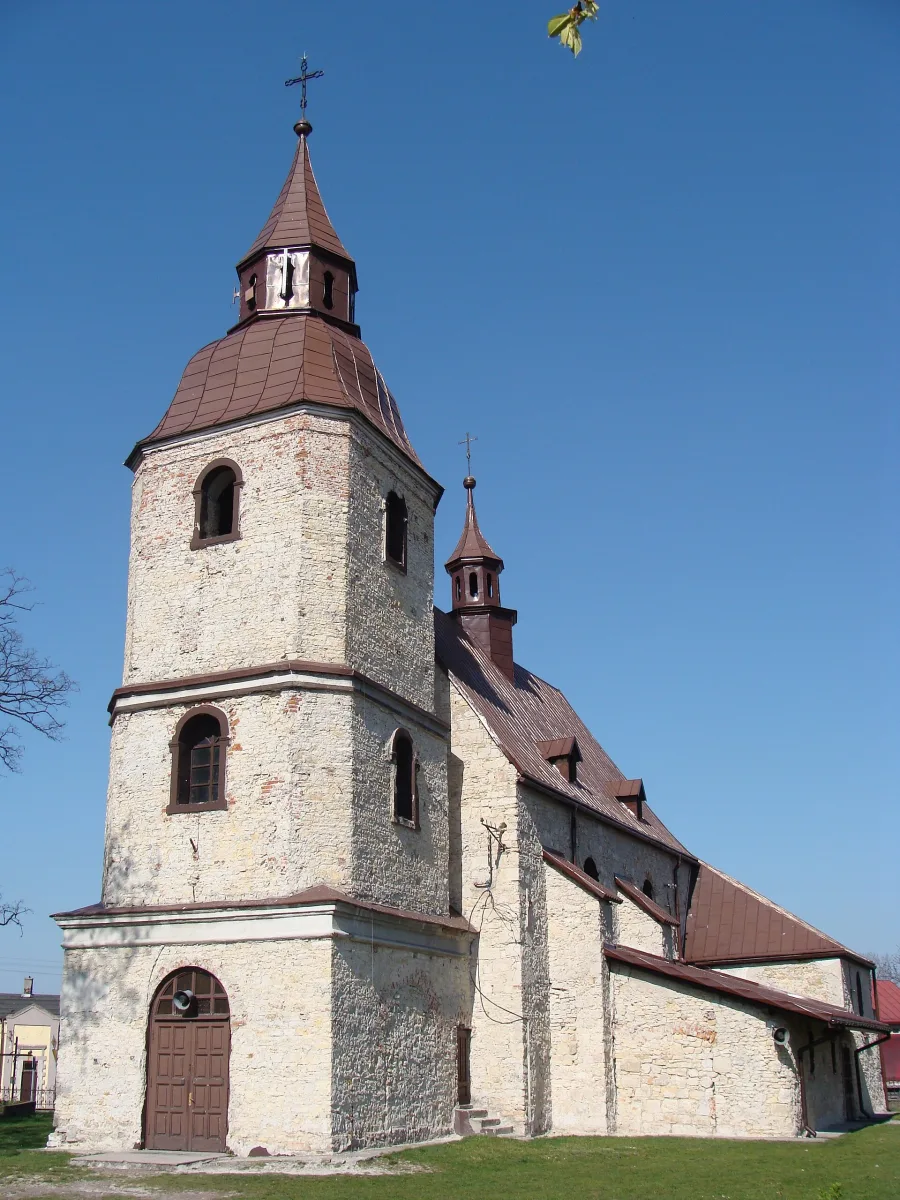
Church of Romanesque origin from the turn of the 12th and 13th centuries, the Shrine of Our Lady of the Good Way, with a Gothic painting.
The Church of St Martin and St Dorothy in Wojkowice Kościelne is one of the few monuments of Romanesque architecture in the Silesian Voivodeship and the only monument in this municipality. It dates from the turn of the 12th and 13th centuries, and since 1987 it has been the Shrine of Our Lady of the Good Way.
The church was built at the turn of the 12th and 13th centuries, probably in 1200-1229, founded by the owner of Wojkowice Kościelne from the Nowina family. It was rebuilt in 1618, 1700 and 1750 and after the Second World War, so today its style is described as Neo-Romanesque. The Romanesque character has been retained by the rectangular, barrel-vaulted chancel of ashlar stone, the sacristy converted into a treasury and a fragment of the nave.
It is a single-nave church with two side porches, a sheet-metal roof and a tower with a Baroque spire with an octagonal lantern. The smallest bell hangs in the little roof turret. The nave is closed by a gallery with an organ and two boxes. During the Second World War the church was damaged, and the Germans dismantled the bells from the tower for melting down. In 1984 a fire broke out, after which the church was fully restored.
In 1625 Fr Marcin Zelbrzykowski brought to the church a painting of the Virgin and Child, which began the Marian cult. The Gothic painting of the Hodegetria type was made around 1440-1450, is painted in tempera on a panel and hangs in the Baroque high altar. The faithful regard it as famed for graces. The Shrine of Our Lady of the Good Way was established on 27 June 1987 by Bishop Stanisław Nowak, and it is the only shrine in Poland with this dedication.
The Baroque high altar dates from before 1743 and was founded by the parish priest Jakub Konieczny. Its authorship is attributed to the Silesian sculptor Paweł Walenty Wiązkowicz and his workshop. After the fire of 1984 the altar was unprofessionally rebuilt and has retained almost only the figure of St Dorothy or Catherine, covered with a thick layer of gilding.
On the right stands a small Rococo pulpit topped with cherubs' heads, on the left a side altar from the 18th century with a painting of St Anthony. A stone font with the coat of arms of Prussia and the initials of the parish priest Jakub Konieczny has survived, as has a richly decorated bronze laver from the 15th century in the form of a polygonal turret. The engravings on its sides show the Virgin and Child, St John the Evangelist and two angels. The organ with a Classicist case is probably 19th-century. By the sacristy wall you can see a Renaissance sandstone portal.
The area around Siewierz makes a good context for an excursion. It is less than seven kilometres from here to the Bishops' Castle in Siewierz, and the Kuźnica Warężyńska Reservoir lies about three and a half kilometres away.

Be the first! Add a comment.
You need to log in to add a comment.
Log in