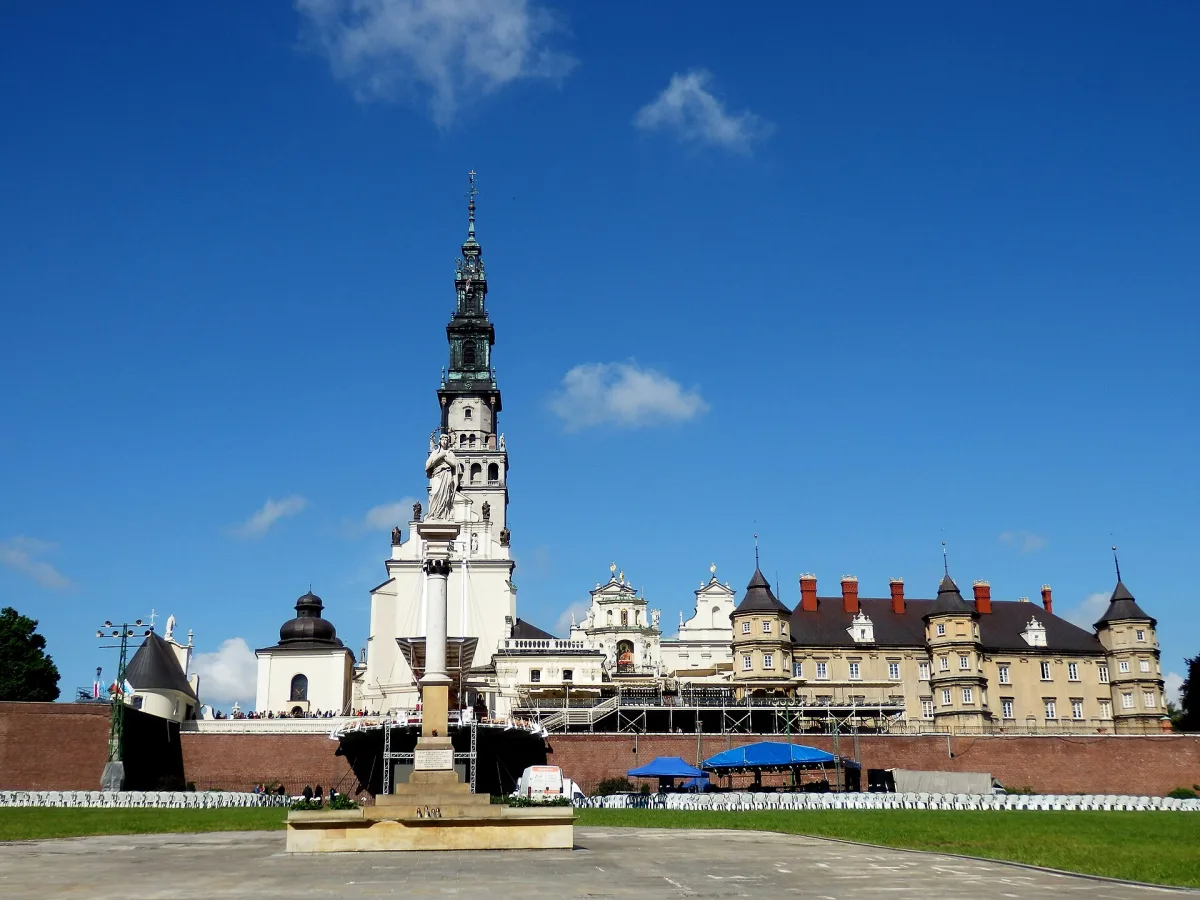
A shrine and Pauline monastery on a hill in Częstochowa, with the icon of Our Lady of Częstochowa, a 17th-century fortress, a treasury and a viewing tower.
Jasna Góra is a Marian shrine and a monastery of the Pauline Order on a hill in Częstochowa. It is the main destination of Catholic pilgrimages in Poland, and its centre is the icon of Our Lady of Częstochowa. Since 16 September 1994 the complex has held the status of a Monument of History.
The Paulines came to the hill from Hungary in 1382, brought by Duke Władysław of Opole. The monastery was founded on 22 June of that year, and the decree settling the monks is dated 9 August. Two years later the duke entrusted to their care the image of the Virgin and Child, known from then on as the icon of Our Lady of Częstochowa.
According to legend, the icon was painted by St Luke the Evangelist. Research from the 20th century points to the 14th century and an unknown Italian artist. In 1430 a gang of robbers attacked the monastery, stripping the icon of its valuables and slashing it with sabres. After restoration in Kraków it returned to the hill in 1434. The scars on the face of the Virgin are the feature by which the icon is recognised at once, and the shrine links them to the damage of 1430.
The fortifications of Jasna Góra were built from around 1620 on the initiative of King Sigismund III Vasa. The fortress was designed by the royal architect Andrea dell'Aqua as a quadrangle with bastions at the corners.
In November 1655, during the Swedish Deluge, around 4,000 soldiers with 36 cannons stood before the monastery. It was defended by about 160 soldiers of the garrison, fewer than a hundred monks and a few members of the nobility, led by the prior Augustyn Kordecki. The siege lasted from 18 November until the night of 26 to 27 December. Historians note that it was above all religious and symbolic in significance, not a turning point in the course of the war. In 1813 Tsar Alexander I ordered the fortress to be dismantled: within six weeks the upper parts of the walls were pulled down and the moats filled in.
The church has had the rank of a minor basilica since 1906, and its oldest part is the Gothic presbytery from the 15th century. The present Baroque three-aisled building dates from the turn of the 18th century, after the fire of 16 July 1690. You can read more about the church itself in the entry on the Jasna Góra Basilica in Częstochowa.
The icon is in the Chapel of Our Lady of Częstochowa, north of the basilica. John Paul II called it the Altar of the Nation. The image was painted on three lime-wood boards measuring 121.8 by 81.3 cm, and it is covered by a silver shutter from 1723.
The tower stands on the west side of the basilica. It was built in 1617-1625 and took its present form in 1901-1906. Two viewing galleries are open to visitors, at roughly a quarter and half of the height, reached by metal stairs. The whole tower has 519 steps, but the small balcony at the top is for technical staff only.
The treasury was built in 1649-1651 above the sacristy. Its collections include gifts from kings and magnates: a late Gothic monstrance donated by Sigismund the Old, a Nuremberg cross from 1510, silver trays and rosaries.
The 600th Anniversary Museum was opened in 1982 in the building of the former monastery printing house. It shows the history of the icon's presence at Jasna Góra and of the Paulines brought from Hungary.

Be the first! Add a comment.
You need to log in to add a comment.
Log in