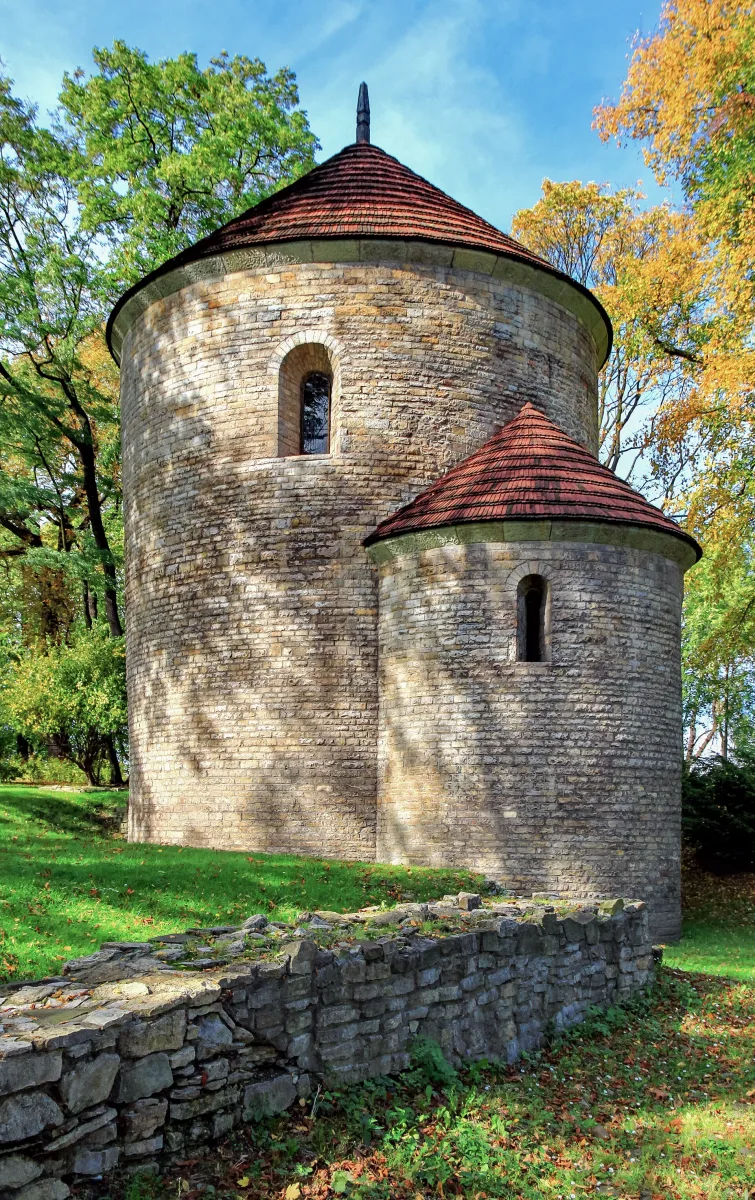
A Romanesque rotunda of the 11th or 12th century on Castle Hill in Cieszyn, a former castle chapel of Saints Nicholas and Wenceslas.
The Rotunda of St Nicholas stands on Castle Hill in Cieszyn and is one of the oldest surviving circular-plan buildings in Poland. In the heritage register it is listed as the castle chapel of Saints Nicholas and Wenceslas. The building is dated to the 11th or 12th century, and its image appeared on the Polish twenty-złoty banknote.
It is regarded as the only Romanesque rotunda in Poland preserved together with the vault of its nave. It was built of limestone in the Romanesque style, and the walls are about a metre thick and consist of two layers of carefully dressed stones, filled with rubble bound with mortar. The interior of the nave has a diameter of about 6.5 m, and adjoining it is a semicircular apse 140 cm in diameter. The nave is covered by a dome laid from rings of flat stones, and the apse by a spherical conch.
Originally the chapel had a western gallery, supported on columns and half-columns. It was reconstructed in the early 1950s. The stairs to the gallery are hidden in the thickened north wall.
The first written mention of a church of St Nicholas in Cieszyn comes from a document of Bishop Lawrence of 25 May 1223, issued for the Norbertine nunnery in Rybnik. Scholars dispute whether it refers to the rotunda or to a second church outside the stronghold. In sources of the 18th century the rotunda appears as the chapel of St Wenceslas. It was probably the first masonry building on Castle Hill and was originally surrounded by a mighty timber-and-stone rampart ten metres wide.
When the castle was rebuilt at the end of the 13th century and in the 14th, the rotunda was adapted to the Gothic building. The floor level was raised by two metres, and the Romanesque windows of the apse were walled up and replaced with larger, Gothic ones. In the 14th century the floor was covered with glazed tiles, laid in the image of the Silesian eagle and the inscription “Premislaus Dux Tessinensis”. The church was damaged by fires, known from sources of 1484, 1520, 1552 and 1570.
After the Thirty Years' War the castle fell into ruin, and the ducal residence was moved to the lower castle. In 1839 the Habsburgs, who had inherited Cieszyn after the Piast line died out, transformed the hill into a romantic garden. Archduke Charles had artificial ruins and a pavilion laid out here, which hid the Romanesque walls under a Neoclassical costume. About 100 m from the rotunda lies the Habsburg Hunting Lodge.
The rotunda owes its present appearance to a re-Romanisation in the mid-20th century. Archaeologists studied it as early as 1941, and further archaeological and architectural research took place in 2013-2016. In the post-war period it served as a tourist site, and on 6 December 1997 it was re-consecrated.
Holy Mass is celebrated in the rotunda once a year, on 6 December, on St Nicholas's Day. The rules for visiting the interior and the opening hours are best checked on site or at the Cieszyn Information Centre.
At a distance of about 200 m from the rotunda is the Printing Museum in Cieszyn.
About 600 m from here lies the Market Square (Rynek) in Cieszyn.

Be the first! Add a comment.
You need to log in to add a comment.
Log in