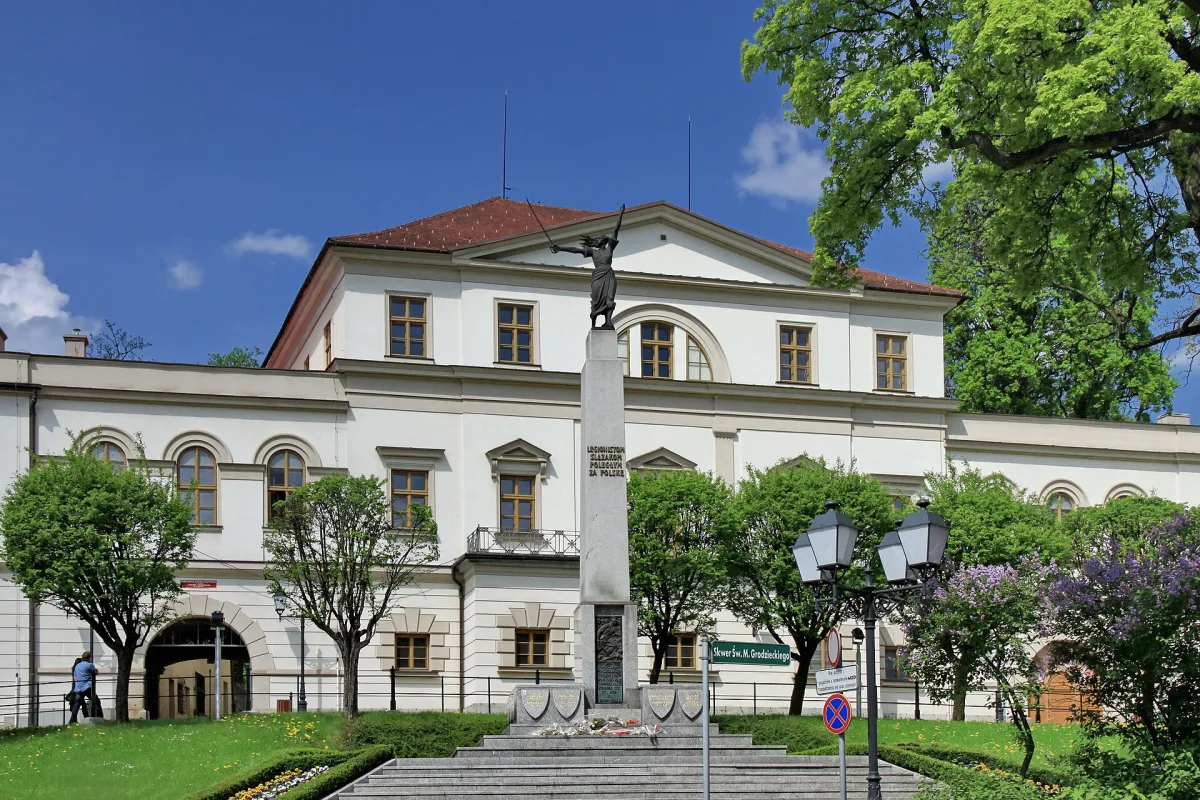
Neoclassical palace from 1838-1840 at the foot of Castle Hill in Cieszyn, designed by Joseph Kornhäusel, now home to Zamek Cieszyn.
The Habsburg Hunting Palace is a neoclassical building at the foot of Castle Hill in Cieszyn, built in 1838-1840 as a summer palace. Today it houses Zamek Cieszyn, a cultural institution that operates as a design centre, and a music school.
In 1838 Archduke Charles Louis of Habsburg brought Joseph Kornhäusel, a representative of Viennese neoclassicism, to Cieszyn. The upper and lower castles had been destroyed during the Thirty Years' War. Kornhäusel was to convert the remains into a residence, but the ruins were pulled down, and the remnants of the lower castle were used in 1838-1840 to build the palace. The heritage register dates the castle to the first half of the 14th century.
The palace did not serve its original purpose. The Habsburgs rarely stayed here, and day to day it housed the administration of the Cieszyn Chamber. Two events entered its history: a concert by Ferenc Liszt in June 1846 and Wagner performances by artists of the Vienna Opera in the late 1880s, staged in the neighbouring orangery. Emperor Franz Joseph I stayed here in 1880, 1890 and 1906 and had an apartment on the first floor at his disposal. In 1914-1916, when Cieszyn was the seat of the Army High Command, the palace was visited by, among others, Emperor Wilhelm II and Field Marshal Hindenburg.
In 1918 the palace became the seat of the National Council of the Duchy of Cieszyn, the first Polish authority in Cieszyn Silesia. Since 1947 part of the building has been occupied by the I. Paderewski State Music School, and since the renovation in 2005 the rest, together with a new orangery, has been used by Zamek Cieszyn.
The brick, two-storey palace is built on the plan of an inverted letter T and faces the town with its façade. The centre is adorned with a Palladian serliana, and the façade has thirteen bays, the three central ones projecting and crowned with a triangular pediment. The wings incorporate the remains of two defensive towers, and the wall of the northern bastion is 2.1 metres thick. In front of the palace stands the Cieszyn Nike, the Monument in Honour of the Silesian Legionnaires, from 1934, designed by Jan Raszka. The Germans destroyed it in 1939, in the communist period its elements were used for a Red Army monument, and it was recreated in its pre-war form in 2005.

Be the first! Add a comment.
You need to log in to add a comment.
Log in