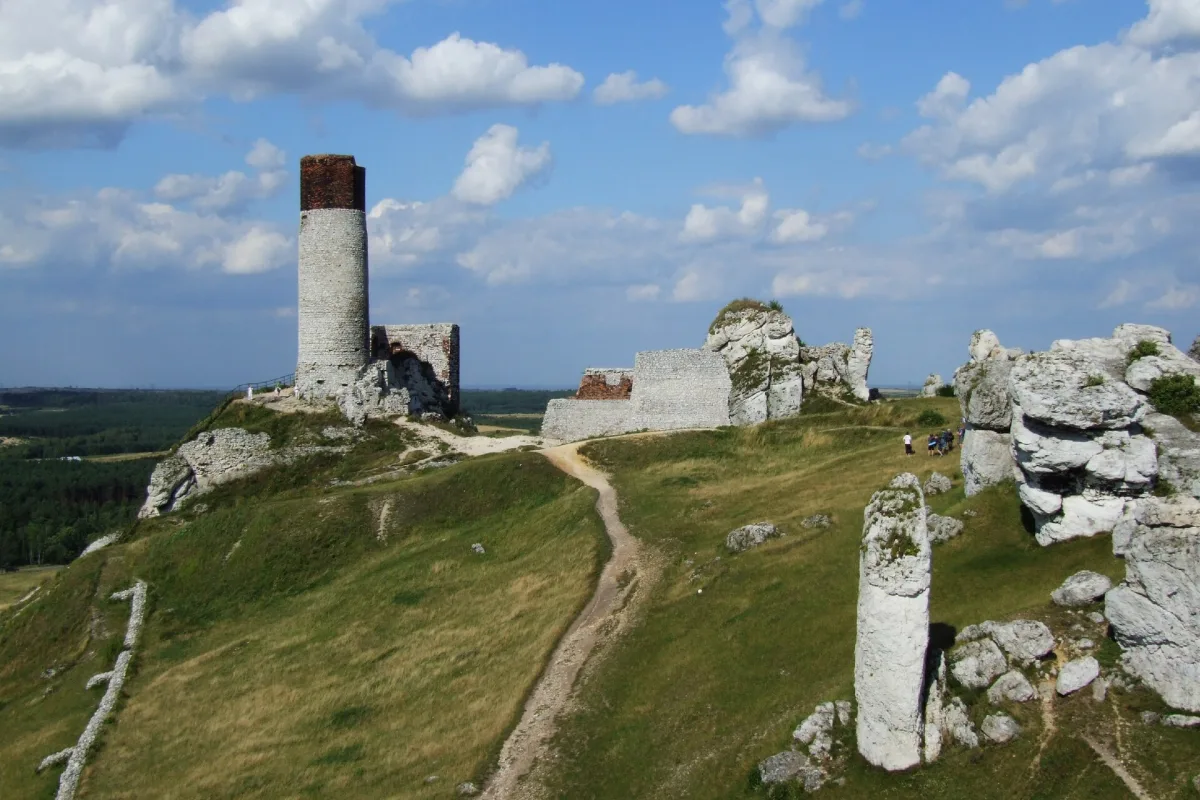
The ruins of a medieval royal castle in the Jura at Olsztyn near Częstochowa, on the Trail of the Eagles' Nests.
Olsztyn Castle is the ruin of a medieval stronghold in the Kraków-Częstochowa Upland, in the system of the Eagles' Nests, in the town of Olsztyn near Częstochowa. The site is entered in the heritage register, which dates it to the 14th century, although the first elements were built earlier.
The first mention of the castle, then called the castle in Przemiłowice, dates from 1306, but the stronghold had existed earlier. Research from 2010 confirmed its 13th-century origin. In the 14th century Casimir the Great expanded the watchtower into one of the most strongly fortified castles on the Silesian-Lesser Poland borderland.
In 1370 Olsztyn was given in fief to Władysław of Opole, and in 1391 the castle, after a week-long siege, was taken on the orders of Władysław Jagiełło by Spytek of Melsztyn and returned to the Crown. The settlement below the castle received town rights in 1488. In the 15th century the lower castle was built, and in 1545 King Sigismund Augustus stayed here.
In 1587 the castle was attacked by the Austrian troops of Archduke Maximilian, a pretender to the Polish throne. The starost Kasper Karliński was in command, and the defence succeeded, though at the cost of his son's life. The event was described by Władysław Syrokomla and Aleksander Fredro in the play "The Defence of Olsztyn".
After being rebuilt, the castle fell into ruin, and in 1655 the Swedes took it and wrecked it. During the construction of the parish church in 1722-1726 large fragments of the lower parts were pulled down, and in the 19th century peasants took the walls apart for building material.
What survives are the walls of the residential part, two towers, a cylindrical one (the keep) and a square one (the Starost's Tower), fragments of the walls of outbuildings, partly the cellars, and the foundations of a forge and traces of bloomery furnaces. The castle's website also mentions a viewing tower.
Archaeological research in 2015 covered the lower castle and made it possible to describe the position of the bridge piers and the gate tower. Four years later, in a cave on the grounds of the lower castle, over 200 flint tools made by Neanderthals were found. According to tradition, the castle held the Voivode of Poznań, Maciej Borkowic, as a prisoner, and a legend also says that an underground passage exists to the monastery at Jasna Góra.
In the town stands the Model of Olsztyn Castle, which shows the former appearance of the stronghold.
About a kilometre further on is the Kielniki Quarry, and nearby is also the Sokole Góry nature reserve.

Be the first! Add a comment.
You need to log in to add a comment.
Log in