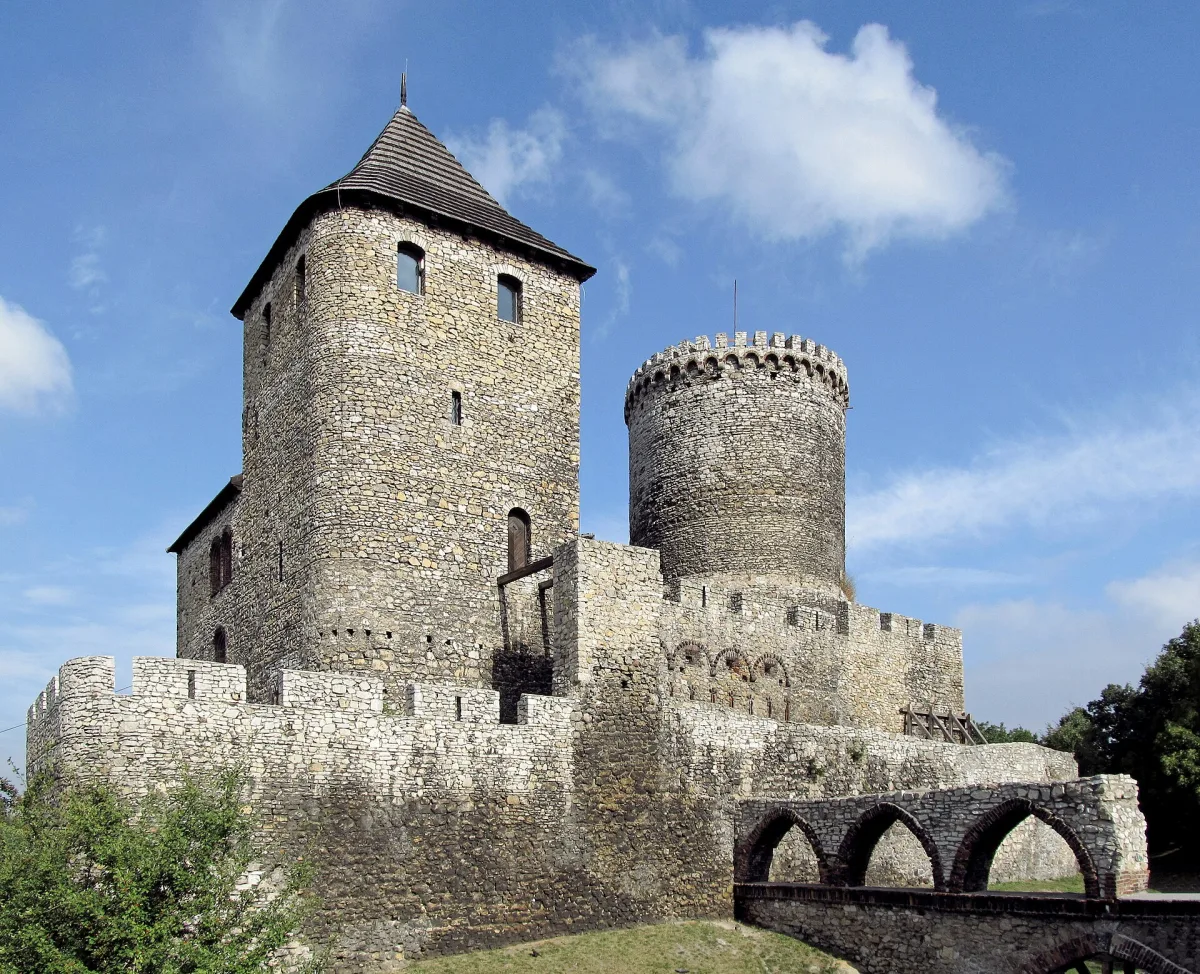
A medieval castle on Castle Hill above the Czarna Przemsza, built by Casimir the Great in 1349 and rebuilt in 1952-1956.
Będzin Castle stands on a hill above the Czarna Przemsza and is one of the best-known buildings of the Dąbrowa Basin. Casimir the Great added it in 1349 to an older stone tower, and its present shape results from the rebuilding in the 19th century and the reconstruction of 1952-1956. The castle is open to visitors, houses the Dąbrowa Basin Museum and has a round tower from which there is a panorama of the surroundings.
The history of fortifications on Castle Hill goes back to the 9th century, when a stronghold was built here.
In the second half of the 13th century, probably under Bolesław the Chaste, a stone keep was built within the stronghold, which stands to this day. In 1349 Casimir the Great added to it a castle consisting of an upper castle, surrounded by two rings of walls, and a lower one with a gate on the north side. The construction is linked with the loss of Silesia and its passing under Bohemian rule in 1348: the border between the Crown and Bohemia then ran along the Czarna Przemsza, at the foot of the castle. The town's founding charter of 1358 says that the town was founded "under our castle".
The castle burned many times and was rebuilt, and negotiations that ended the dispute over the Polish crown were held within its walls.
In August 1588 the plenipotentiaries of Poland and of Emperor Rudolf II came to Będzin to negotiate the release of Maximilian of Habsburg, imprisoned after the Battle of Byczyna. The negotiations ended with the signing of the Będzin pacts on 9 March 1589 in Czeladź. In 1616 the castle burned down together with part of the town, and during the Swedish Deluge it was burned and partly demolished. It was rebuilt in 1665. According to tradition, in 1683 it hosted Jan III Sobieski on his way to Vienna. Contrary to a widespread opinion, the Tatars did not take the stronghold.
The castle owes its present appearance to the rebuilding of 1834 and the reconstruction of 1952-1956.
In 1834 Count Edward Raczyński commissioned the rebuilding of the ruined castle to a design by Franciszek Maria Lanci, who introduced pseudo-Gothic elements, among them blind loopholes and machicolations, and lowered the cylindrical tower. In 1952-1956 reconstruction was carried out to a design by Zygmunt Gawlik. In 1919 the Society for the Care of Castle Hill was founded, and the rebuilding in the 1920s was designed by Prof. Adolf Szyszko-Bohusz. The lower castle has survived only as remnants of foundations.
In July 1956 the Dąbrowa Basin Museum was set up in the castle, the first museum institution in the Basin, with a collection of weapons and armour from past centuries.
In 1969 the round tower was opened to visitors, from which a panorama of the Basin opens out. Other museums of the region are described in the entries on the Museum in Sosnowiec and the "Sztygarka" Municipal Museum in Dąbrowa Górnicza.

Be the first! Add a comment.
You need to log in to add a comment.
Log in