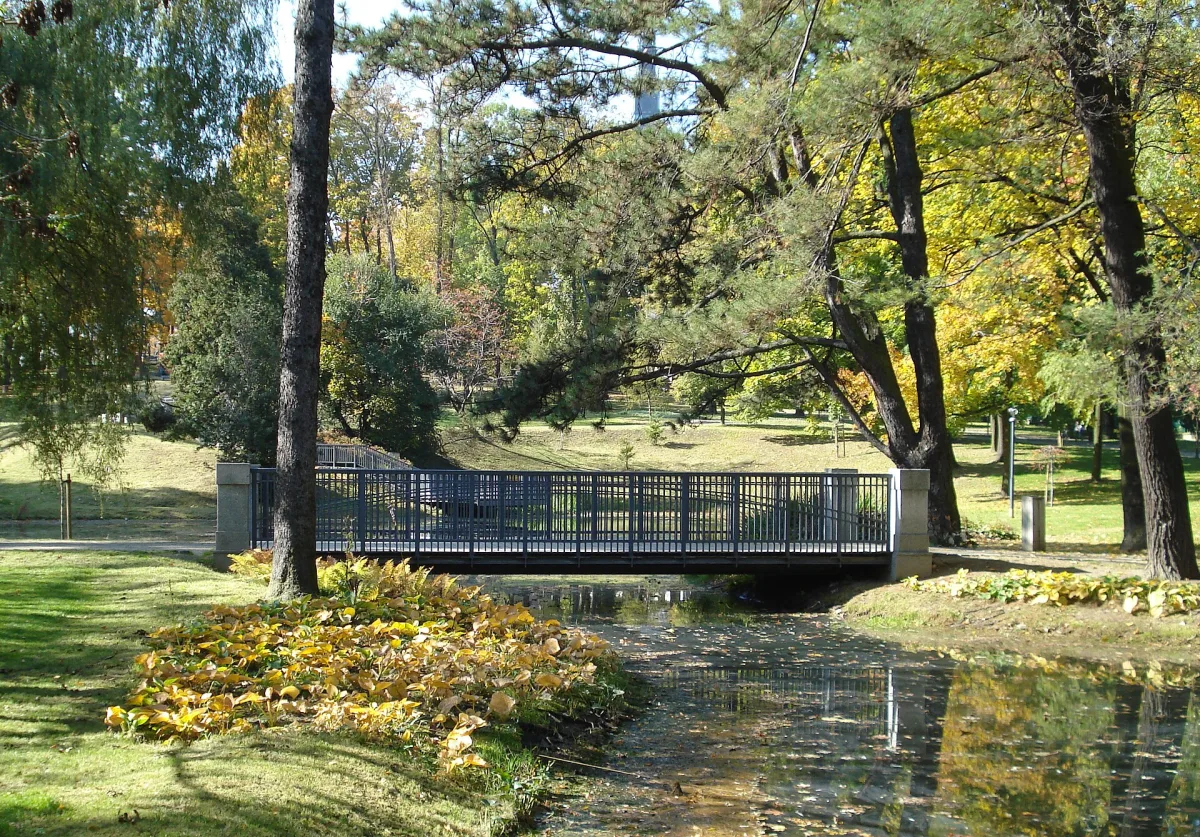
Two city parks in Częstochowa by Jasna Góra, a historic monument site with pavilions from the 1909 exhibition and an underground mining museum.
The Jasna Góra Parks are two city parks in Częstochowa, Stanisław Staszic Park and 3 Maja Park. They surround the monastery on Jasna Góra from the east. Together with Henryk Sienkiewicz Avenue they cover 11.8 ha, and since 16 September 1994, together with the monastery, they have had the status of a Historic Monument of Poland.
The boundaries of the parks were set in 1819-1826, when Blessed Virgin Mary Avenue was laid out. In 1843 the city authorities decided to create a garden; the work lasted from 1844 to 1847 and about 1,400 trees were planted.
In 1908, before the Great Industrial and Agricultural Exhibition of 1909, the Warsaw gardener Franciszek Szanior completely redesigned the neglected area. Today's layout of the parks refers to his early 20th-century design and was restored during the revitalisation of 2000-2008. The official opening after the revitalisation took place on 19 February 2008. Among the things created then were two playgrounds, the so-called little market square, granite chess tables and drinking fountains.
Staszic Park contains several buildings erected before the exhibition. The limestone Ethnographic Pavilion was designed by Konstanty Jakimowicz. The Peasant Farmstead, laid out as a model farmstead, was designed by Zdzisław Kalinowski and Czesław Przybylski. The former Hygiene Museum, an eclectic building designed by Bruno Paprocki, now serves as the Temporary Exhibitions Pavilion. The pavilions are managed by the Częstochowa Museum.
The building of the former astronomical observatory was put up in 1909 to a design by Władysław Jabłoński. An observatory worked here from 1929 thanks to the efforts of Father Bonawentura Metler, and since 2010 the building has housed Zodiak, a multimedia education centre for the youngest children.
In the basement between the Ethnographic Pavilion and the former Hygiene Museum is the Iron Ore Mining Museum. Old workings have been recreated here, equipped with machinery from the closed Szczekaczka iron ore mine. It is one of the sites of the Silesian Industrial Monuments Route.
Staszic Park has about 1,300 trees, most of them 100-150 years old, and 3 Maja Park about 1,600, often more than 130 years old. The nine most impressive trees have been recognised as natural monuments.
Among the sculptures are a reclining girl in sandstone, the work of Władysław Rudlicki from 1911, a monument to Stanisław Moniuszko from 1958 by Stefan Policiński, and a bust of Kazimierz Pułaski by Jerzy Kędziora from 1994. The sundial by the former observatory was made from a block of black granite that had been the base of the monument to Tsar Alexander II, which stood in 1889-1917 on the square in front of the monastery.

Be the first! Add a comment.
You need to log in to add a comment.
Log in