
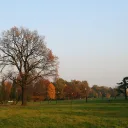
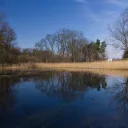
The southern part of the historic landscape park of the former Donnersmarck residence in the Brynica valley, with ponds, avenues and glades.
The palace park in Świerklaniec is an extensive landscape complex of the former residence of the Henckel von Donnersmarck family, set in the Brynica valley in Tarnowskie Góry County. This entry covers its southern part, which includes the Junak pond. The park is entered in the heritage register, and today it covers more than 180 hectares.
The first park by the Donnersmarck castle was probably created in 1670-1680. The present landscape-style layout was laid out in the 18th century on former marshland by the Brynica, and it acquired its present form in 1865. Gustav Meyer was engaged for its extension, and according to the National Heritage Board of Poland it is not ruled out that the original concept was co-created by Peter Joseph Lenné.
In 1868-1875 Count Guido Henckel von Donnersmarck built a palace in the heart of the park, known as the Little Versailles (in the style of French Neo-Renaissance with Baroque elements). In the second half of the 1890s (sources give 1895-1897) a neo-Gothic chapel was built on the edge of the park, and in 1903-1905 the family mausoleum was added to it, and the last major investment was the neo-Baroque Bachelors' House (Dom Kawalerów).
In the southern part of the complex stood a farmstead of compact, symmetrical composition in the shape of a quadrangle, and the gardening complex was set up in the northern part. The vegetation was shaped freely, in the form of groups of trees, screens and specimen trees, combining native and exotic species. Today the stand is dominated by maple, horse chestnut, alder, spruce, pine, Douglas fir, poplar, oak, lime, hemlock and elm.
The trees form dense walls of greenery that set off intimate garden spaces, interspersed with glades. Fragments of the former water system survive, that is ponds and streams. The main avenues are surfaced, while the paths deeper in the park remain earthen.
After 1945 the palace and the old castle were destroyed, looted and set on fire, and their remains were gradually demolished (the palace in the 1950s; the ruins of the old castle were blown up in 1962). The surviving entrance gate was moved to the Voivodeship Park of Culture and Recreation in Chorzów. The construction of the Kozłowa Góra reservoir on the Brynica blurred the former panoramas and open areas next to the park. Of the former complex there survive, among other things, the Bachelor's House, the chapel with the mausoleum, the pools within the terraces and the sculptures by the French artist Emmanuel Frémiet by the fountains.

Be the first! Add a comment.
You need to log in to add a comment.
Log in