
A historic park of about 26 ha beside the Habsburg castle, laid out in 1712 in the Italian style and redesigned as a landscape park, with the Chinese House on an island.
Castle Park in Żywiec covers about 26 hectares in the town centre, south-east of the Habsburg castle. It was laid out in 1712 as a formal garden and later transformed into a landscape park. It has the status of a historic monument and is part of the castle complex entered in the heritage register.
The first mention of a park next to the castle comes from an inventory of 1664. The present layout was created in 1712 by the Wielopolski family in the Italian style: the park was divided into quarters, and the paths crossed at right angles. Soil and turf were brought in from the area around Rychwałd for its construction. In 1715 an orangery was built, which has not survived, and around 1720 a fountain was probably installed and about 18 stone sculptures were set up. In the second half of the 18th century a canal, the Chinese House and a gazebo with the Starykoń coat of arms were added.
In the first half of the 19th century the layout was altered by Adam Wielopolski together with the gardener Jan Merek. In 1838 the park passed to the Habsburgs and was extended to the south-west. At the turn of the 19th and 20th centuries, and then in 1930-1936, the geometric layout was redesigned in the spirit of English landscape gardens; some of the new elements were designed by the English landscape architect Brenda Colvin and carried out by Kit Beckh. A viewing glade appeared at that time, and the wooden bridges over the canals were replaced with stone ones.
The best known feature is the Chinese House, a two-storey brick pavilion on an octagonal plan, which after the park was redesigned ended up on an island. The park also retains a canal, a basin with a fountain, pergolas and a rose garden. In the outer courtyard between the Habsburg Palace and the Old Castle stands an ornate iron well, the work of the Żywiec craftsman Julian Rybarski.
The park gradually gained new functions. In 2007 the town stables with a mini zoo were opened, in 2009 the park and the Habsburg Palace were revitalised, and in 2012 a bench with a statue of Alicja Habsburg was unveiled. The Miniature Park was opened in December 2021, and in 2024 a brine graduation tower was put into operation. In 2023 an oak named “Tadeusz” was planted in memory of Tadeusz Jänich.
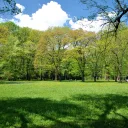
The park has lime, oak, maple, horse chestnut, ash, beech (including the weeping variety), hornbeam and willow trees, and among the yews and thujas there is no shortage of ornamental shrubs. Natural monuments include a small-leaved lime and a pedunculate oak. A lime avenue in the western part and an oak avenue have survived. In the north-eastern part lies a rose garden with a fountain, surrounded by a hornbeam avenue. The water system with an island and a gazebo was created in the first half of the 19th century, when the millrace was dug out into a canal; in the 20th century the regulated watercourse also formed a waterfall, which existed until the 1950s.
Close to the park are the Żywiec City Museum and the Co-Cathedral of the Nativity of the Blessed Virgin Mary. A few kilometres further on is the Żywiec Brewery Museum.

Be the first! Add a comment.
You need to log in to add a comment.
Log in