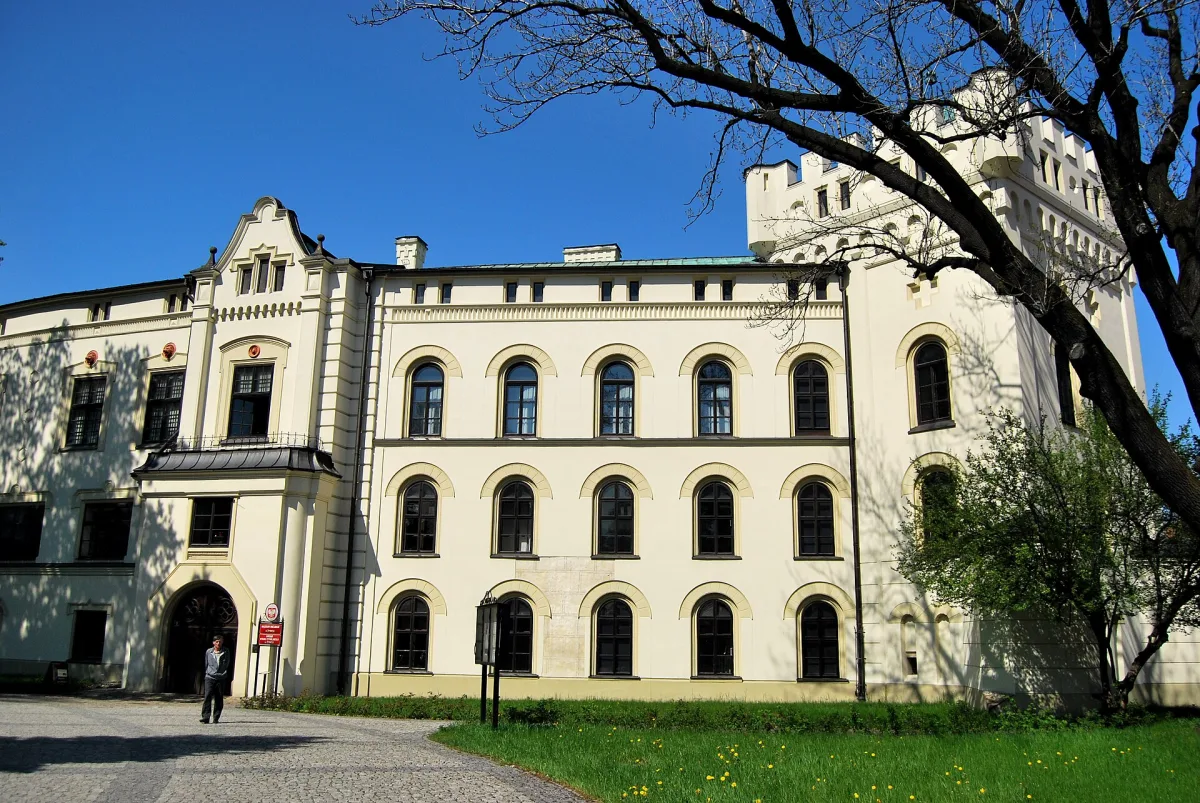
A museum in the Old Castle in Żywiec with exhibitions on the history of the town, the culture of the Żywiec highlanders, archaeology, nature and sacred art.
The Żywiec Municipal Museum (Muzeum Miejskie w Żywcu) is housed in the Old Castle and shows the history of the town and region and the culture of the Żywiec highlanders. The institution grew out of a collection gathered from 1925 by schoolgirls of the Local Studies Circle, and since 2005 it has been based in the castle. Its permanent exhibitions cover the history of the town, folk culture, archaeology, Beskid nature, sacred art and the old judiciary.
The museum began with a collection gathered from 1925 by schoolgirls of the Local Studies Circle at the State Women's Teachers' Seminary, under the school's director Tadeusz Charlewski. The first exhibition, opened in 1934, included over 300 exhibits from the Żywiec region: costumes, folk art and household objects. It also showed a copy of the Żywiec Chronicle (Dziejopis Żywiecki) by Andrzej Komoniecki.
In 1936 the collection was taken over by the Section of Friends of the Żywiec Region, which created the Museum of the Żywiec Land. In 1938 it was moved to a townhouse at Rynek 1. The collections then received finds from the excavations on Grojec hill, carried out in 1937-1938. During the Second World War the Germans seized the collections, and in 1941 they took away the most valuable sacred exhibits. After the war, in April 1945, the museum was revived, and in 1946 the collections were moved to the Old Castle. Since 1990 the founding body has been the town of Żywiec, and in 2005 the castle became the museum's permanent seat.
The building of the castle is attributed to the Dukes of Oświęcim or to Mikołaj Strzała. The oldest Gothic complex from the first half of the 15th century consisted of a single residential tower and wooden buildings, surrounded by an earthen rampart and a shallow moat. Under the Komorowski family the castle was turned into a fortified stronghold with four towers, defensive walls and corner bastions, and in the second half of the 16th century into a Renaissance residence with cloisters and sgraffito decoration.
The second period of splendour came in the time of the Wielopolski family. At the beginning of the 18th century the castle was rebuilt into a palace residence with a representative staircase, Baroque facades and a chapel, and an Italian garden was laid out to the south. The Habsburgs gave the building an outer facade in the historicist style, to a design by Karol Pietschka, which has survived to this day. After 1945 the castle housed flats, an archive and offices, and a renovation was carried out in 1976-1989.
The museum presents the exhibitions “History and Tradition of the Town of Żywiec”, “Folk Culture of the Żywiec Region”, “Archaeology”, “Birds and Mammals of the Żywiec Region”, “Confessates, or Courts, Sentences and Torture in Żywiec”, “To Save the Fatherland” about the inhabitants of the Żywiec region in the struggle for independence in 1830-1945, and “Sacred Art of the Żywiec Region”.
In the history and art department you will see Żywiec burghers' costumes, town charters, guild painting from the turn of the 19th and 20th centuries, and examples of Gothic art and historic furniture. The ethnographic department gathers festive and ceremonial costumes of the Żywiec highlanders, folk sculpture and paintings, toys, farm implements and folk instruments. In the natural history department the Beskid fauna and flora and the remains of fossil animals are shown, and the archaeology department presents material from the pre-war excavations and from the 1980s.
About 200 metres from the museum, by the New Castle, is the Miniature Park in Żywiec with miniatures of 23 buildings raised by the former owners of the town.
Nearby also stands the Co-Cathedral of the Nativity of the Blessed Virgin Mary in Żywiec.
It is about 3.4 kilometres from here to the Żywiec Brewery Museum.

Be the first! Add a comment.
You need to log in to add a comment.
Log in