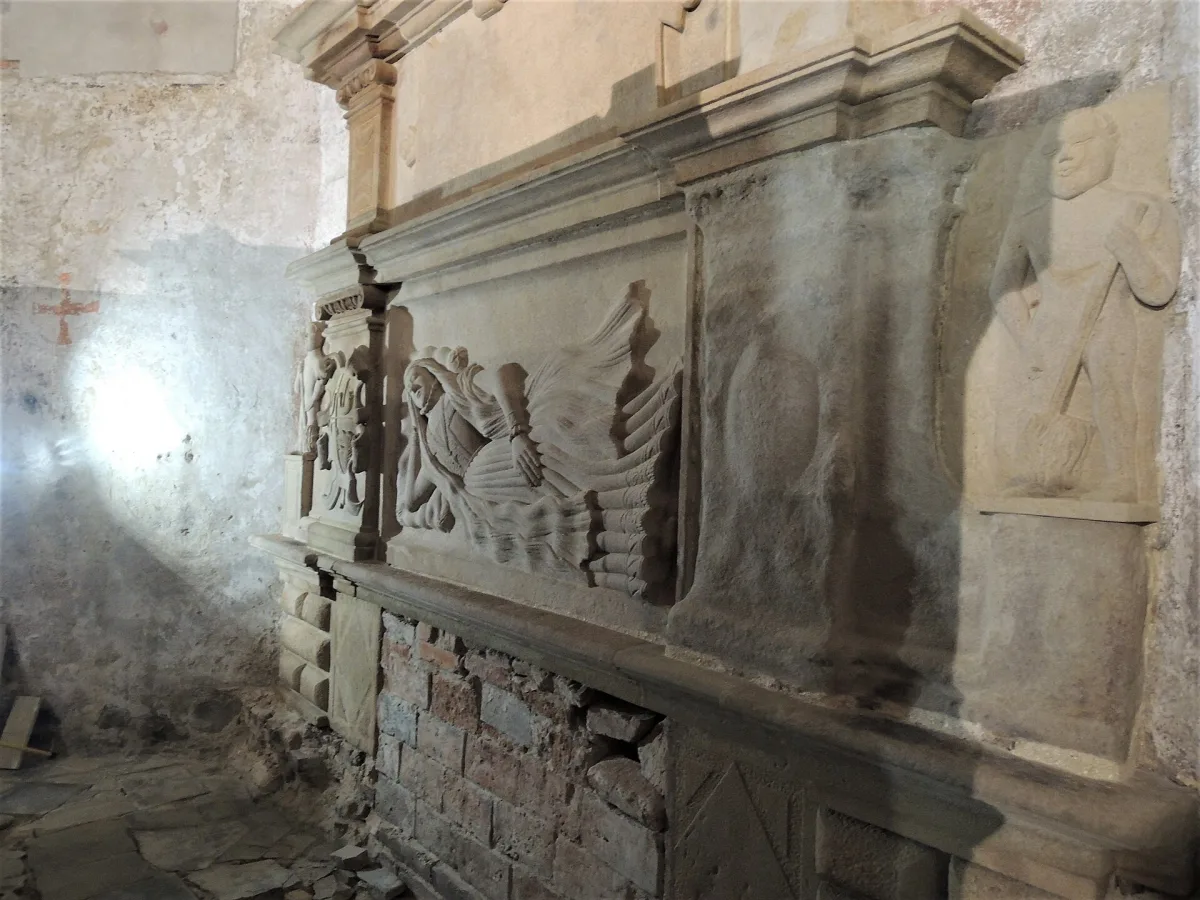
A four-tier Renaissance cenotaph of the Voivode of Kraków and his wife in the chancel of the church in Bestwina, uncovered after conservation in 2015-2017.
The tomb of Stanisław and Jadwiga Myszkowski stands in the chancel of the Church of the Assumption of the Blessed Virgin Mary in Bestwina. It fills the whole apse, is 789 cm high including the figure at the top and 364 cm wide. It was made of sandstone, probably between 1575 and 1592. It is regarded as one of the most monumental works of funerary art in the Silesian Voivodeship.
Stanisław Myszkowski, Voivode of Kraków and owner of Bestwina, died suddenly on 16 April 1570 during a session of the Sejm in Warsaw. He was buried in the Evangelical cemetery in Kraków, as was his wife Jadwiga, née Tęczyńska, who died in 1592. The monument in Bestwina is therefore a symbolic tomb. Myszkowski was a Calvinist and turned the local church into a Calvinist meeting house, and since there was no altar in the meeting house, the tomb in the chancel was easy to see.
The lower part is formed by a plinth with rustication and diamond-shaped panels. Above lies a bas-relief of Jadwiga asleep, in a Renaissance gown, with her head resting on her hand, and on either side are pilasters with the coats of arms of Stanisław's ancestors and genii with inverted torches, a symbol of death. The third tier is an oval cartouche with a Latin epitaph. At the very top rests Stanisław in armour, with a mace in his hand, and beside him lie a sword and a plumed helmet. The whole is crowned by the Korab coat of arms of the Łaski family, from which his mother came, and a figure of a young man with a sword, perhaps an allegory of courage or justice.
After the church was taken over by Catholics at the turn of the 17th century, an altar was placed in the chancel. In the second half of the 18th century it was replaced by a larger one, and in the mid-19th century it was moved up against the wall so that it completely covered the tomb. The monument was mentioned only in the 1953 Catalogue of Art Monuments in Poland and in a guidebook of 1962. In 2014 a series of photographs was taken through the gap behind the altar, and Renaissance details appeared in them. Later that same year it was decided to move the altar away, and conservation took place in 2015-2017. The sculpture at the top, previously removed and given to the museum in Bielsko-Biała as a figure of St Cordula, was then restored, and a fragment of Renaissance flooring and two walled-up Gothic windows were also discovered in the chancel.

Be the first! Add a comment.
You need to log in to add a comment.
Log in