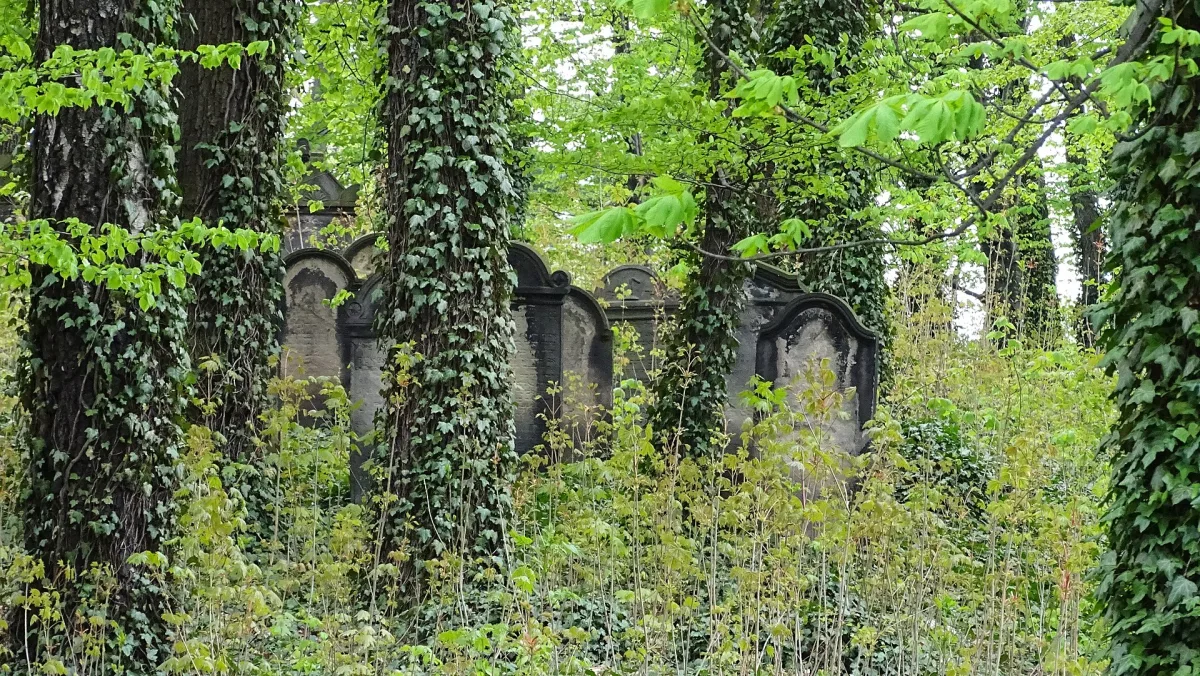
Jewish cemetery in Mikołów founded probably in the 18th century, with over three hundred gravestones and a monument to the victims of the death marches.
The New Jewish Cemetery in Mikołów is a necropolis founded probably in the 18th century, at the junction of Stara Droga and Konstytucji 3 Maja streets. It covers 0.5 hectares, according to other sources 1 hectare. It is entered in the heritage register.
The oldest surviving gravestone dates from 1726 and belongs to Chaim, son of Juda Lejb. In 1828 the cemetery was enlarged. Buried here were the Jews of Mikołów and followers of Judaism from nearby towns, among others from Pszczyna and Żory.
In the interwar period a pre-burial house stood at the entrance, and the site was surrounded by a brick and stone wall. More than three hundred gravestones with inscriptions in Hebrew and German have survived.
The cemetery survived the Second World War practically without damage. In January 1945 it lay on the route of the so-called death march of prisoners from the German Nazi Auschwitz-Birkenau concentration camp. Prisoners who died of exhaustion or were killed by guards were buried in the cemetery. The number of those buried is uncertain: the estimates given range from 50 to about 160 people. Not long afterwards the Germans shot 14 prisoners, possibly members of the resistance, brought from Katowice, at the eastern wall. Their bodies were also buried in the cemetery.
After the war the cemetery was closed and began to deteriorate: slabs were stolen, and matzevot were knocked over and broken. In the 1950s a section was separated from the former necropolis and a monument to the victims of the death marches was placed there. In 1973 the cemetery was entered in the heritage register, but the degradation continued. The damaged wall was pulled down in 1982 and a few years later replaced with a metal fence. The site was tidied in 1988.

Be the first! Add a comment.
You need to log in to add a comment.
Log in