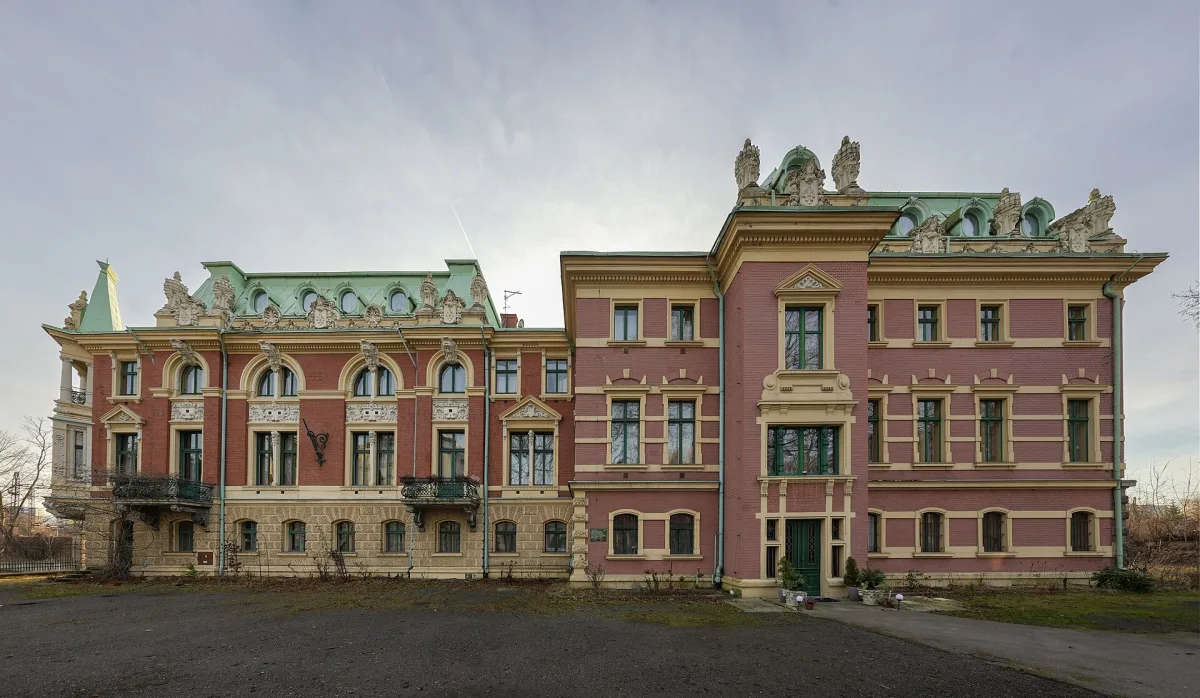
A Neo-Baroque palace of a family of industrialists from the turn of the 19th and 20th centuries in Sosnowiec, with preserved reception rooms.
Dietel Palace (Pałac Dietla) is a Neo-Baroque residence of a family of industrialists, standing at Stefana Żeromskiego 2a in Sosnowiec. It is entered in the heritage register, and its interiors have kept part of their former furnishings and decoration.
Henryk Dietel (born 1838 according to the palace website, 1839 according to other sources; died 1911), from a Saxon family of industrialists, came to Sosnowiec in June 1878 and founded a worsted wool spinning mill. At the same time he built a family home. In the mid-1880s the small house was rebuilt into a one-storey building, to which a Neo-Renaissance palace block was added. The first plans from the 1880s were signed by Stanisław Waligórski, and the first design for an extension was made in 1890.
The last rebuilding, at the turn of the 19th and 20th centuries, unified the façades: the northern part was raised to the height of the southern, and Neo-Renaissance gave way to Neo-Baroque with elements of Neo-Rococo. After a roof fire in 1900 the palace received a high roof with dormers and an attic with garlands and vases. Around 1900 a walled park with an orangery and small architectural features was also created. The palace belonged to a patronage complex together with the park, the former factory, the workers' housing estate and the Evangelical church.
The reception rooms are on the first floor. The most important is the two-storey ballroom with mirrors and stucco, a balcony, a parquet floor with a star-shaped rosette and two crystal chandeliers. It was added together with the orangery in 1894. A considerable part of its oak furnishings has survived.
In the Neo-Baroque dining room, also called the Dutch room, the walls are covered with oak panelling with built-in sideboards, and the panels refer to painting from Delft. The Neo-Romanesque smoking room has panelling with plant and animal motifs and two stained-glass windows. The Art Nouveau study is linked to the dining room by massive sliding doors. The palace bathroom has also survived, and it was used in the film “Między ustami a brzegiem pucharu” (“Between the Lips and the Rim of the Cup”).
The Dietel family lived here until 1945. In January of that year the palace was taken over by a Soviet NKVD commandant's office, and many parts of the building and furnishings were destroyed. Until 1997 it housed a music school. Since 1997 the building has been in private hands, and its renovation has been under way since then. Alongside lies Dietel Park.
Nearby also stands Sielec Castle.

Be the first! Add a comment.
You need to log in to add a comment.
Log in