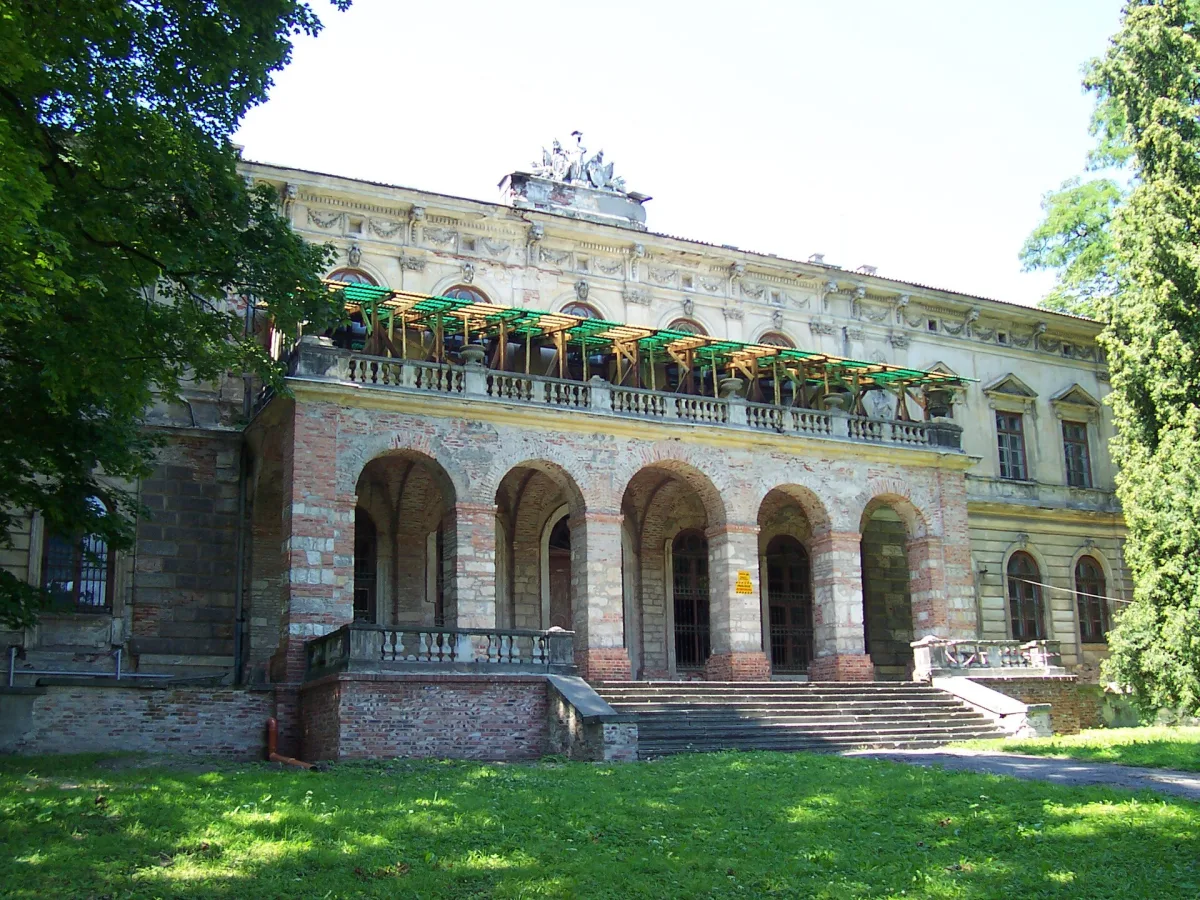
A Renaissance and Baroque palace from the 17th century within bastioned fortifications, with a park designated a natural monument.
Pilica Castle is a palace from the early 17th century, surrounded by bastioned fortifications from the 17th century. It stands in the town of Pilica in the Kraków-Częstochowa Upland and is entered in the heritage register. Its history is intertwined with the Padniewski, Zbaraski, Warszycki and Sobieski families.
Pilica was bought in 1570 by the Bishop of Kraków, Filip Padniewski. His nephew Wojciech Padniewski, castellan of Oświęcim, began building a late Renaissance residence just before 1605. It consisted of two rectangular buildings joined by walls, which formed a courtyard.
In 1613 the estate was bought by the castellan of Kraków, Jerzy Zbaraski. Around 1620 he extended the residence: above the courtyard a three-aisled hall on two rows of columns was built, and on the side of the Italian garden a two-storey loggia with 13 arcades. The building took the form of an Italian villa.
The first fortifications were built by Zbaraski, as shown by a letter of 1623 which mentions the Venetian military engineer Andrea dell'Aqua. The work was completed around 1645 by Stanisław Warszycki. The fortifications, on a rectangular plan with outer dimensions of 168 to 217 metres, consist of six bastions joined by a rampart 10 to 16 metres high. A moat about 20 metres wide was dug on the west and south sides.
On the ramparts two vaulted casemates survive next to the ravelin, along with traces of a counterguard on the western bastion. The brick facing visible today was added around 1874-1894. The castle was briefly occupied by the Swedes in 1655, and Warszycki recovered it in February 1656.
In 1731 the castle was bought by Maria Sobieska, née Wessel. She added a Baroque terrace on the south side, which still stands today, and pulled down the two southern bastions and the wall on the town side, which meant the fortifications lost their military significance. In 1734 King Augustus III of Poland was a guest here. In 1846 the palace roof collapsed.
After 1874 the Warsaw industrialist Leon Epstein gave the palace a Neo-Renaissance appearance and built two orangeries and a Romantic gate in the rampart. From 1908 until 1945 the castle belonged to the family of Kazimierz Arkuszewski.
Beneath the castle walls, from the end of 1942 to the spring of 1944, the German gendarmerie shot about 80 Poles and about 70 Jews. In 1945 the palace was taken over by a Red Army field hospital. After the war it housed a children's home, a school, and from 1957 to 1982 a reformatory for boys.
In 1989 the complex was bought from the State Treasury by Barbara Piasecka Johnson, who planned a residence and a painting gallery. After a year of renovation the work was halted when the descendants of Arkuszewski made claims. The legal dispute lasted until her death in 2013.
The palace is surrounded by a park of 10 hectares, designated a natural monument as a work of garden art. It contains a Neoclassical well.
In Pilica you can also see a synagogue and a Jewish cemetery. It is about 3.7 km from here to Smoleń Castle.

Be the first! Add a comment.
You need to log in to add a comment.
Log in