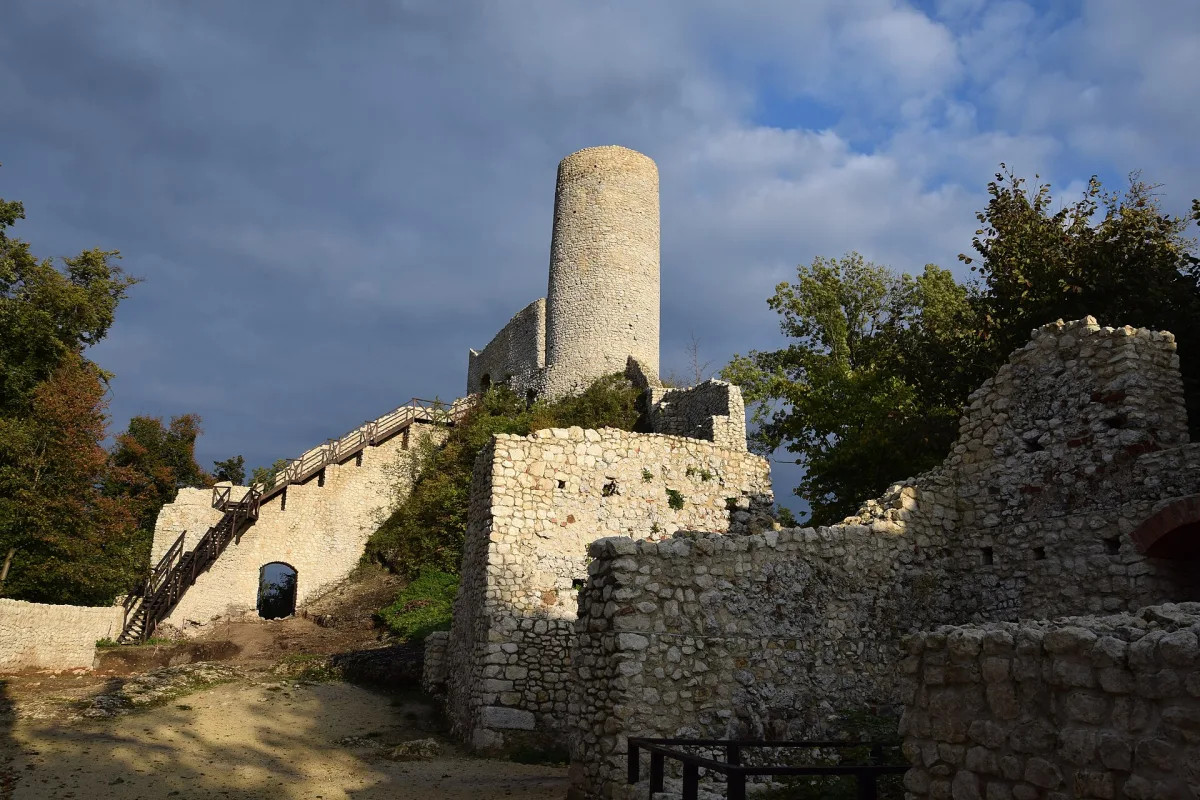
Gothic castle ruins on a limestone hill in a nature reserve, with a round tower, opened to visitors in 2015.
The ruins of Smoleń Castle stand on a rocky hill in the Kraków-Częstochowa Upland, in Pilica municipality. The most recognisable feature is the round tower of the upper castle, and the structure itself lies within a nature reserve. Since 2015 the ruins have been secured and open to visitors.
The castle was built in the 14th century on a limestone cliff, and the first reliable mention of it dates from 1394. Some sources link its foundation to Otto of Pilica, while the heritage register attributes it to John of Pilica, so the exact founder remains a matter of dispute.
In medieval sources the stronghold was called Pilica, and it took the name Smoleń only in the 16th century. In the 15th century it belonged to the Pilecki family, and at the turn of the 14th and 15th centuries the owner was Elżbieta Pilecka-Granowska, the third wife of Władysław Jagiełło. Her son Jan Pilecki took over the castle in 1414. In 1570 Jan Pilecki sold the castle to the Bishop of Kraków, Filip Padniewski, and in 1577 it was acquired by Wojciech Padniewski. He later moved to a new residence in Pilica, and the old castle began to fall into ruin. More about that residence is on the card for Pilica Castle.
The castle consisted of three parts built in successive stages. The oldest is the upper castle: perimeter walls, a residential building and a cylindrical tower about 7.5 metres in diameter, which was entered from a height of several metres.
After 1350 the eastern castle was added, surrounded by a stone wall up to 2 metres thick, laid out on a pentagonal plan. A Gothic pointed-arch gate survives from it. In the courtyard there is a well which tradition linked with Tatar prisoners. The filled-in well is 26 metres deep, although in the past people spoke of a hundred or even two hundred metres. After 1450 the western part of the castle was extended and joined by a wall to the upper castle.
Destruction came over the following centuries: in 1655 the castle was devastated by the Swedes, and in 1797 the Austrians used its stone to build a customs house. In the 1840s the ruin was bought by Roman Hubicki, who tidied it up and set up a shot factory nearby. The monument was entered in the register in 1932, and in the 1950s and 1960s the walls were secured as a permanent ruin.
In 2010 signs forbidding entry were put up, because the walls had begun to collapse. After securing and partial reconstruction the castle was opened to visitors in 2015, and the tower can be entered. In 1997 Błażej Muzolf of the museum in Łódź carried out preliminary archaeological research here, but its results were not published.
The castle hill belongs to the Smoleń nature reserve, covering 4.32 hectares, created in 1959 and under strict protection. About 160 species of vascular plants and 60 species of mosses grow here, including ivy, lady's slipper orchid and alpine currant. A closed path with information boards runs around the hill, and the ruins lie on the Trail of the Eagles' Nests. The nature of the hill is covered in a separate entry, Smoleń Nature Reserve.

Be the first! Add a comment.
You need to log in to add a comment.
Log in