
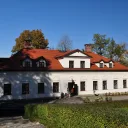
Classicist manor house from 1830 with a portico, outbuildings and a park with monumental trees.
The manor house complex in Rychwałd near Żywiec is a Classicist manor house from 1830 with two historic farm buildings and a park of two hectares. The whole is entered in the heritage register. Today it is a hotel and leisure venue, so you see the interiors as a guest, and the surroundings from ul. Spacerowa.
The manor house was built thanks to the Milieski family, who in 1810 bought the Rychwałd estate from Jan Franciszek Wielopolski. After Stanisław Milieski, the estate was taken over in 1814 by Walenty Milieski. In 1830 the manor complex was erected on the site of a former 18th-century manor farm. The family owned it until 1940, when the Nazi authorities confiscated the manor house and placed in it a branch of the Bund Deutscher Mädel camp.
In 1945, under the land reform, the manor house was managed by a cooperative from Łodygowice, and later by a seed-growing station. In 1985 the complex was taken over by a company from Katowice, and a year later by the Budryk mine, which carried out a renovation and set up a holiday home for its employees. In 2002 the manor house passed into private hands, was renovated and developed as a hotel and leisure venue.
The manor house is built of stone, rendered, on a rectangular plan. The garden façade is decorated with projecting bays and a portico on a high base, with two pillars and two columns supporting an entablature with a triangular pediment. The whole is covered by a hipped tiled roof. On the carriage-entrance side there is a large rectangular courtyard with two historic farm buildings with gable roofs with half-hips. The cellars under the building are barrel-vaulted. In the park monumental trees have survived: a 34-metre Weymouth pine, three large-leaved lime trees, a bird cherry and a common hornbeam.

Be the first! Add a comment.
You need to log in to add a comment.
Log in