
The flood of 1958 and the decision to build dams
The reservoirs on the Soła have two separate histories. The older one, Międzybrodzie, was created before the war. The younger one, Żywiec, is a consequence of the catastrophic flood of 1958, which destroyed a considerable part of Żywiec and tore away the town's bridges over the river. It was then decided to regulate the Soła with dams at Tresna and Czaniec, and the flooded valley was to become Żywiec Lake.
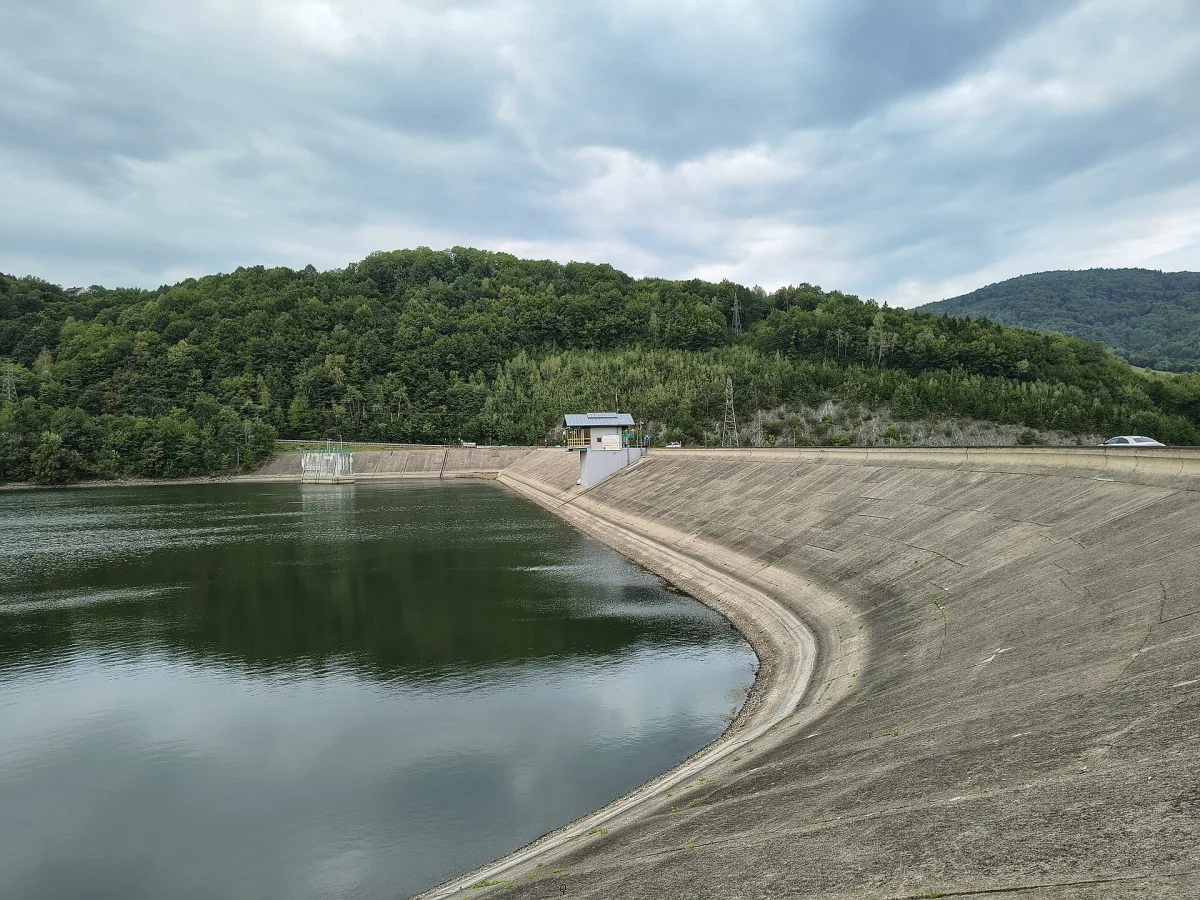
The reservoir is impounded by an earth dam 310 metres long. Its height is given as 38 metres or 39 metres above the valley floor, so it is better to stay with an approximation for this figure. The total capacity is 94.6 million m³, and the maximum length of the lake at the normal impoundment level reaches 6.6 km. The reservoir serves flood protection, energy production, tourism and the regulation of inflows to the upper Vistula.
What ended up under the water
The sources do not agree on the list of flooded localities. Some name Zarzecze, Tresna, Zadziele and Stary Żywiec. Others speak of whole or partial areas of Moszczanica (the hamlet of Rędzina), Oczków, Pietrzykowice, Zadziele, Zarzecze and Żywiec itself, and do not name Tresna. What is known, then, is that whole villages and parts of others ended up under water, but an exact list cannot be given in one sentence.
Best described is Stary Żywiec. Until 1929 it was a separate village and the seat of a municipality, and was then incorporated into Żywiec. At the time of incorporation it had 84 houses and 720 inhabitants. About 200 farms ended up under water there.
Resettlement, the cemetery and the church
Earthworks began in 1959, preceded by the resettlement of residents. Buildings, land and trees were valued, and expropriation hearings took place in one of the houses on Kościelna Street. Those who could not build new houses themselves lived mainly in blocks put up by the company building the reservoir, on the XX-lecia PRL estate in Żywiec. Others ended up on other estates in Żywiec, and some took plots on Grapa hill in the Sporysz district, where the Church of Christ the King stands today. Some people moved to Jaworze, and a few families each to Kozy and Pruchna. Some of the expropriated considered the compensation disproportionately low in relation to the value of the properties they were leaving. In return for the closed school in Stary Żywiec the company built new schools in Żywiec and in Zarzecze.
In 1963 burials from the Stary Żywiec cemetery were moved to the Transfiguration of the Lord cemetery. The wooden chapel of St Vitus was demolished in 1964, because the water reached its foundations, but the spring of St Vitus was preserved and moved higher up the slope. The Gothic All Saints church, the first seat of the Żywiec parish, burned down during the fighting for the town in 1945, and its remains were flooded along with the whole area. In 2012 a wooden tabernacle thrown up by the water was found on the lake shore. Researchers dated it to the 19th century and regarded it as a probable part of the furnishings of that church.
The dates are also given differently: the reservoir was created in 1966 and put into use in 1967. In 2015, during a drought, the water level fell and exposed parts of the bed. Some sources speak of a drop of about 2 metres, others of several metres and of the temporary exposure of fragments of the flooded localities.
Wilczy Jar: the trace of the tragedy of 1978
One of the most painful events in the history of the region is linked to the lake. On 15 November 1978, early in the morning, two buses carrying miners to the Brzeszcze mine slid from a height of 18 metres into the water at Wilczy Jar near Oczków. 30 people died and 9 survived. A commemorative plaque stands by the bridge. We describe this place in a factual way, because the memory of that night is part of the history of the lake.
The dam in Porąbka and the lake at the foot of Żar
Higher up the Soła lies Międzybrodzie Lake, older by more than thirty years. The dam at Międzybrodzie Bialskie was built in 1928-1937, and the name Porąbka Dam came about because the construction management was based in neighbouring Porąbka. It is a gravity dam, about 37 metres high and 260 long. It was designed by Prof. Gabriel Narutowicz and the engineer Tadeusz Baecker, and built by the Société Franco-Polonaise of Warsaw.
The sources give the date differently: according to some the lake was created in 1937, while others mention a ceremonial handover of the reservoir and dam on 13 December 1936, in the presence of Deputy Prime Minister Eugeniusz Kwiatkowski and the Marshal of the Sejm Stanisław Car. The reservoir has a capacity of 26.6 million m³ and is about 5 km long, and on its shores lie the holiday villages of Międzybrodzie Bialskie and Międzybrodzie Żywieckie. The hydroelectric power station at the dam was built in 1951-1954.
The power station in the mountain
Above the lake rises Żar, and inside it operates the Porąbka-Żar Power Station, regarded as the second largest pumped-storage power station in Poland and the only underground one. The first hydro set was synchronised with the grid on 6 January 1979. The idea of a Polish pumped-storage power station arose as early as the pre-war years, and one of the first to propose it was Gabriel Narutowicz, who supervised the design of the dam, although he did not specify a location. The upper reservoir, entirely artificial and with no natural inflow, holds 2.3 million m³ of water, and the lower one is Międzybrodzie Lake. The chamber with four turbine sets, each with a generator output of 125 MW, was hollowed out in the rocks of the Carpathian flysch, and water flows down to it through two adits 872 metres long. The construction of the upper reservoir forced the relocation of the gliding field from the summit to the lower slopes, where it still operates.
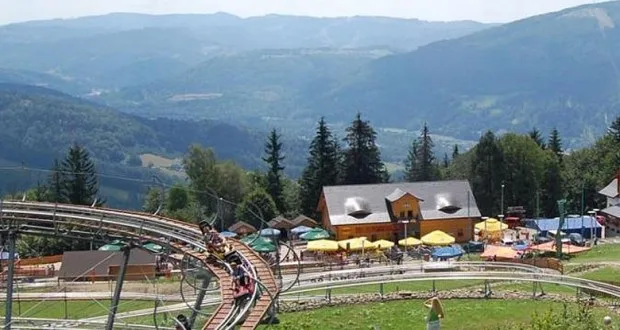
On the southern slope of Żar there is now a ski resort, and in the mountains above the lake stands the tourist and retreat house at Chrobacza Łąka, a former mountain hut from the 1930s. Lower down the Soła lies also Czaniec Lake, a drinking-water reservoir on which water sports are prohibited.
What to see after reading
The history of the flooded villages helps in understanding the area. In the Żywiec City Museum you will see the history of the town and the region, and on Grapa hill the Grapa nature reserve protects a woodland of oak-hornbeam forest. The remaining lakes of the voivodeship are covered in a separate overview of reservoirs.
Be the first! Add a comment.
You need to log in to add a comment.
Log in