
A miner going down into a mine had many reasons to be careful: gas, water, fire, rockbursts. In the stories told underground these dangers also had their master. He was Skarbnik, the spirit of the underground, spoken of across Upper Silesia and far beyond. Below we separate what the tales relate from what can be pointed to as fact.
Who Skarbnik was according to the tales
Skarbnik is a figure from Slavic belief: a spirit inhabiting the underground, especially mines, who guards the earth's resources and the treasures buried in it. He was also said to be the ruler of an underground realm, to which he took the souls of miners killed at work. In Cieszyn Silesia he was called Pustecki.
Most often he appeared as an old, bearded miner with a small lamp in his hand. The tales also give him other forms: a goat, a horse, a dog, a mouse, a frog, a spider or a fly. He could also be invisible, and a miner might sense his presence or hear knocking.
Protector and stern judge
According to the tales Skarbnik was kindly disposed towards people. He warned of rockbursts, flooding and fire, and he could befriend the hard-working. The lazy, dishonest, stingy and those who cursed in the mine, however, he treated sternly and vengefully. A guide at the Guido Mine put it in modern terms: Skarbnik is the old equivalent of a health and safety inspector, who disliked miners making noise below, swearing, whistling or singing. There is a sensible core in this story: underground, noise and carelessness could indeed cost lives, so the prohibitions attributed to the spirit enforced ordinary caution. That is, however, our interpretation, not something the sources say.
Skarbnik in Tarnowskie Góry
The most famous Silesian story about Skarbnik is tied to Tarnowskie Góry. According to the tales, around 1490 a peasant named Rybka ploughed up a lump of silver-bearing ore in a field. The legend says that Skarbnik then appeared and, in return for looking after the miners, demanded from the peasant the whole of the first yield. He was supposed to have hidden the lumps in various corners of the town.
Here legend should be separated from record. Rybka, as the finder of the ore, was noted in 1612 by Walenty Roździeński in his work Officina ferraria. The quoted passage speaks of a peasant named Rybka and of ore, not of Skarbnik. The spirit motif appears in the versions of the legend retold today.
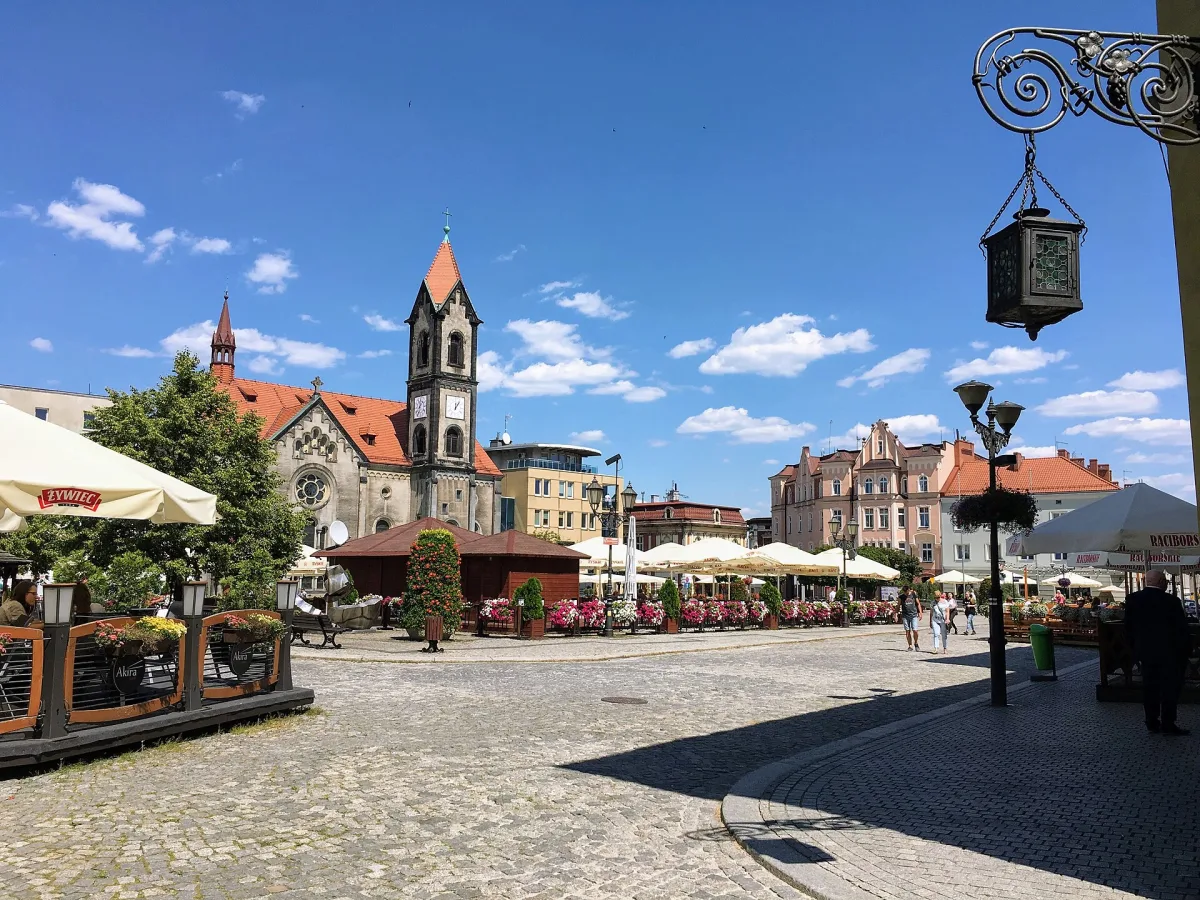
The historical background is well documented. Tarnowskie Góry arose as a mining settlement in 1526 and from the 16th century was a centre for the extraction of silver, lead and zinc, as the Polish Press Agency (PAP) writes on the dzieje.pl portal. Beneath the town runs a labyrinth of galleries, excavated chambers and drainage adits, part of which can be visited in the Black Trout Adit. The history of the town and of mining is presented by the Museum in Tarnowskie Góry.
Skarbnik in the procession and in the tourist mine
To this day Skarbnik is a regular character at Gwarki, the Tarnowskie Góry festival. In the procession walk the peasant Rybka with a cow, Skarbnik, King John III Sobieski and other figures linked to the town's history. The first Gwarki were organised in 1957 on the initiative of local history enthusiasts. They refer to the miners' holiday celebrated on 16 July, commemorating the rediscovery of silver-bearing ores in 1784.
He can also be met in Zabrze. The Guido Coal Mine Heritage Site, operating on the basis of a mine from 1855, introduces the figure of Skarbnik in its tour for children, who, as the guide says, may frighten them a little, but also warn them and talk. A figure of Skarbnik also appeared in Katowice as part of the Ślonski Godki Trail, a series of small outdoor sculptures of characters from Upper Silesian belief, opened in September 2017. The trail lasted one day, because on the next day most of the figurines turned out to have been destroyed or stolen.
Why the story survived
Skarbnik remained in legend because the miner's craft revolved around danger for centuries. A spirit who punishes recklessness and rewards diligence gave order to the imagination of people working in the dark. Another strand of mining tradition, Barbórka (St Barbara's Day, the miners' holiday), has a separate article in this section.
Be the first! Add a comment.
You need to log in to add a comment.
Log in