
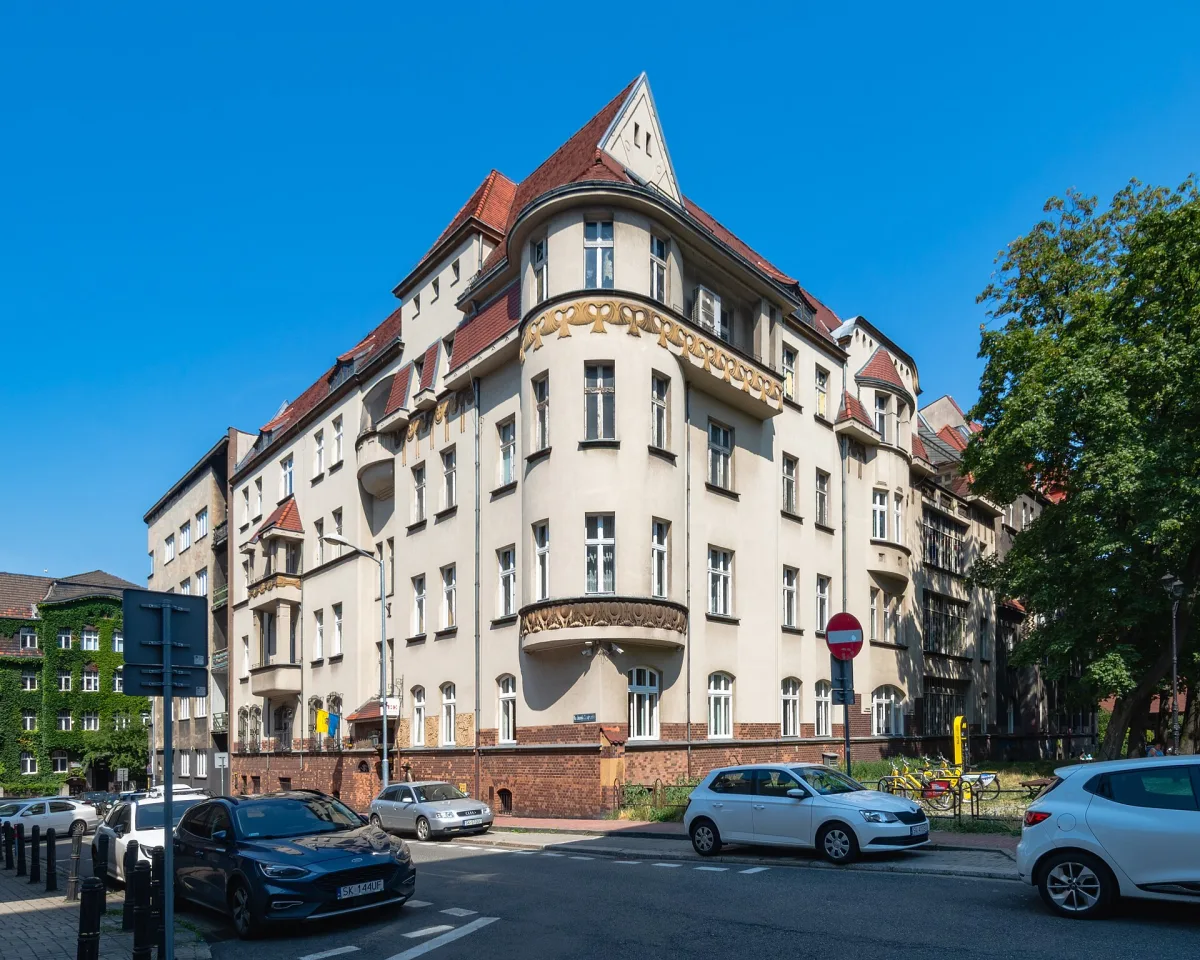
A wooden church can be taken down log by log and put back together somewhere else. In Silesia this was done for various reasons: to save a building from destruction, to give a church to a new housing estate, to turn it into a museum exhibit, or simply because the faithful bought it as firewood. Below are nine such moves, from 1938 to the end of the 20th century, together with what the sources say about them and where the sources disagree.
The first move: from Syrynia to Katowice
St Michael the Archangel's Church in Kościuszko Park is the oldest surviving building in Katowice, although it originally stood in Syrynia near Wodzisław Śląski. It was probably built in 1510. The date was given by the German art historian Hans Lutsch, who relied on a year carved into a beam that no longer exists. This is the only basis, because no documents about the building of a new church in the 16th century have survived, so 1510 may have meant only an enlargement or renovation of an older church. The first wooden church in Syrynia is said to have been built in 1305.
Two things decided the move. The parish in Syrynia became independent in 1925 and was building a new church, and it sold the old one to the city of Katowice. Earlier, the church had been saved from demolition by a visit from Emperor Wilhelm II in 1913: after returning to Berlin, the emperor ordered that the wooden church in Syrynia must not be pulled down if a new one were built. In August 1938 the church was carefully dismantled and re-erected in Katowice on the site of the Bismarck Tower of 1903. The tower had been demolished in 1933, and its fragments were used in building the Cathedral of Christ the King. The church was consecrated on 11 June 1939.
The idea came from Tadeusz Dobrowolski, director of the Silesian Museum, which was then under construction, and a conservator of monuments. He wanted to create a gallery of Upper Silesian timber architecture in the city. Next to the church stood a granary from Gołkowice and a 17th-century barn, which were meant to be the seed of an ethnographic park. The plan was interrupted by the war, and Dobrowolski was arrested. The church remained, retaining about 35 per cent of its original materials. Since 1997 it has been a branch of the Katowice History Museum and also a parish church. Inside there is a Baroque pulpit from the 17th century and a late Gothic sculpture of the Madonna from Dębieńsko.
The open-air museum as a destination: the church in Chorzów
Dobrowolski's idea returned after the war in a different form. As early as 1928 Dobrowolski had declared, in a letter to the Church authorities, the creation of an institution to which the most valuable and endangered wooden churches, a burden on their parishes, would be moved. The idea of an open-air museum was revisited in the early 1950s, and the Upper Silesian Ethnographic Park in Chorzów was officially established in 1974.
St Joseph the Worker's Church stands in the Upper Silesian Ethnographic Park after two moves. It was built in 1791 in Nieboczowy on the Oder in Wodzisław County, as an enlargement of a chapel from 1380. In 1971 it was moved to Kłokocin, a district of Rybnik, and since 1995 it has stood in Chorzów. It was consecrated on 28 September 1997. The original furnishings have not survived, so the present ones were gathered from various churches: the 18th-century high altar comes from a burnt church in Moszczenica, and the 19th-century patron's pew once stood in the church in Wisła Wielka.
A new estate, an old church: Jastrzębie-Zdrój and Kaczyce
Two churches connected with Jastrzębie-Zdrój show how the moves resulted from changes after the war. In both cases a new brick church was built in the original village, and the wooden one lost its caretaker.
The Church of St Barbara and St Joseph is the oldest church in Jastrzębie-Zdrój, built in the first half of the 17th century in Jedłownik, today a district of Wodzisław Śląski. Jedłownik is mentioned in the Peter's Pence register of 1447. The original patron was St Mark the Evangelist, and Barbara became patron only after 1678, when a new high altar dedicated to her was installed. In 1949-1952 a new brick church was built in Jedłownik and the wooden one fell out of use. A tradition from 1849 says that the year 1345 was carved into one of the beams, which would make the church much older. This has not been confirmed by any research, and the heritage register dates the building to the 17th century.
In the 1960s mines and housing estates were being built in Jastrzębie-Zdrój. The first of them, Przyjaźń, had about three thousand residents, who belonged to the parish on the Zdrój estate. An expert report of 1974 found fungus in the structure and a leaking roof, so the move was carried out quickly. The foundation stone was blessed on 8 July 1974, the work was finished in December, and the consecration took place on 3 December 1974. The timber frame and shingles were made by specialists from Żywiec. Because of the slope of the ground, the building was given a basement.
The Church of the Exaltation of the Holy Cross in Kaczyce came to its village from the neighbourhood of Jastrzębie. As the church of St Bartholomew it was built before 1620 in Ruptawa, today part of Jastrzębie-Zdrój, on the site of an older church mentioned in 1447. In Ruptawa a new brick church had stood since 1949, and there was no money to repair the old one. Meanwhile, the Morcinek mine was planned in Kaczyce, and the village had no parish of its own. The residents asked for the wooden church to be moved, and consent was given by the Katowice voivode and the Voivodeship Conservator of Monuments. It was dismantled and rebuilt in 1971-1972 with minor changes, without the bell turret and with a reduced belfry room in the tower. It was consecrated on 25 June 1972, already under a new dedication.
Two churches in Rybnik
There are two relocated churches in Rybnik. St Lawrence's Church in Ligota-Ligocka Kuźnia was built in 1717 by the carpenter Jakub Siedlaczek of Gliwice, originally in Boguszowice. It has stood on its present site since 1975. The most valuable item is a painting by Michael Willmann from 1685 showing the martyrdom of St Lawrence, which was moved in 1810 from the Cistercian church in Rudy. At Christmas a nativity scene with 13 moving figures is set in motion.
A year younger is the Church of St Catherine and Our Lady of the Rosary in Wielopole. It was built in 1534 in Gierałtowice, funded by Stanisław Dąbrówka, and in 1976 it was moved to Rybnik. It is regarded as one of the oldest monuments of timber architecture in the Rybnik region. It preserves a patron-saint polychrome from 1534, discovered during renovation in 1960-1961.
The Beskids: churches from Upper Silesia and from Jaworzynka
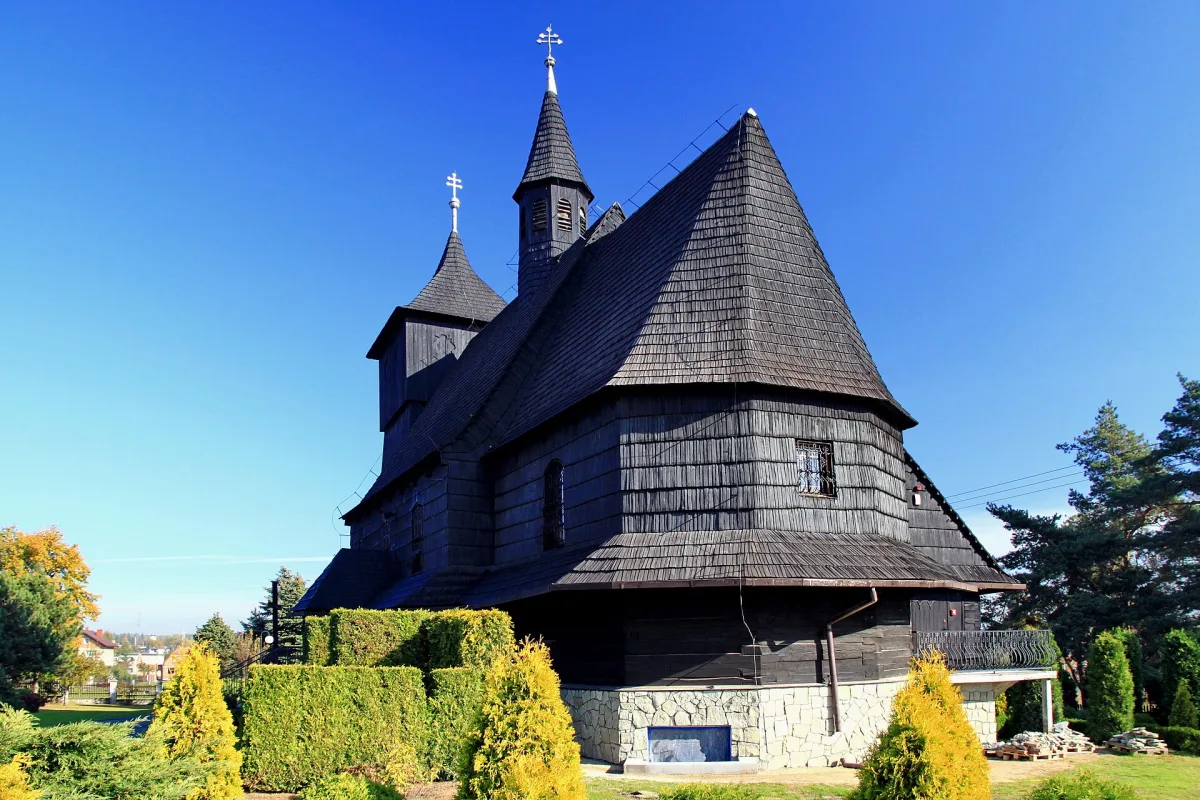
The Church of the Exaltation of the Holy Cross on Kubalonka travelled the longest way: from the Gliwice area to the Silesian Beskids. It was built in 1779 for the parish in Przyszowice near Gliwice, where it was a cemetery church. In January 1945 artillery shells destroyed the roof, the nave with the tower and the polychrome, and the faithful rebuilt the church in 1947-1949. By a letter of 7 August 1957 the diocesan curia in Katowice ordered it to be handed over free of charge to the parish in Istebna. In the autumn of that year it was dismantled and, before winter, put together on Kubalonka, and it was brought into use in 1958.
The communist authorities did not allow it to be fully used for liturgical purposes. Until 1967 it housed an exhibition of sacred art from Upper Silesia, a rectorate was established in 1971, and since 1983 the church has been a parish church. The Baroque high altar from 1779 and a pulpit from 1697 with reliefs of the four Evangelists have survived.
Not far away stands a second relocated church, St Joseph's in Mlaskawka. In Jaworzynka-Trzycatek a stone chapel of Our Lady of Frýdek was built in 1866, and in 1947-1948 the residents erected a wooden church there as thanks for surviving the war. In 1997 it was dismantled, moved to Mlaskawka and on 24 May of that year consecrated as the church of St Joseph. In Trzycatek a new brick parish church was built on the site of the wooden one. The reliefs of the Stations of the Cross and the tabernacle were made by Jan Krężelok of Koniaków. The roof, formerly shingled, was later covered with corrugated sheet metal.
A hunting chapel turned into a church
The most modest of these stories is the one from Pawełki in Kochanowice municipality. The Church of Our Lady of Fátima was built as the chapel of St Hubert beside the residence of Count Ballestrem in the Brzoza woodland. In 1956 the local people bought the chapel from the state as firewood, carried it to Pawełki and put it together again on a private plot. It continued to serve religious purposes, and in 1982 it was formally recognised as a filial church of the parish in Kochanowice. Today it belongs to the parish in Lubecko. The log construction made of round logs has prominent projecting log ends of varying length, and the tiled roof is topped by a bell turret.
What the moves have in common
In several cases the reason was the same: a parish received a new brick church, and the old one lost its caretaker. The move ended with the building being recreated with minor changes, under a new dedication or with a new function. All the churches described except the one in Chorzów are active places of worship, so check opening hours for the interior with the parish. The church in Chorzów is visited on open-air museum terms.
Be the first! Add a comment.
You need to log in to add a comment.
Log in