
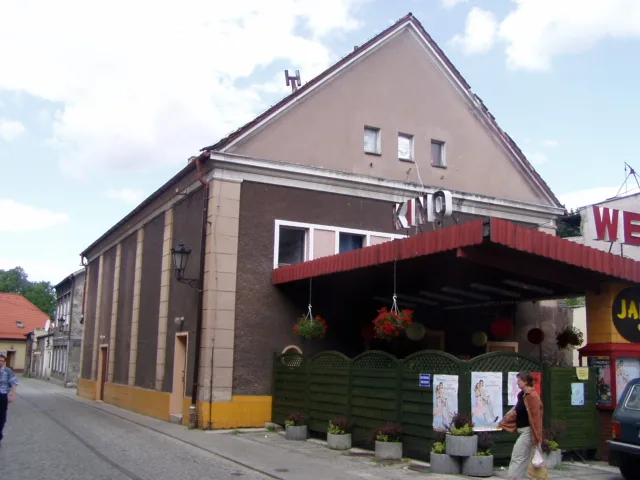
Some synagogues in the Silesian Voivodeship survived the war as buildings, but after 1945, in the face of the Holocaust or the departure of Jewish communities, they did not return to their former role. They were turned into cinemas, cultural centres, fire stations, warehouses, residential houses and shops. The change of function often obliterated the interiors and facades, and sometimes only a plaque, the layout of the hall or a single detail recalls the original purpose.
Cinemas in former synagogues: Pszczyna and Żory
The synagogue in Pszczyna was opened on 21 September 1835 on the site of a house of prayer founded in 1765. At the beginning of the war the building was set on fire, but the fire was quickly put out. In 1941-1942 it was rebuilt as a cinema: the old openings were bricked up, new ones were cut, and the entrance was moved to the east wall. After the war the cinema continued to operate under the name Wenus, and of the original decoration two pilaster capitals on the west wall survive. Its later history is described in the entry on the synagogue in Pszczyna.
The synagogue in Żory, built in 1830-1835 on Kościuszki street, was devastated by the Germans during the war. After 1945 it was rebuilt as the Znicz cinema. In the 1980s the building stood empty, and in the early 1990s the cinema resumed operation as Vega, and later under the name Na Starówce. A thorough renovation began in October 2007 (the former synagogue in Żory).
In Wodzisław Śląski the synagogue of 1826 was closed already in the interwar period, because there was no Jewish community in the town. In 1938 it was bought by the Union of Silesian Insurgents and converted into the Insurgent's House (Dom Powstańca). During the war the Czar cinema was housed here, contrary to an earlier agreement to respect the building as a former place of worship. The later commercial functions and the form of the building are described in the entry on the synagogue in Wodzisław Śląski.
A cultural centre, a church community house, a fire station
The synagogue in Żarki, built around 1870 on the initiative of progressive Jews, returned to culture most fully. Devastated during the war and damaged in a bombing raid, in 1954-1957 it was rebuilt for the needs of the Municipal and Commune Cultural Centre, which is housed there to this day. The building was then extended to the east and the front wall was altered. It was restored in 2009-2011 with EU funding; the layout of the main hall with the women's gallery above the vestibule has been preserved. Details are given in the entry on the synagogue in Żarki.
In Mysłowice the synagogue built in 1826 on Mieroszewskich square was sold, after a new, larger synagogue was erected, to a furniture company. In 1927 it was bought by the Catholic parish of the Sacred Heart of Jesus, and in 1928 it was adapted as a Catholic Community House. The clearest trace of its former function is the wooden women's galleries running around the hall on three sides (the synagogue in Mysłowice). In the Brzezinka district the synagogue of 1910-1911 was sold in 1922 after the branch of the community was dissolved; it then served for meetings of Silesian insurgents and as a residential house, and the ornamental gable of the facade has been preserved (the synagogue in Brzezinka).
In Bieruń a 19th-century Reform house of prayer was devastated by the Germans, and in the 1950s it was turned into a fire station. Renovations in 1973, 1981, 1985 and 2006 gradually obliterated the original architecture (the synagogue in Bieruń).
Warehouses, residential houses and buildings with no new use
A residential house saved the synagogue in Miasteczko Śląskie. After the community was dissolved in 1923 the building of 1863 was sold to a private buyer and converted into a house, thanks to which it survived the occupation, although it is heavily altered (the synagogue in Miasteczko Śląskie). In Sławków the brick house of prayer of 1896 was devastated during the occupation and used as a warehouse; after the war it housed the municipal cultural centre for some time, and on the wall there is a plaque in Polish and Hebrew (the synagogue in Sławków). In Szczekociny the synagogue from the early 19th century was converted after the war into a warehouse; a commemorative plaque was unveiled in 2009 (the synagogue in Szczekociny).
In Zawiercie the house of prayer of 1880 was devastated during the occupation and rebuilt several times after the war, so it lost its original appearance. The building's current function is worth checking before a visit (the synagogue in Zawiercie). The synagogue in Krzepice on the Liswarta, devastated by the Germans, remained after the war a permanent roofless ruin; since 2016 it has belonged to the municipality (the synagogue in Krzepice).
A rediscovered hall in Będzin
A separate case is the Mizrachi house of prayer at Potockiego 3 in Będzin, founded at the end of the 19th century by the merchant Jakub Chil Winer. It was probably the only Będzin synagogue to survive the war undamaged. After 1945 the hall was divided by a partition and a coal store and junk room were set up in it, and the place fell into oblivion. On 6 July 2004 members of the Dąbrowa Basin Centre of Jewish Culture entered the interior and found paintings by Altek Winer, including a full cycle of the signs of the zodiac. After a five-year conservation renovation the building was opened in early 2012 (the Mizrachi synagogue in Będzin). The rules for visiting are given by the institution running the building.
Be the first! Add a comment.
You need to log in to add a comment.
Log in