
Three villages, one mountain neighbourhood
Istebna, Jaworzynka and Koniaków lie in the upper part of the Silesian Beskids, on the border with the Czech Republic and Slovakia. They are customarily called the Beskid Three Villages (Beskidzka Trójwieś). They are among the youngest settlements of Cieszyn Silesia and also the highest-lying in the Silesian Beskids, with Koniaków regarded as the highest-lying village there. The first settlers came here from western Upper Silesia, and Vlach shepherds settled alongside them. Pastoralism was the residents' basic occupation until the middle of the 19th century, hence so many cottages, shepherds' instruments and stories of mountain huts in these villages.
None of the three villages has a large museum with a building and a ticket office. Instead there are regional rooms, private collections and studios, run by families and associations, often in the very cottages where people once lived. Several of these places are visited by prior arrangement, so it is worth starting the day's plan with a phone call, not with the car.
Istebna: the Kawulok cottage and artists' studios
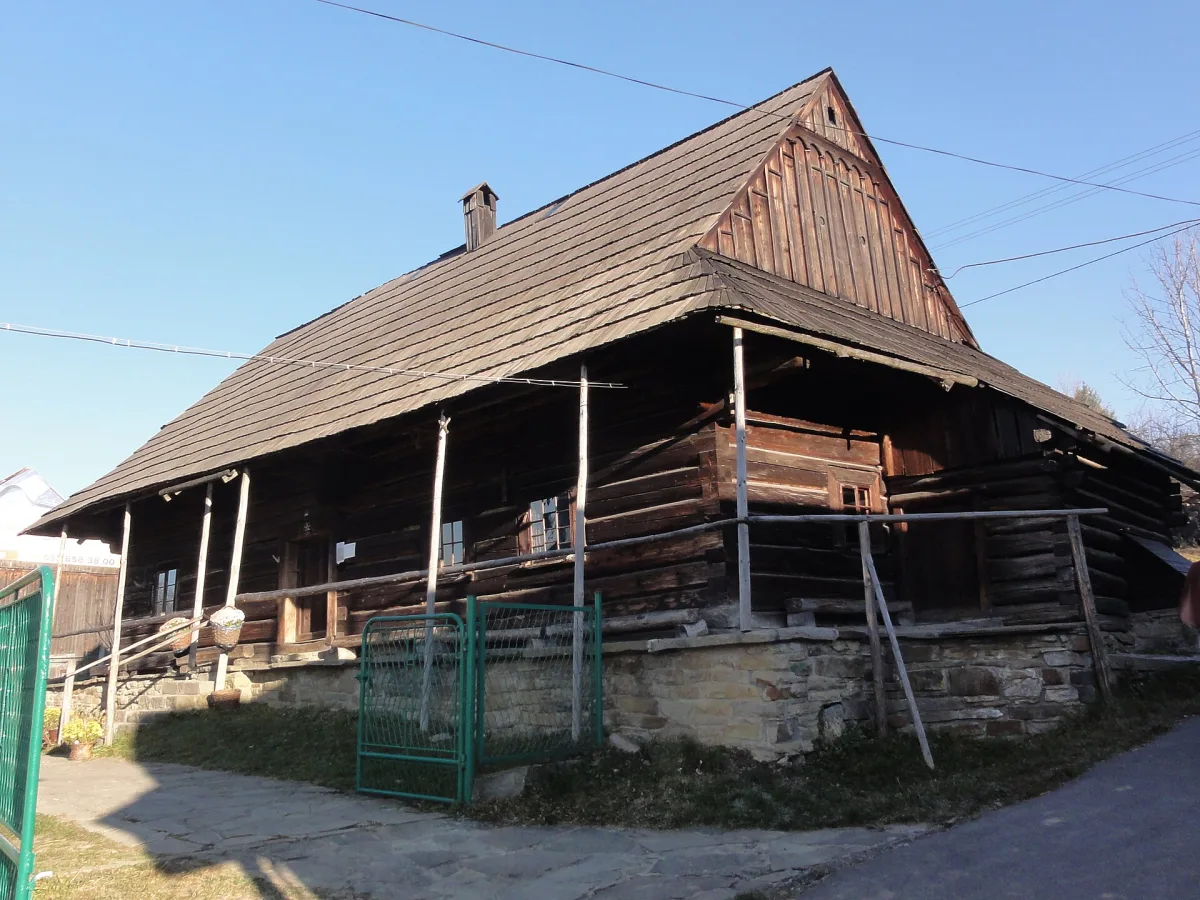
The Kurna Chata Kawuloka (Kawulok smoke cottage) stands in the hamlet of Wojtosze. It is a wooden highlander cottage from 1863, belonging to the Kawulok family. The regional room was founded by Jan Kawulok, a regionalist, maker of folk instruments and storyteller. After his death in 1976 it was run by his daughter Zuzanna, a populariser of the traditions of the Beskid highlanders, until her own death in 2018. In one of the rooms stands a “kurlawy” stove, also called “kurny”: a stove without a chimney, from which the smoke went straight into the room. Hence the name of the smoke cottage and the black room. The full furnishings of an old house are shown here, from furniture and household items to farm tools, and the cottage also runs workshops, including lace-making.
On the same Andziołówka, in a studio from 1922, is the Jan Wałach Museum, devoted to the graphic artist and painter, a master of the woodcut. Nearby, on Bucznik, is the Konarzewski Family Museum and Gallery, a family collection of paintings and artworks created by deceased and living members of the family of artists. A votive chapel of the Konarzewski family from 1923 survives nearby. Two Istebna artists, Ludwik Konarzewski and Jan Wałach, also made the polychromes in the nave of the parish church, in 1928-1929.
A completely different story is told by the Jerzy Kukuczka Memorial Room in the hamlet of Wilcze. Kukuczka was born in Katowice, but his family comes from Istebna. He was the second person in the world to climb all fourteen peaks above eight thousand metres, and he died on 24 October 1989 on the south face of Lhotse. The room was opened in 1996 in a house that he bought from the family. You can see photographs from expeditions, climbing equipment, medals and books. It is a private museum and is visited by arrangement by telephone.
Jaworzynka: a highlander cottage and a museum of trees
The Na Grapie Regional Museum in the hamlet of Gorzołki was created in 1993 on the initiative of the writer and poet Jerzy Rucki. It was set up in a wooden cottage from 1920 that was moved here. In the room stands a smoke stove set on inverted spruce roots, used for drying herbs, and in a barn from the 1930s machines and farm tools are shown. Istebna costumes, everyday items, instruments and works by local artists have been collected here. The museum is run by the Friends of the Museum Society, which has a regional ensemble and a singing group. Workshops are held here: butter, bread and curd cheese by old methods, blacksmithing, embroidery and basket weaving. A trail through Jasnowice begins here and reaches further to Istebna, and then towards Kubalonka.
The Istebna Spruce Museum is an example of how a Beskid museum can tell the story of a forest. The institution has operated since 2001 at the Regional Gene Bank of the Istebna Spruce, which is part of the Carpathian Gene Bank run by the Wisła Forest District. The exhibition describes the history of Beskid spruce stands, the growth cycle of the Istebna spruce, a variety of the Norway spruce, and the characteristics of the wood from which, among other things, folk instruments are made. In 2002 a demonstration capercaillie aviary was created next to it, in which the birds are bred in order to be released afterwards in the Beskid forests.
Jaworzynka also has its tri-border point of Poland, the Czech Republic and Slovakia at Trzycatek. The name comes from an old customs post where a duty of one thirtieth of the value of goods was collected.
Koniaków: the lace that has its own museum
The Lace Museum in the hamlet of Szańce has the full name of Maria Gwarek Memorial Room. Maria Gwarek (1896-1962) was a Koniaków lace-maker and activist, on whose initiative a lace-making cooperative was founded in Koniaków in 1947. The museum was created in 1962, after her death. It has gathered bonnets, shawls, ruffs, collars, decorations for bed linen, curtains and doilies, and among the exhibits is an unfinished doily made of surgical thread that Maria Gwarek was making for the British Queen Elizabeth II.
The beginnings of Koniaków lace are described in two ways in the literature. The first records of lace as a decoration of bonnets date from 1883-1884, and it was taught in school after compulsory schooling was introduced in Austria in 1869. After that the versions diverge: according to one hypothesis the first doilies were made in Koniaków around 1906-1907, when Zuzanna Wałach saw them while in service at the Habsburg manor near Goleszów; according to the other, dated to 1900, she learned crocheting from her mother. What is certain is that in 2017 the traditions of making Koniaków lace were entered on the National List of Intangible Cultural Heritage. Its characteristic is that it is made without a template or pattern book.
From Koniaków it is convenient to set out for Koczy Zamek, a treeless hill (847 m above sea level) with a wide panorama. The name has two explanations. A legend tells of a Hungarian count Kocsi who was said to have had a small castle here. Franciszek Kotula, on the other hand, thought that the name was connected with the Hussite wars and the Hungarian word for a wagon, because the Hussite wagon-fort troops fortified themselves on bare hills with a ring of wagons.
Wooden churches along the way
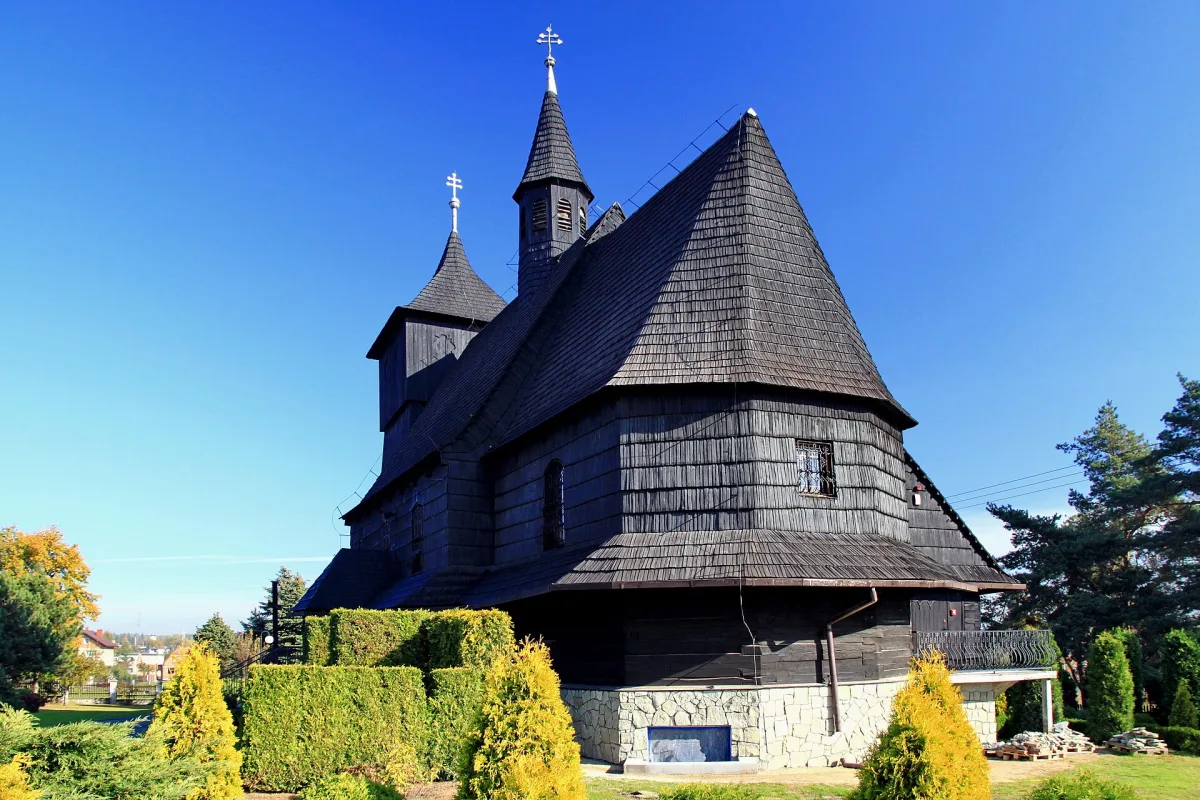
The museums of the Three Villages combine well with a short trail of wooden churches. St Joseph's Church in Mlaskawka was built in Jaworzynka-Trzycatek in 1947-1948, and in 1997 it was dismantled and moved to Istebna, where on 24 May 1997 it was consecrated again. The Church of Our Lady of Fátima on Stecówka was built as a chapel in 1957-1958. In the night of 2 to 3 December 2013 most of the church burned down, after which it was rebuilt in a similar shape and slightly larger dimensions. Both belong to the Wooden Architecture Trail of the Silesian Voivodeship.
Be the first! Add a comment.
You need to log in to add a comment.
Log in