
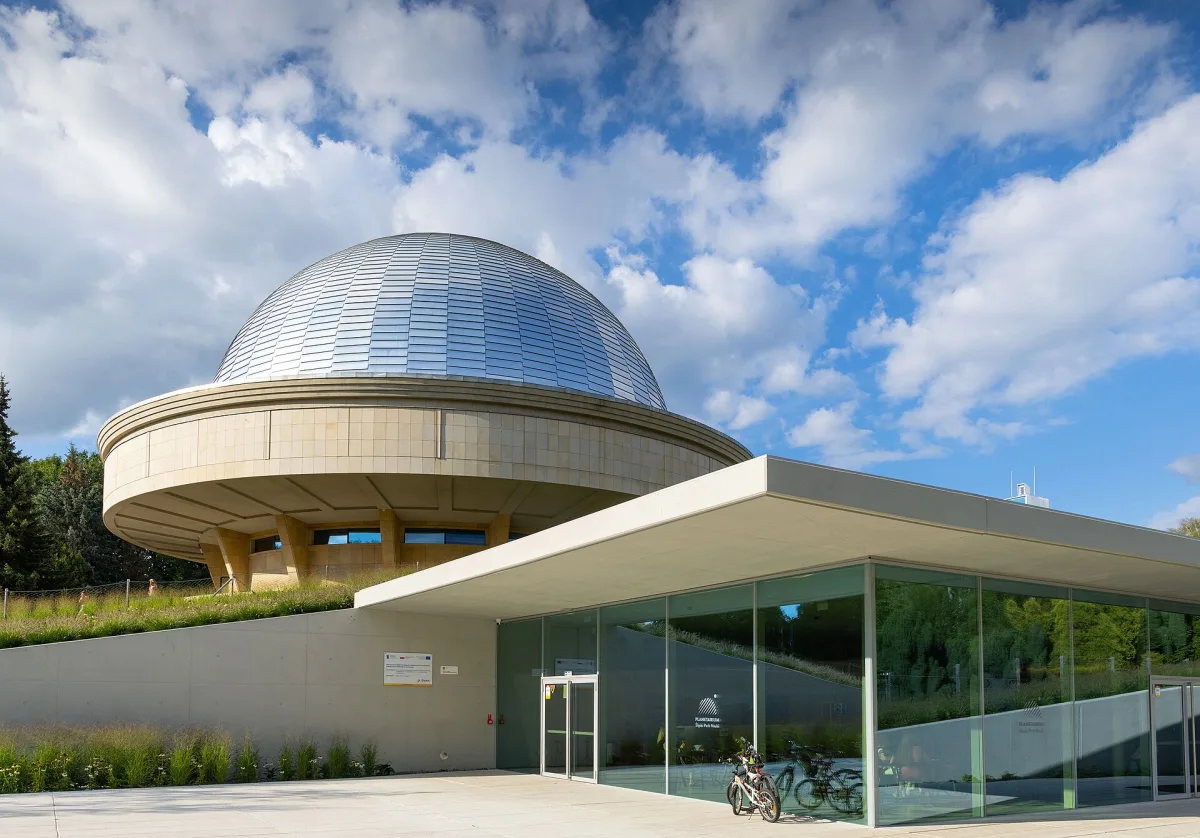
On the highest elevation of Silesian Park, called Góra Parkowa, stands a building visible from afar: a concrete dome 23 metres in diameter. This is the Silesian Planetarium in Chorzów. It is regarded as the largest and oldest planetarium and astronomical observatory in Poland, and the institution was founded on 4 December 1955. The history of the park in which it stands has a separate article in this section.
Built in the Copernicus Year
Construction began in 1953, to mark the Copernicus Year, and work lasted until 1955. The planetarium was built in the Provincial Park of Culture and Recreation, as today's Silesian Park was then called. The institution bears the name of Nicolaus Copernicus.
The design was by the architect Zbigniew Solawa. He was born in 1910 in Kraków, completed his architectural studies in 1940 at the Lwów Polytechnic, and from 1955 lectured at the Academy of Fine Arts in Kraków. In 1967 he settled in the Republic of South Africa and died there in 1987. Among his works are the housing estate on Aleja Daszyńskiego in Kraków and the Chorzów planetarium itself.
A monument since 2013
The building was entered in the heritage register in 2013. The object's card in our database describes it, following the register, as a concrete structure in the Socialist Realist style, dated to 1953-1955. The planetarium thus arose in an era in which architecture was linked with propaganda, while at the same time its task was purely scientific and educational: to show ordinary people the sky.
The Jena projector and the dome
In 1955-2018 the central instrument was a Zeiss projector from Jena, also called simply the planetarium or UPP, from the English Universal Projection Planetarium. It weighed more than two tonnes, and standing upright it was five metres tall. It reproduced the appearance of the sky from any place on Earth at any time, imitating the real firmament. The screen was the largest dome in the country, 23 metres in diameter, and the auditorium seated 300 people.
After the rebuilding, an analogue GOTO Chiron III projector works in the hall, which displays about 100 million stars on a spherical screen with an area of almost 800 square metres. It is complemented by a system of ten digital Sony projectors, showing moving images on the dome in True 8K resolution. On the horizon a reconstructed panorama of Katowice, Chorzów and Siemianowice Śląskie from 1955 has been placed.
Rebuilding and the observatory
The four-year rebuilding ended with a ceremonial opening on 11 June 2022. The planetarium was then transformed into the Planetarium - Silesian Science Park (Planetarium - Śląski Park Nauki). In an additional building, located mainly underground, there are interactive exhibitions on seismology, meteorology and astronomy. The project was developed by the Poznań studio Consultor. The old Zeiss projector was not consigned to oblivion: according to the object's card it now stands in the astronomy hall.
An observatory also operates in the complex of buildings. It has a 30-centimetre refractor, regarded as the largest in Poland. In December 2023 two new instruments were put into service: a PlaneWave CDK700 optical telescope with a mirror 70 centimetres in diameter, which replaced the telescope from 1955, and a Primalucelab Spider 500A radio telescope with a dish 5 metres in diameter, working at a wavelength of 21 centimetres. The radio telescope makes it possible to observe the Sun, the Moon and bright radio sources and to study the distribution of hydrogen in the arms of the Milky Way. A sundial, a climatological station and a seismological station also operate on the grounds.
A stamp and the surroundings
The planetarium has appeared on postage stamps: Poczta Polska issued one on 15 September 1966 in the Tourism series, and another on 29 June 2007 in the Polish Cities series.
A visit is easy to combine with a walk around the area. In the park there are also the Silesian Zoological Garden, the open-air museum Upper Silesian Ethnographic Park, the Rosarium, the park railway, the Elka cable car and the Legendia amusement park. Shows and exhibitions are described on the planetarium's website, because the programme changes more often than the walls.
Be the first! Add a comment.
You need to log in to add a comment.
Log in