
The Silesian Museum is now housed in a former mine, but the first museum of that name operated in 1929-1939 and never opened its own building. It was created by a resolution of the Silesian Sejm, and in August 1939 its most valuable collections were sent by train to Lublin. The museum's present home is described in a separate text about the Culture Zone.
From a society to a resolution of the Silesian Sejm
The museum grew out of a grassroots initiative. In 1924 the Society of the Museum of the Silesian Land was founded; it collected relics of Silesia's material and spiritual culture and intended to place them in schools until suitable premises could be found. In 1927 the Silesian voivode Michał Grażyński set up a Department of Art at the voivodeship office, and on 27 July of that year he appointed Tadeusz Dobrowolski as district conservator of monuments and head of the Silesian Museum. Sources date the beginning differently: the Wikipedia entry on the museum in Katowice takes the resolution of the Silesian Sejm of 23 January 1929 as the formal start, while the entry on the Upper Silesian Museum speaks of a museum established in 1927. The first purchases, for example Silesian and Kraków sukmana coats, date from 1927.
Dobrowolski's plan envisaged departments of natural history, prehistory, ethnography, old and contemporary art, the mining and metallurgical industry, and relics of the uprisings and the plebiscite. The voivode wanted the museum to set a monograph of Silesia against the background of a Polish national synthesis. The department of the mining and metallurgical industry was soon abandoned, while the gallery of Polish painting received, among others, works by Jan Matejko, Józef Chełmoński, Maksymilian Gierymski, Jacek Malczewski and Julian Fałat.
The museum opened to the public on 29 May 1930. At first the collections occupied the fifth floor of the Voivodeship Office building, 40 rooms in all, and attendance averaged 35,000-50,000 people a year. In 1931 the natural history department received six rooms in the building of the Silesian Technical Scientific Institutions. The resolution on which the museum was based was passed by the Silesian Sejm, whose building of 1929 stands on Silesian Sejm Square.
An open-air museum and a building of its own that never opened
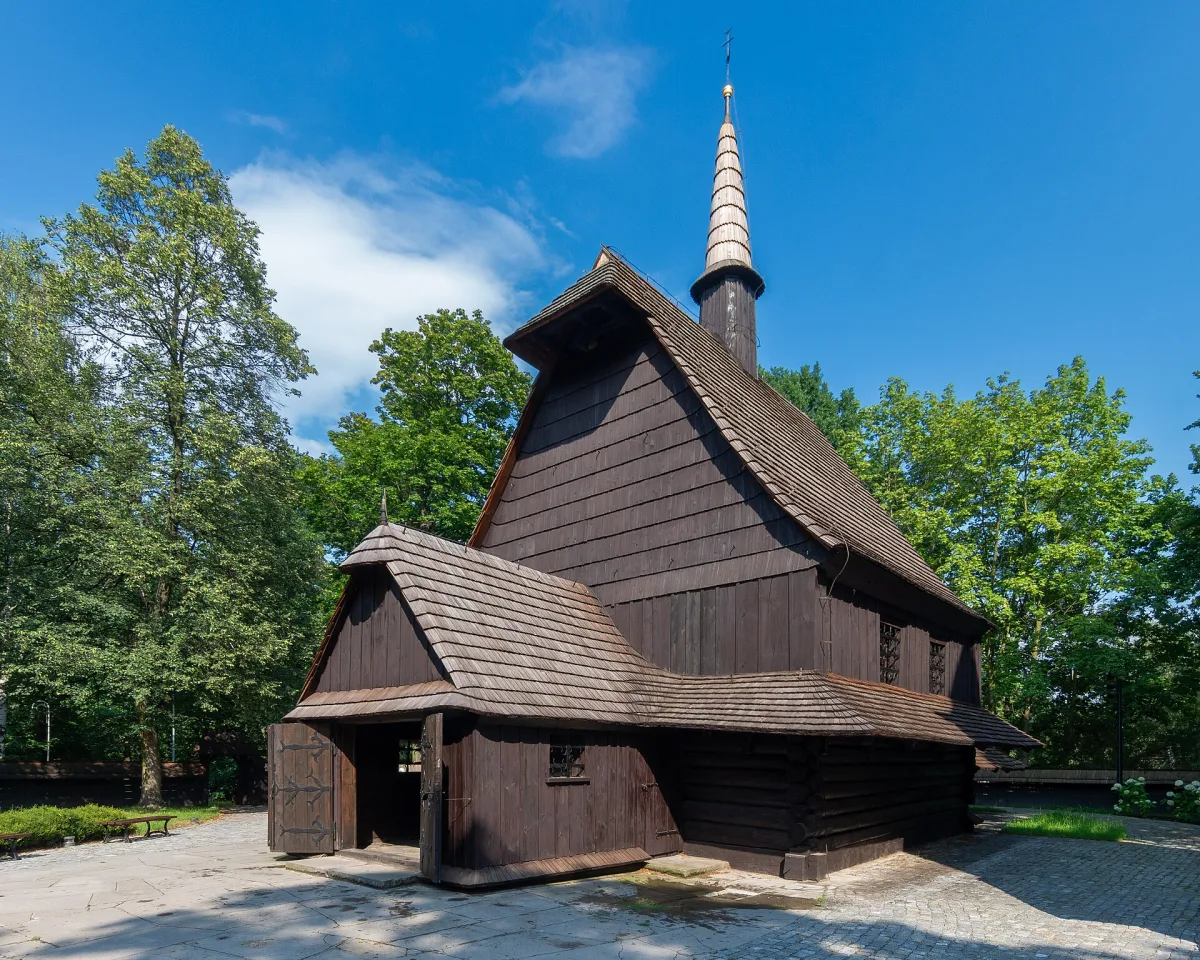
The museum also began to create a branch in the form of an open-air museum of an Upper Silesian village. One of the first exhibits was the wooden Church of St Michael the Archangel, moved from Syrynia to a hill in Kościuszko Park in 1938; the idea came from Dobrowolski. The church still stands there and is a branch of the Museum of Katowice History.
The rooms in the voivodeship office were too cramped, so the aim was a building of its own. An architectural competition at the beginning of 1930 did not produce satisfactory results. In 1934 the voivode instructed Karol Schayer to organise an architectural office, and on 8 August 1936 preparatory work began on the building site. The H-shaped building, with a seven-storey central block and two wings, was to have air conditioning and escalators, a novelty in Polish museum construction. The main works were completed in 1939, and the opening was planned for 1940.
In 1939 the collections numbered 100,000 natural history specimens, about 1,700 prehistoric items, 9,000 ethnographic items, 2,100 works of art and 5,000 photographic plates. The gallery of Polish painting held 280 paintings.
20 August 1939 and the fate of the collections
Before the outbreak of war, director Dobrowolski decided to evacuate the most valuable collections to Lublin. On 20 August 1939 crates containing Polish painting and guild art, together with all the documentation of the collections, were sent there by train and deposited temporarily in the Lublin museum. Further transports were to follow, but after 1 September only a small part of the exhibits arrived.
After the Germans occupied Katowice, the museum ceased to exist. Franz Pfützenreiter, director of the Provincial Museum in Bytom, became commissioner of the institution. The exhibits remaining in Katowice were taken to Bytom, and the collections from Lublin were brought there as well. They were crammed into small rooms without proper conditions, many were destroyed, and some became objects of trade. Among the losses are Maksymilian Gierymski's painting “Alarm in the Insurgent Camp” and works by Ślewiński, Siemiradzki, Witkiewicz and Wyczółkowski. The Bytom institution, today the Upper Silesian Museum, states that in 1943-1944 the most valuable collections, including those from Katowice, were evacuated to the western part of Upper Silesia, and that front-line fighting and looters completed the destruction.
The empty building in Katowice was first turned into a warehouse for furniture looted from Poles, and in 1941-1944 it was demolished down to the foundations. After the war a trade union building was erected on the site.
The return of the name and part of the collections
In 1945 Dobrowolski came to Katowice to revive the museum, but the communist authorities did not listen to him. The Upper Silesian Museum in Bytom was to tell the story of the region's culture. The Silesian Museum was restored only in December 1984, following initiatives from the Solidarity period, in the former Grand Hotel on Korfantego Avenue. In 1988 part of the pre-war collections returned from Bytom, including the most valuable collection of Old Polish painting, and in 1996 the ceramics, prints, drawings and decorative arts.
A sister institution also dates from those years: the Silesian Library began in 1922 as the Library of the Silesian Sejm. In Janów the Szyb Wilson Gallery shows contemporary art and organises a festival of naive art, and in the Culture Zone, where the museum is housed today, the NOSPR concert hall and Spodek are neighbours.
Be the first! Add a comment.
You need to log in to add a comment.
Log in