

Wałach: the graphic artist from Andziołówka
Jan Wałach was born on 8 August 1884 in Istebna, in the hamlet of Andziołówka, and died there on 30 June 1979. He studied at the School of Artistic Crafts in Zakopane (1902-1904), then at the Academy of Fine Arts in Kraków under Józef Mehoffer, Julian Fałat, Ferdynand Ruszczyc and Jan Stanisławski (1904-1908), and completed his studies in Paris. During the First World War he served in the 100th Infantry Regiment and was appointed regimental painter.
His greatest fame came from drawings and woodcuts in which he recorded highlander types, architecture, scenes from the life of a Beskid village and religious subjects. His work was shown in Kraków, Katowice and Warsaw, and for his woodcuts he received a bronze medal in Paris in 1937. He also designed stained-glass windows and decorated church interiors. After the Second World War he worked alone and forgotten, and a wider audience was brought back to him only by a retrospective exhibition in 1999.
Today his work can be seen in the Jan Wałach Museum on Andziołówka. The museum was founded in 2008 and is housed in the wooden building of his former studio, erected in 1922. Inside are easels, the artist's belongings, and paintings and prints from the years 1902-1979. It is a private institution, so check the visiting arrangements with the people who run it.
Bucznik: the settlement built by Konarzewski
Right next door, between Andziołówka and the Olecka valley, lies Bucznik. The name comes from the old beech trees that grew in the middle of the settlement. In 1922 the painter and sculptor Ludwik Konarzewski senior (1885-1954) began building a house and studio here. The symbolic date of the colony's founding is taken to be 3 May 1923, the feast day of the chapel of Our Lady Queen of the Polish Crown, which Konarzewski built as a votive offering for a safe return from tsarist exile in the Buzuluk area.
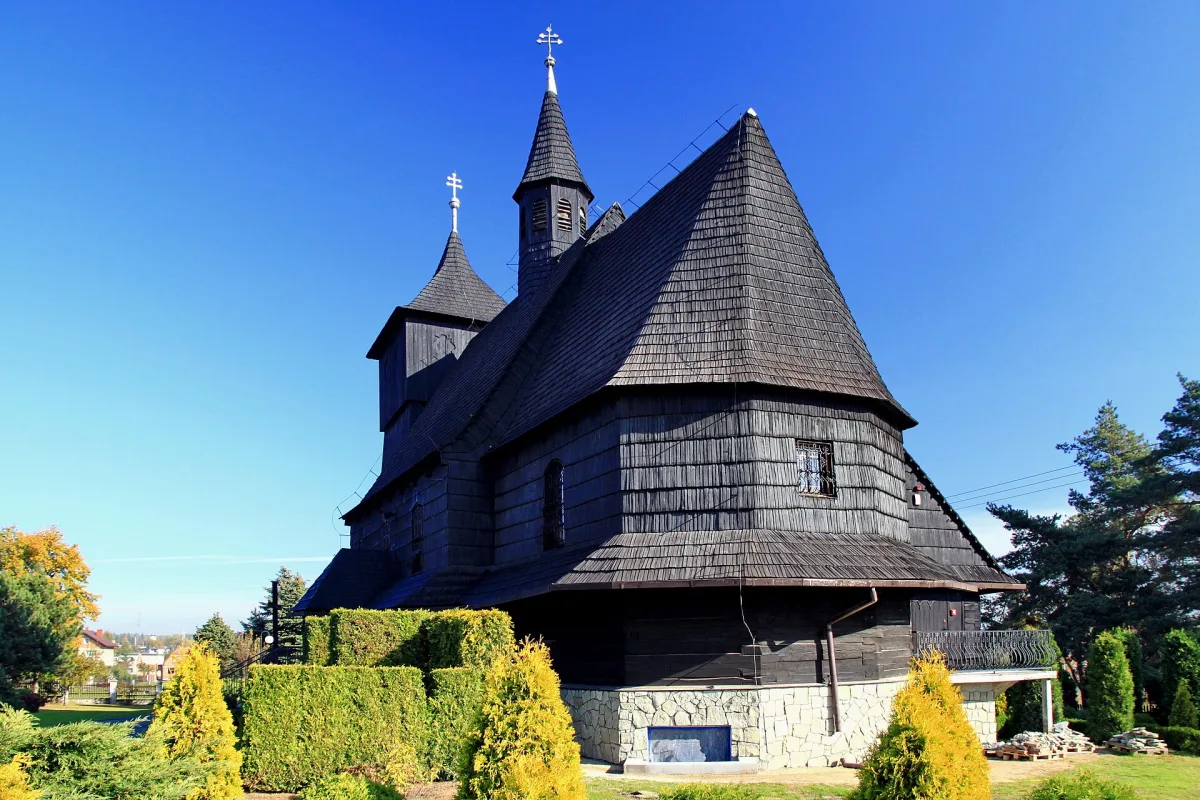
The chapel measures about 10 by 5 metres, is built of timber in log construction and is roofed with shingles. Its form draws on the traditional architecture of the Silesian Beskids and the Zakopane style. Inside stands a triptych altar carved by the founder himself: the Virgin Mary with the Child above the Piast Tower in Cieszyn. The chapel is a family property, so it is worth checking with the parish beforehand whether you can go in.
Beside the chapel the first guesthouse in mountain Istebna was built, also named “Bucznik”. Among its guests were the painter Julian Fałat, the physician Ludwik Hirszfeld, the writer Zofia Kossak-Szczucka, the writer Gustaw Morcinek, the activist Wojciech Korfanty and the composers Tadeusz Joteyko, Stanisław Niewiadomski and Feliks Nowowiejski. Konarzewski wanted to turn Istebna into a cultural and summer resort on the model of Wisła, or even Zakopane. At the house he gathered sculptures, paintings, regional costumes and a library, and his studios grew into an informal art school for young people. Thanks to the workshops, the guesthouse, the museum and the library, Bucznik came to be regarded as an artists' colony.
Shared work in the church
The paths of the two artists met in the parish church of the Good Shepherd in the centre of Istebna. After the extension of 1928-1929 its nave was decorated with polychromes by Jan Wałach and Ludwik Konarzewski. The high altar is Konarzewski's work, and the painting of Christ the Good Shepherd set in it, against the landscape of Istebna, was painted by Wałach. Konarzewski is the author of the polychromes depicting Hell and Heaven, and Wałach of the confession of the highlanders. Both are named as folk artists of Istebna. An article from 1937 titled “The village of two painters (J. Wałach and L. Konarzewski)” also exists.
There is one more connection: Fałat taught Wałach in Kraków and later stayed at the guesthouse in Bucznik. Wałach and Bucznik were, however, two separate studios in one village, not a joint artists' colony.
Bucznik after the war
During the Second World War the occupation authorities ordered the buildings of Bucznik to be demolished. Only the chapel survived, and most of the collections were looted, destroyed or dispersed. The family returned here in 1945 and resumed the activity of the art school, which operated until about 1960. In 1960 construction began on a brick house with a studio at number 596, to a design by the architect Stanisław Konarzewski. In 1980-1985 a wooden house at number 29 was built next to it, considered one of the first residential wooden buildings of a new generation in Poland.
Today the private Museum and Gallery of the Konarzewski Family operates here. It tells the story of Ludwik senior, his son Ludwik junior, junior's wife Joanna and other members of the family, including the ceramicist Maria Konarzewska-Wszołek and the composer Stanisław Konarzewski. Members of the family guide visitors around the gallery and the chapel, and a visit has to be arranged in advance.
What else to see nearby
From Bucznik it is about 800 m in a straight line to the Zagroń Istebna complex, and two kilometres further, towards the centre of the village, stands the Jerzy Kukuczka Memorial Room: the Memorial Room in Istebna. Folk tradition is shown by the Kurna Chata Kawuloka, a private ethnographic museum in a cottage from 1863. A few hundred metres from it rises the Evangelical church of 1927-1930. All these places are in one village, so it is worth planning a whole day for them.
Be the first! Add a comment.
You need to log in to add a comment.
Log in