
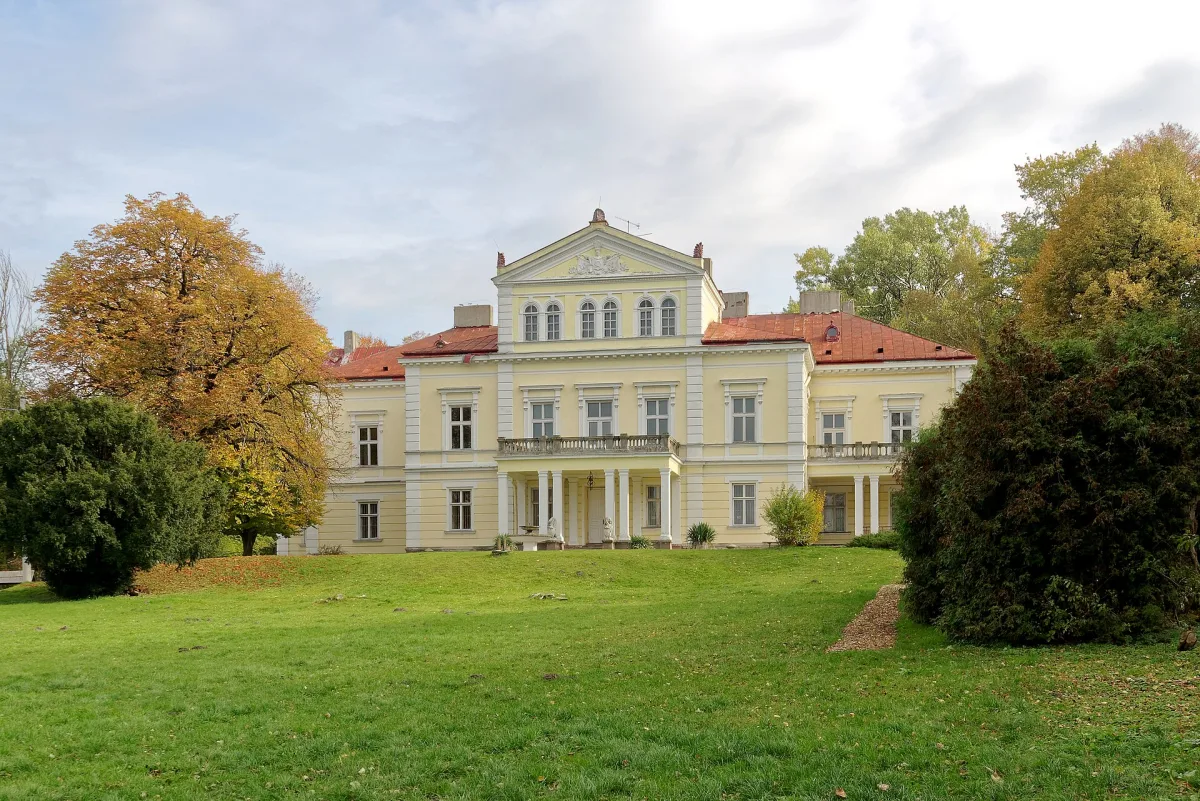
Złoty Potok lies on the Wiercica in Janów municipality, in the heart of the Kraków-Częstochowa Upland of the Jura. The first written mention of the village dates from 1153, and its former importance is shown by a stronghold site, a manor house and a church. Today the place is associated with a poet who gave names to the surrounding rocks, and with a tree older than most of the monuments in the area.
A village on the Wiercica
The beginnings of settlement on the Wiercica go back to the turn of the 8th and 9th centuries, when the fortified rock stronghold Osiedle Wały was built, one of the larger ones in the south of Poland. The first mention of the village of Potok in 1153 shows it as a metalworking centre. It probably received the epithet Złoty (“golden”) from the golden background of the coat of arms of the Potocki family of the Pilawa arms, who became owners at the beginning of the 13th century.
In the 16th century a manor house was built here, called the Zameczek (“little castle”). From 1851 the estate belonged to the Krasińskis, and in 1856 General Wincenty Krasiński built a Neoclassical palace on the site of the manor house. Later the estate passed to the Raczyńskis, who lived here until 1939. The Raczyński Palace is not open to visitors today and is in very poor technical condition.
Summer 1857: Krasiński and the rocks
From May to 20 September 1857 Zygmunt Krasiński, author of The Undivine Comedy and Iridion, lived in Złoty Potok with his wife Eliza née Branicka and their children. He occupied a small manor house built in 1827 or 1829 (the sources give both dates), next to his father's palace. During walks in the forests the poet gave names to the rock outcrops, and to the pond at the foot of the palace he gave the name Iridion.
The stay was cut short by tragedy: his youngest daughter Elżbieta died here. The girl was buried in the Raczyński chapel in the crypt of the church of St John the Baptist. The manor house today holds the Zygmunt Krasiński Regional Museum, opened in 2008 on the initiative of the municipality. Earlier, from 1985 to 2007, a biographical museum of the poet operated here, a branch of the Częstochowa Museum.
Which rocks exactly received names from Krasiński, the sources do not settle. Among the outcrops in the area, the Devil's Bridges, the Rock with a Cross and Twardowski's Gate are mentioned, but this is a list of rocks in the reserve, not proof of who named them.
The Dziad oak and the park by the river
The palace and the manor house are surrounded by an English-style park of almost forty hectares, designed by Franciszek Szanior. The Wiercica flows through its middle. Foreign species grow in it, among them Japanese larch, Turkestan elm and the American tulip tree. A natural monument is an oak of about 600 years, called Dziad (“the Old Man”). The age is an estimate.
Beyond the park begins the Parkowe nature reserve, established in 1957. The Wiercica rises from two springs in its eastern part, named Elżbieta's Spring and Zygmunt's Spring. A trout farm was also set up in the area, regarded as one of the first in Europe.
The organ in the church
The church of St John the Baptist dates from the 15th century, was originally Gothic, and is Neoclassical today. The organ case dates from the second quarter of the 17th century, and the organ itself from the turn of the 16th and 17th centuries, and it is regarded as one of the oldest working organs in Poland.
In the same village there is also the monument to Jan Kiepura, commemorating his childhood years in the nursery of Countess Raczyńska.
Be the first! Add a comment.
You need to log in to add a comment.
Log in