
In Silesia and its surroundings there are Marian shrines whose history begins with a single statue or a single painting. Four of them, in Leśniów near Żarki, Rychwałd near Żywiec, Hałcnów in Bielsko-Biała and in Szczyrk, share the fact that their cult grew out of a legend, a roadside chapel or a gift from a powerful founder. Outside this set there are also Piekary Śląskie and Pszów, known much more widely. Below, each of the four centres is treated separately, divided into what the sources confirm and what tradition relates.
Leśniów: a statuette by a spring
Leśniów is a district of Żarki near Myszków. According to legend, in 1382 Duke Władysław of Opole, travelling to Opole, stopped in a clearing and left a wooden statuette of the Mother of God by a spring, and the water of this spring was said to have life-giving power. This is a legend, not a finding of historians, and in one of its versions the duke was also carrying an icon which was to become the painting at Jasna Góra. A wooden church in Leśniów existed probably already in 1325.
The Gothic figure of Our Lady of Leśniów is about 70 cm high and was made of lime wood in the 14th century. The Pauline Fathers received the church in 1706 from the owner of Żarki, Józef Męciński, and the masonry monastery was built in 1755-1768. The figure was crowned in 1967 by Cardinal Stefan Wyszyński, in the presence of Cardinal Karol Wojtyła. Thanks to his efforts the feast of Our Lady of Leśniów, Patroness of Families, celebrated on 2 July, was established.
The history of the shrine also includes a criminal episode: on 2 December 2010 the crowns from 1746, made by the Częstochowa goldsmith Jan Szabelski, were stolen. New crowns were made from the votive offerings of pilgrims, with a pearl rosary donated at Jasna Góra by John Paul II worked into them, and the re-coronation took place on 2 July 2011.
Rychwałd: a painting from Greater Poland
Rychwałd lies near Żywiec, and a parish was established there in 1472. In the 1540s a wooden church of St Nicholas was built, founded by Mikołaj Komorowski, and consecrated in 1547. In 1644 Katarzyna Grudzińska, née Komorowska, gave the parish a painting of the Mother of God with the Child, brought from her husband's estate in Środa Wielkopolska. The painting, done on a lime board, dates from the early 15th century and is in the Byzantine style.
The first recorded miracle dates from 1647, and a bishop's decree recognised the painting as miraculous in 1658. Pilgrims came in great numbers already during the Swedish invasion in the mid-17th century. In 1732 the foundation stone was laid for a new masonry church, consecrated on 2 August 1756; the old wooden one was moved to neighbouring Gilowice, where it stands to this day. The painting was crowned twice: in 1817 by the clergy of the Żywiec land and on 18 July 1965 with papal crowns, by Cardinal Wyszyński and the Archbishop of Kraków Karol Wojtyła. Since 1947 the shrine has been run by the Franciscans, and by a decree of 25 March 2017, on the 25th anniversary of the creation of the Bielsko-Żywiec diocese, the church received the title of minor basilica.
Hałcnów: a pietà from under an oak
Hałcnów, founded at the end of the 13th century, was a separate locality until 1977, and today is a district of Bielsko-Biała. The figure of Our Lady of Sorrows, called the Hałcnów or Beskid Pietà, was made probably in the 18th century. It was first fastened to a roadside oak, then placed in a small chapel. People who prayed there were said to experience graces, so in 1777-1781 a church was built, and the figure was moved into it on 6 November 1784.
The sources differ in two places. The coronation of the figure in 1926 is attributed by dzieje.pl to the Archbishop of Kraków Adam Sapieha, and by other sources to the auxiliary bishop Anatol Nowak. The date of the destruction of the church during the fighting of 1945 is given by dzieje.pl as 2 February, and by other sources as 4 February. What is certain is that the original figure burned, the parishioners rebuilt the church and carved a new pietà, and in 1993 it was crowned with crowns blessed by John Paul II. Pope Francis raised the church to the rank of minor basilica by a decree of July 2015, and the proclamation ceremonies took place on 2 July 2016.
Szczyrk: the apparitions of 1894
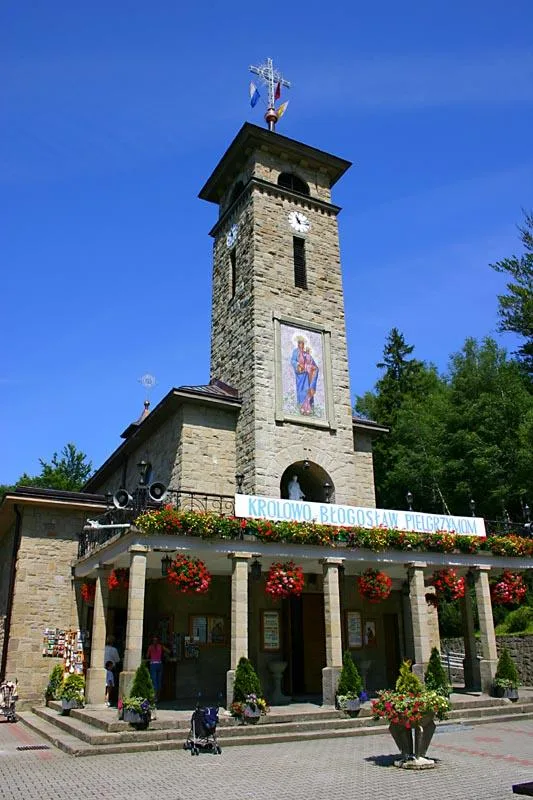
The Shrine of Our Lady Queen of Poland, called the Shrine on the Górka, stands at an altitude of 670 m above sea level in the northern part of Szczyrk, by the trail to Klimczok. Its beginnings go back to 1894. According to dzieje.pl, the Mother of God then appeared to 12-year-old Julianna Pezda, and later two more children saw her. She recommended reciting the Angelus prayer and building a chapel; a small wooden chapel was erected in the same year. These are accounts of apparitions, not established fact.
Construction of a masonry chapel began in 1912 and was completed after the First World War. Since 1938 the place has been looked after by the Salesians from Oświęcim, who in 1948 initiated the building of the present church. Dzieje.pl states that it was built until 1953, other sources: until 1954. On the hundredth anniversary of the apparitions, 3 May 1994, Bishop Tadeusz Rakoczy blessed the church and raised it to the dignity of a shrine, and the painting of Our Lady Queen of Poland was crowned in 2008 by Cardinal Stanisław Dziwisz. Next to the church stand the Chapel of the Apparition with a beech stump and a grotto with a spring regarded as miraculous. The whole practical side is described on the card of the shrine in Szczyrk.
Be the first! Add a comment.
You need to log in to add a comment.
Log in