
The painting, the plague and the first vows
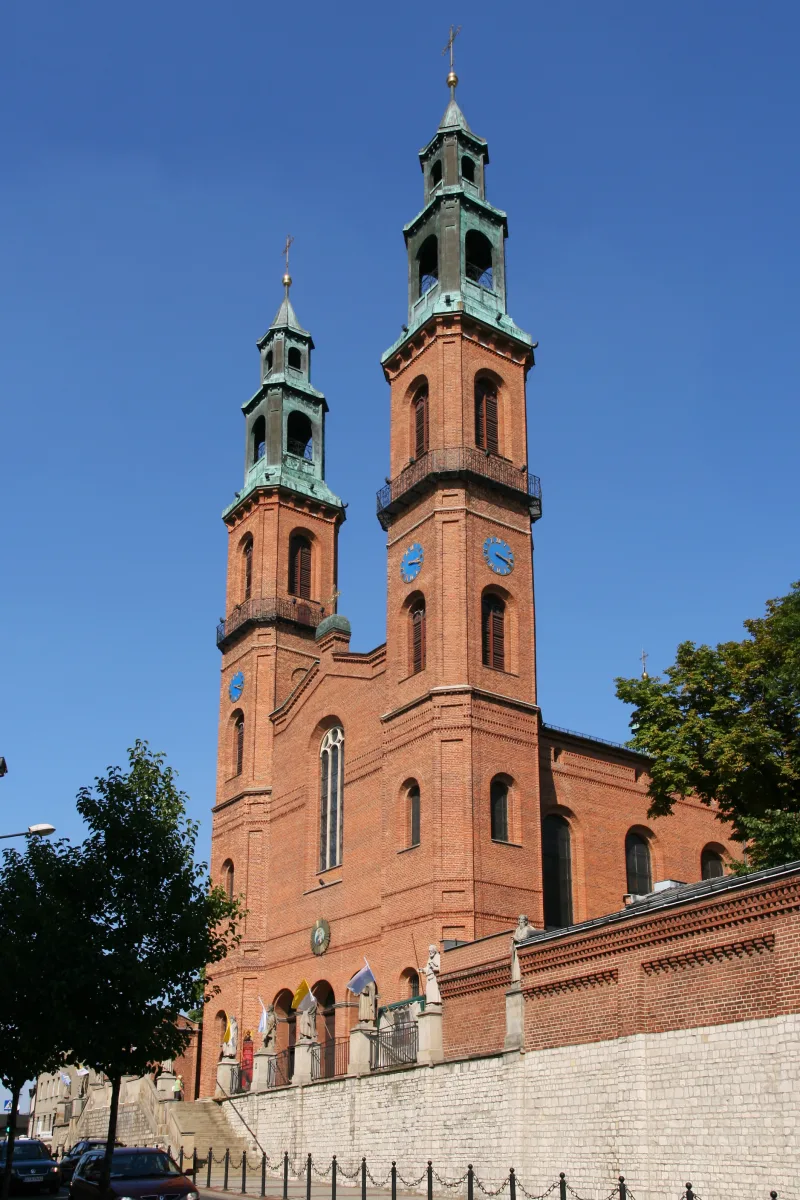
Piekary Śląskie has been a pilgrimage centre since the 17th century, and for many people of Upper Silesia it remains a place to which one travels with the whole family and the whole parish. The heart of the shrine is the Basilica of the Blessed Virgin Mary and St Bartholomew, and in it the painting of Our Lady of Piekary, venerated as Mother of Justice and Social Love.
The beginnings are modest. From 1303 a small wooden church of St Bartholomew stood in Piekary, and in a side altar hung an image of Mary with the Child whose author and founder we do not know. According to the account of the parish priest Jakub Roczkowski, after the painting was moved to the high altar in 1659 people began to speak of healings. The parish regards this date as the beginning of the proper cult.
The first documented pilgrimage is linked with the year 1676. A plague broke out in Tarnowskie Góry then, and the inhabitants prayed before the Piekary painting. As the epidemic receded, they vowed an annual pilgrimage. Some sources speak of a plague, others of a cholera epidemic. According to the dzieje.pl portal, the oldest documented pilgrimages arrived in Piekary in 1676 from Tarnowskie Góry and in 1681 from Opole. The Tarnowskie Góry tradition continues: the faithful from the town, whose old buildings are shown by the Market Square in Tarnowskie Góry (Rynek), according to the basilica's card make a pilgrimage to Piekary on the first Sunday of July.
In 1680 the painting was taken to Prague, where a plague had struck the city, and on the way back it stopped in Hradec Králové. The Archbishop of Prague then officially recognised it as miraculous. In 1683, on his way to Vienna, King John III Sobieski prayed in Piekary. The shrine museum keeps gifts given by the king.
The original in Opole, a copy in Piekary
In 1702, for fear of its destruction in religious disputes, the original painting was taken to the Church of the Holy Cross in Opole, where it remains to this day. In Piekary a copy from the late 17th century stayed, measuring 99 by 77 centimetres. This did not interrupt the pilgrimages, however. One of the priests of the time said that it was the Holy Spirit who chose this place, not a brush or canvas. In time the copy took the place of the original and itself became famed for graces.
The painting was crowned on 15 August 1925 with crowns funded and blessed by Pope Pius XI. According to dzieje.pl, the ceremony gathered about 250,000 of the faithful. The crowns were stolen on the night of 7-8 December 1940. To this day it is not known whether it was an ordinary robbery or a provocation by the German authorities. The painting was crowned again in 1965, and after another theft in 1984 a recoronation took place in 1985. The crowns stolen then returned to the basilica in 2015. Since 2000 the painting has been covered by a silver curtain with a panorama of the town, uncovered before the first Mass.
The present church was built by the inhabitants on the initiative of the parish priest Jan Alojzy Fick, who led the parish in 1826-1862. Bishop of Wrocław Melchior von Diepenbrock consecrated it on 22 August 1849. The title of minor basilica was granted to it in 1962 by John XXIII. The history of the painting, the cult and the pilgrims' gifts are shown by the Shrine Museum, opened in 2009, on the 350th anniversary of the cult.
Pilgrimages of social groups, and of men
In the interwar period, alongside pilgrimages from individual parishes, pilgrimages of particular social groups began, that is gatherings of defined groups of the faithful. Two are among the largest. Men and young men come to Piekary on the last Sunday of May, and women and girls on the first Sunday after the feast of the Assumption of the Blessed Virgin Mary. Dzieje.pl states that the men's pilgrimage has been held since 1947 and is attended by from several dozen to more than 100,000 people, above all from Upper Silesia. The start of the group pilgrimages is attributed to the parish administrator of 1941-1947, so the line between the prewar gatherings and the later custom is not sharp in the sources.
These pilgrimages have a fixed tone: the sermons concern work, human dignity and workers' rights. Our Lady of Piekary is regarded as the patron of working people, and the invocation Mother of Justice and Social Love was approved for the Katowice diocese at the beginning of 1983. Karol Wojtyła almost every year from 1965 to 1978 preached to the men on the subject of work. As pope, in 1983 he celebrated Mass at the airfield in Katowice-Muchowiec, to which the painting was brought from Piekary, and spoke of the Mother of Justice and Social Love in a great basin of labour. Today a monument to John Paul II stands at the entrance to the Calvary.
The Calvary on Cerekwica hill
The Piekary Calvary is connected with the basilica. The plan was revealed in 1854 by Father Fick, the first chapel was built in 1869, and the buildings were consecrated on 21 June 1896. On almost 10 hectares there stand 14 chapels of the Way of the Cross, 15 rosary chapels and 11 others, and at the top the Neo-Gothic Church of the Resurrection of the Lord. According to the shrine's website, it is the only calvary not founded by a nobleman but by the faithful, among them miners and steelworkers. For comparison, another Silesian calvary, with chapels in a park above the Kłodnica, is described under the Panewniki Calvary.
The name Piekary appears in the region in more than one place. The Piekary Pits (Doły Piekarskie) lie in Piekary Rudne, in Tarnowskie Góry, not in the pilgrims' town. The invocation of Our Lady of Piekary is also borne by the Church of Our Lady of Piekary on the Osiedle Tysiąclecia in Katowice. In the vicinity of the shrine it is worth visiting the Silesian Botanical Garden in Radzionków, the Bread Museum in Radzionków and the Church of St Barbara in Bytom. Piekary is also linked with Jasna Góra by a shared custom: according to dzieje.pl, in 1979 John Paul II presented the pilgrims from Piekary there with a paschal candle and a papal stole. The Jasna Góra shrine is described under Jasna Góra.
Be the first! Add a comment.
You need to log in to add a comment.
Log in