
What the legend says
According to the tale, the Polish king Leszek III stood one night on the castle tower and saw three stars in the west. He associated them with his sons: Bolko, Leszko and Cieszko. He took it as a sign, summoned his sons and ordered them to set out in that direction, each by a different road, with his own retinue. They were to return in the autumn.
The legend goes on to say that Leszko, searching for water through the forest, discovered a spring at the foot of a hill. He blew his horn, and at the sound Bolko arrived with his retinue. In the evening Cieszko reached the spring too. After a night spent telling stories the brothers decided to return to their father and to come back here in the spring and found a stronghold. It was to be called Cieszyn, from the joy (radość) of the meeting. The spring was to be given the name of the Three Brothers' Well.
The inscription on the well states that these events were supposed to have taken place in 810. This date does not fit the legend: according to the account of Wincenty Kadłubek, Leszek III was supposed to be a ruler contemporary with Julius Caesar, and so to have lived in the 1st century BC.
Where the tale came from
It is not known when the tale of the founding of Cieszyn arose. Many historians point out that it may have arisen in the mid-19th century, after the Spring of Nations, among Polish national activists in Cieszyn Silesia. It was meant to support deriving the name of the town from the word “cieszyć” (to delight). Modern researchers consider both the tale itself and such an explanation of the name unlikely.
The legend is also a variant of the motif of three founding brothers, known from many Slavic stories. In Jan Długosz there are brothers named Przemysław, Oddon and Cieszymir. Emperor Francis I was supposed to have heard the story of the three brothers from the mayor of Cieszyn, Alojzy Kaufmann, during an inspection of the town in 1817. The first publication dates from 1840: a poem on the founding of Cieszyn, Die Gründung von Teschen, appeared in a collection by Paul Lamatsch von Warnemünde, an employee of the Cieszyn town hall.
Where the town really comes from
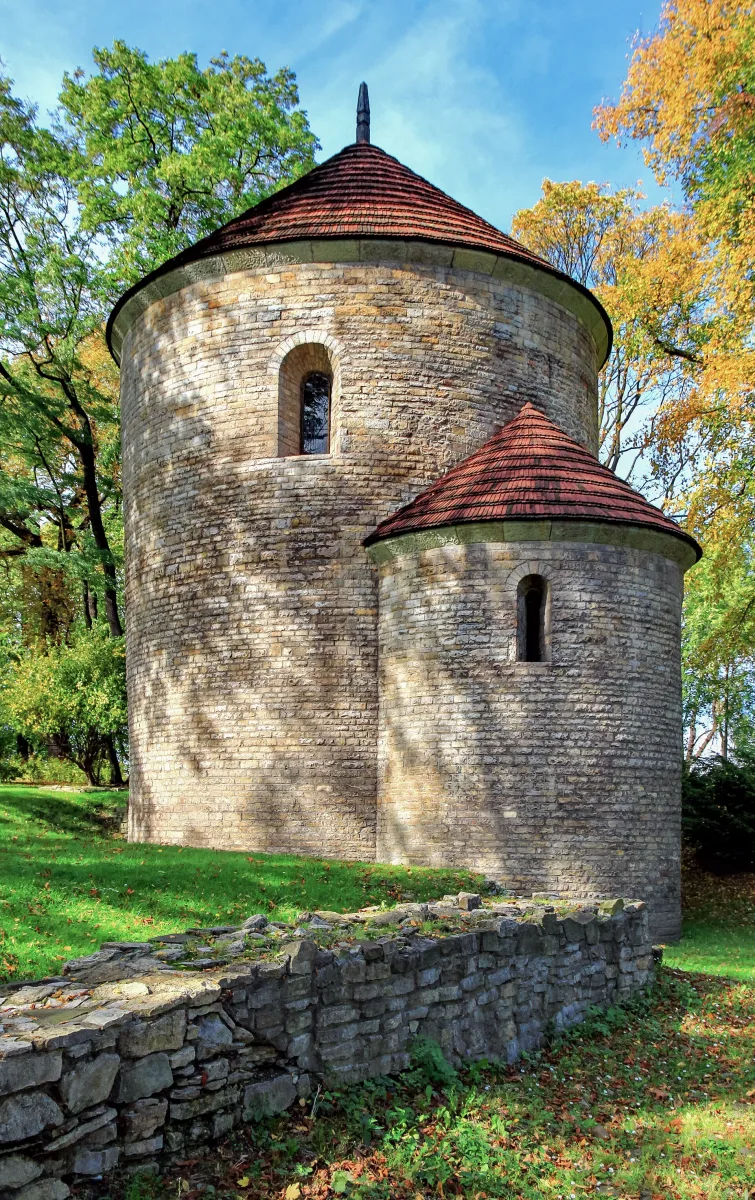
The history of Cieszyn reaches back much further than the date 810 suggests. The oldest traces of settlement on Castle Hill date from the 6th-5th century BC. A Slavic stronghold also stood in Podobora, called Stary Cieszyn. In the 11th century a Romanesque rotunda was built on Castle Hill, today known as the Rotunda of St Nicholas. The oldest known written mentions of Cieszyn date from 1155, and the town was most probably chartered between 1217 and 1223. The year 810 therefore remains a symbolic date, accepted as the beginning of the town only in accordance with the tale.
The well as a structure
The well itself probably existed already in the Middle Ages and supplied residents and the nearby burghers' brewery with water. It is not known since when it has been linked with the tale and since when it has borne the name of the Three Brothers. In the mid-19th century, on the initiative of Paweł Stalmach, the well was renovated, and then covered with a cast-iron neo-Gothic gazebo cast at the ironworks in Třinec.
The sources give the year the gazebo was built differently: some 1868, others 1860, in connection with the celebrations of the town's 1050th anniversary counted from the year 810.
The gazebo is about 3 metres high and hexagonal in plan, with partly openwork walls supported on cast-iron pillars, and a sheet-metal roof in the shape of a pyramid. Three walls are closed, the others open. Inside are plaques with the text of the tale in Polish, Latin and German. After the Second World War only the Polish and Latin inscriptions remained, and the German one was covered with a bas-relief by the Cieszyn sculptor Jan Raszka. After the renovation all three inscriptions can again be seen on the walls.
Where to find it
The well stands by the steep, cobbled Trzech Braci street, between Śrutarska and Sejmowa streets. It is one of the symbols of Cieszyn and a regular stop on walks around the old town. It is easy to combine with a visit to Castle Hill, where the legendary meeting of the brothers gives way to history attested by sources.
Be the first! Add a comment.
You need to log in to add a comment.
Log in