
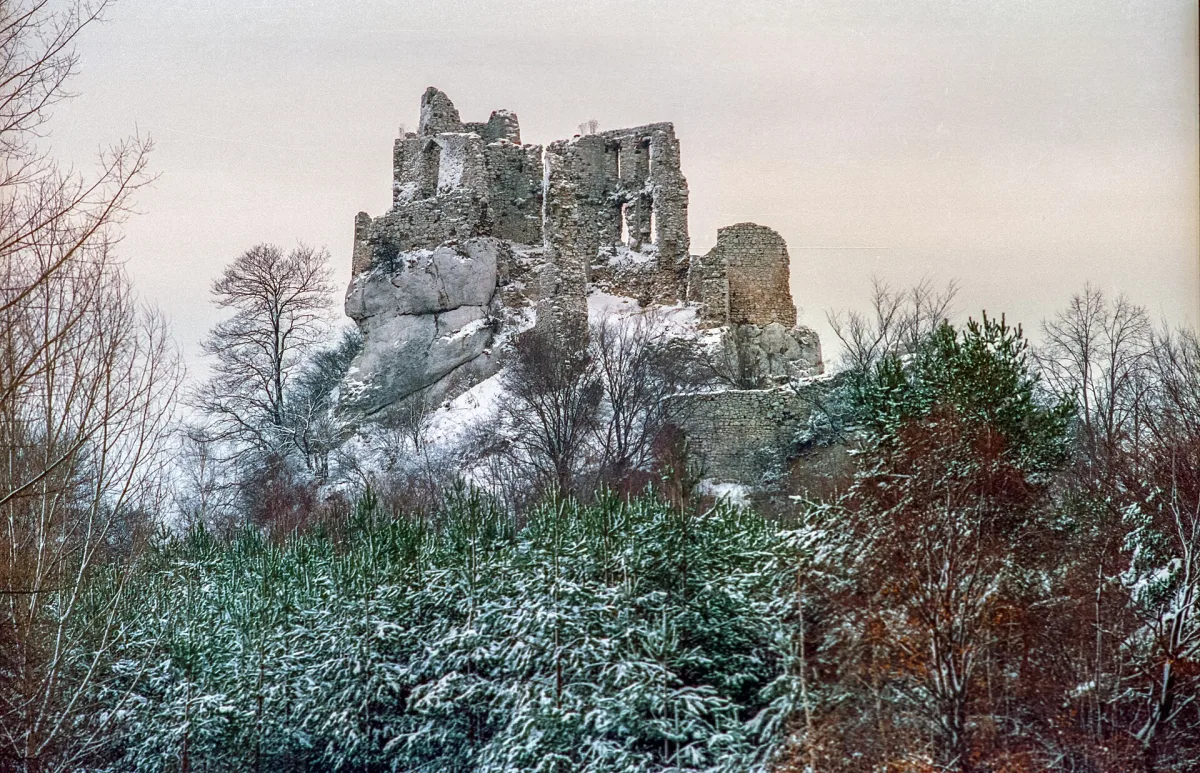
The ruins on the Trail of the Eagles' Nests have a history recorded in documents and a second, oral one: of white ladies, black dogs, a starved voivode and treasures that no one has ever recovered. These are legends, not the findings of historians. Below is an overview of the castles one by one, marking what is a documented record and what is legend. Most of the stories come from a single popular study, so read them as folklore.
Ogrodzieniec: the black dog and the white lady
The largest ruin in the Jura, Ogrodzieniec Castle in Podzamcze, is surrounded by two of the best-known legends. According to the first, the phantom of a huge black dog runs along the walls, guarding the castellan's hidden treasures. In the story it is linked with the figure of Stanisław Warszycki, who retook the castle from Swedish hands after the Deluge and was known, as the author of the National Geographic Traveler text writes, for a strongly developed lust for money. The legend thus connects the treasure with his figure, but this is not a documented fact.
The second legend says that at midnight no horse can be led into the castle courtyard. The cause is said to be a white lady who appears at the top of the condemned prisoners' tower. According to one version, this is the ghost of the beautiful Witysława, imprisoned in the time of Bolesław the Wrymouth by the aged Skarbimir, while her fiancé Piotr Szczerbic sat in the dungeons. Both figures have become so established in the castle's culture that seasonal illuminations are held on the ruins with light installations of the Black Dog and the White Lady. You will find the history of the fortress itself in the article on Ogrodzieniec; here we stay with the legends.
Bobolice and Mirów: brothers, a tunnel and a St Bernard
Two neighbouring castles, Bobolice and Mirów, share a legend of two brothers who resembled each other, Bobol and Mir, and of a woman who set them at odds. After the tragedy the ghost of the White Lady is said to appear in the walls of Bobolice. The same legend mentions treasures hidden in a tunnel between the castles, guarded by an old witch with red eyes and an evil spirit in the body of a huge black St Bernard. The treasure can supposedly be reached only when the witch flies off to the sabbath on Bald Mountain and the dog falls asleep after eating a roasted ram. According to the same story, no one has yet managed to roast a ram during the sabbath. We have described the full versions and the dispute over the endings separately, in the article on Bobol and Mir.
Note the similarity: here, as at Ogrodzieniec, the treasure is guarded by a black dog. This is a common motif in tales of hidden treasures, but the sources we consulted say nothing about its origin.
Olsztyn: the voivode in chains and the starosta's young wife
The castle in Olsztyn near Częstochowa has two stories with ghosts. According to tradition, during the reign of Casimir the Great the voivode of Poznań, Maciek Borkowic, was held prisoner here. He was said to have died of starvation, condemned for a conspiracy against the king, and his ghost, groans and the clanking of chains are said to haunt the area around the castle to this day.
The second story, from the same Trail, concerns a white lady. According to the legend, the very young wife of the starosta Albrecht got lost in the Olsztyn dungeons, that is, in the labyrinth of passages hewn in the rock, and since then she appears to those who linger in the ruins longer than they should. Both stories are legends. What is true, however, are the events recorded in documentation: the siege of the castle in 1587 by the troops of Archduke Maximilian and the sacrifice of the defence commander's son, about which Syrokomla wrote and Fredro wrote a play.
Smoleń, Ryczów and Morsko: the devil, the clock and the black apparition
From the smaller ruins individual threads can be gathered. At Smoleń, as the author of the National Geographic Traveler text writes, attention is drawn to a well that in the castle's heyday was supposedly as much as 200 metres deep and was reportedly dug by Tatar prisoners. On Christmas Eve and on Midsummer night the striking of a mysterious clock is said to be heard in the nearby Clock Cave. All of this has the status of folk tradition, with no confirmation in documents.
The small watchtower in Ryczów is linked by folk tradition with Boner, lord of Ogrodzieniec. The local devil envied him his wealth and at night destroyed what the builders had put up by day, until Boner, discouraged, gave up and an unfinished castle was left on the rock. It is a story about a rich man and envy, not about the history of the watchtower.
At Morsko, known as Bąkowiec, people told of an evil lord who imprisoned in a dungeon his daughter, who was in love with a poor young man. The young man harassed the castle's inhabitants from hiding among the rocks of Okiennik Wielki, and when the lord set out against him, a storm killed the owner, whose ghost was said to wander the ruins ever since as a black apparition. All the legends of Bąkowiec link it with the rock outcrop Okiennik Wielki, into which the medieval stronghold was built.
Why ruins so favour legends
The common core of these tales is simple: treasure, crime and unhappy love. Ruins with dungeons and rock passages are easily filled with conjecture, so stories were embellished to fit the look of the place. That is why the same figures return at different castles: the white lady, the black dog, the starved prisoner.
If you want to see what these places look like, start with the Trail of the Eagles' Nests, which links most of the ruins mentioned. Always keep history separate from story: we know who built the castle and when it was besieged, but only legend knows about the ghost of a lady in the window.
Be the first! Add a comment.
You need to log in to add a comment.
Log in