
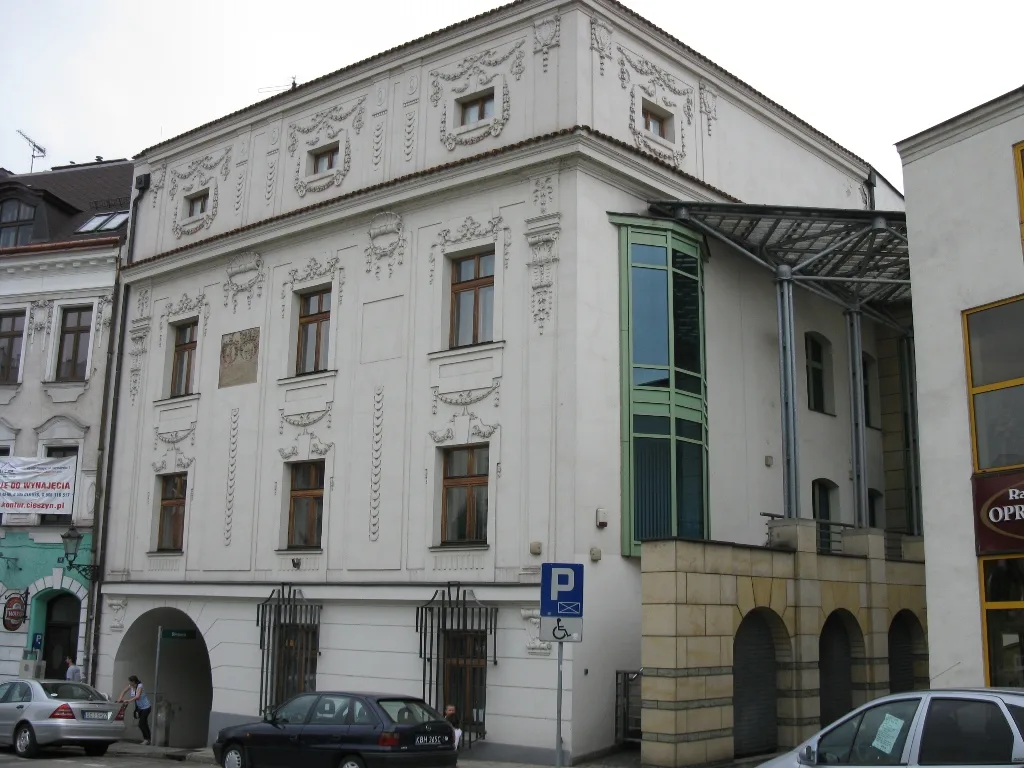
Po naszymu, that is "in our way": this is what the inhabitants of Cieszyn Silesia call their dialect. It sounds different from the Silesian of Katowice or Gliwice, and linguists still argue whether it is a variety of Polish or rather a dialect closely related to Czech. We write about it from the perspective of Cieszyn, because it is there that the dialect acquired a large mural with its words.
A dialect on both sides of the Olza
The Cieszyn dialect is used on both sides of the Olza, that is on the Polish and the Czech side of the border. In Zaolzie it is spoken mainly by the Polish minority, and on the Polish side rural areas and smaller localities give it more room than towns, where general Polish is heard more often. On the Polish side the dialect is strongly influenced by standard Polish, and in Zaolzie by Czech.
The expression "po naszymu" in Cieszyn Silesia usually refers to the Cieszyn variety of Silesian. This is connected both with the distinctness of the speech from the dialects of northern Upper Silesia and with the centuries-long cultural branching off of this region from the rest of Upper Silesia. The name also appears elsewhere: the competition "Po naszymu, czyli po śląsku", held since 1993, in which participants have five minutes for a monologue in Silesian and compete for the title of Silesian of the Year, concerns the whole Silesian ethnolect more broadly.
The dispute over its origin
Polish linguists believe that the dialect of Cieszyn Silesia evolved from Old Polish and has kept many of its features to this day, among other things in vocabulary and syntax. They classify it as part of the Silesian dialect of the Polish language. Czech researchers see it differently: Pavel Kosek placed the Cieszyn dialect in the Silesian group of Czech dialects, together with the Lach dialect, and according to Czech linguists it is related mainly to the Lach and Moravian dialects and is closer to Czech than to modern Polish.
According to the same source, its shape was influenced by Czech, German and standard Polish, as well as Wallachian and Slovak. The entry presents both positions side by side, without deciding between them.
What the Cieszyn dialect sounds like
Against other Polish dialects it is distinguished by three features given by dialect researchers:
- a narrow pronunciation of the vowel "ę" in every position,
- no mazurzenie, that is "sz" is distinguished from "s" and "cz" from "c",
- the ending "-ym" in the first person singular, for example "vinšujym" (I wish) and "ńesym" (I carry).
This last feature does not occur everywhere: in Wisła the ending "-e" is used. The spelling in the entries is phonetic, hence characters such as "š" or "ń". Other examples are written phonetically in the same way: "pińundze" (money) and "ḿynso" (meat) preserve a trace of the old nasal vowels, which disappeared in Czech, "gura" (mountain) and "noga" have a hard "g" where Czech has "h", and the question "kaj idźeš?" means "where are you going?". The dialect also keeps the distinction between "i" and "y" and between "l" and "ł", which sets it apart from most Czech dialects.
In the area around Bogumin complete denasalisation took place, and in Karviná "ł" is pronounced differently than in the rest of the dialect area. The dialect therefore has local varieties, and no list of features describes them all.
Jabłonkowanie in the Beskid Three Villages
In the south-east of the region the Jabłonków dialect is used, spoken by the inhabitants of Istebna, Koniaków and Jaworzynka. Its hallmark is jabłonkowanie, that is the blending of the series "ś, ź, ć, dź" with "sz, ż, cz, dż" into an intermediate pronunciation, for example "śzćzekaćz" instead of "szczekać" and "ściekać". It has also kept the Old Polish pronunciation of "rz" as a fricative consonant. A description of this dialect and of the life of the highlanders who use it can be found in the article on the Silesian highlanders.
The mural and books in the dialect
In 2023 a mural "Po naszymu" was created on a block of flats at Barteczka 23 in Cieszyn, on the Bobrek Wschód estate, made up of 70 words of the Cieszyn dialect. It was chosen for realisation under the Cieszyn participatory budget for 2023. Example words mentioned in connection with this project are zwyrtać, drzistać, pusa and ździorbo. These are words popular in Cieszyn Silesia.
The dialect also has its own literature. Writers who wrote in Cieszyn dialect include Aniela Kupiec, Emilia Michalska, Władysław Młynek, Mieczysław Peterek, Karol Piegza, Jerzy Rucki, Maria Szturc and Adam Wawrosz. Karol Piegza also proposed the original name of the event that was later adapted to the dialect as Gorolski Święto. Vocabulary is collected in the "Słownik gwarowy Śląska Cieszyńskiego" (Dialect Dictionary of Cieszyn Silesia), published in Ustroń in 2010 and edited by Jadwiga Wronicz.
From the dictionary comes, for example, a quotation about the przepiórka, a sheaf of grain decorated with flowers that was left in the field as a sign of the end of the harvest: "Na gazdowym polu już stoi przepiórka mogymy iść zbierać kłóska". The custom is probably known throughout Poland, but the quotation shows how it sounds in Cieszyn dialect.
Be the first! Add a comment.
You need to log in to add a comment.
Log in