
The Bestwina royal carp (Bestwiński karp królewski) is a variety of mirror carp with a small head and a fleshy body, entered on the List of Traditional Products on 17 June 2014 in the category of fishery products. According to the ministry's record, fish farming in Bestwina goes back to the 16th century, and in the second half of the 19th century methods were developed here that are still used today. The sources do not always agree on the details, however, so below we note who claims what.
Pond after pond
Bestwina lies in Bielsko County, in the area of historical Lesser Poland. In the western part of the village there is a complex of fish ponds with an area of about 100 hectares, which is a nesting place for waterfowl. The river Łękawka flows through the village and joins the Vistula in Kaniów.
The product record cites a press publication of 2003, according to which fish farming in Bestwina had been developing since the 16th century and was a phenomenon on a world scale. This is a single cited source, not a document of the period, so we treat it as a tradition rather than a certainty. A PAP news item of 2014, published on the dzieje.pl portal, says on the other hand that the history of breeding the Bestwina royal carp goes back to the 19th century. The discrepancy can be reconciled: the ponds may be older than the variety itself, but none of the cited sources says so directly.
Tomasz Dubisch's transfer ponds
The record states that in 1868 Tomasz Dubisch, then master fisherman of the Iłownica complex, discovered a rearing system consisting of gradually moving young carp to successive, previously flooded and fertile ponds, called przesadki (transfer ponds), while reducing the stocking density. Thanks to this the breeding cycle was shortened to three years, and fish production rose. The record describes this discovery as accidental and refers to an article in a trade magazine of 2007.
The principle is simple: the fish grow, so they need more and more room, and a well-prepared pond rich in food speeds up growth. The rearing methods in traditional earth ponds, developed in the second half of the 19th century, according to the record have practically not changed.
The Galician carp and the medal in Berlin
Dubisch's work was continued, the record says, by his pupil Adolf Gasch. He was after a fish with more meat and a better developed body, that is, a more favourable proportion between the more and less valuable parts of the carp, and not just greater weight. The result was a breed with a small head and a fleshy body, known as the Galician or royal carp. According to the record, it won a gold medal at the international agricultural exhibition in Berlin in 1880 and from then on spread across Europe. The exhibition and the medal are also given by the fishing association cited in the PAP news item.
Here the question of place arises. The record cites a study of Adolf Gasch as a breeder from Kaniów, and according to other sources the mirror carp known as the royal carp, formerly Galician, was bred in Kaniów. Kaniów borders Bestwina on the north, and today both places belong to the same municipality. The name of the product refers to Bestwina, but the history of the variety is therefore also linked with neighbouring Kaniów.
Where carp is raised today
According to the record, traditional methods are used in pond farms around Bestwina and in neighbouring municipalities: Czechowice-Dziedzice, Jasienica, Jaworze and Wilamowice. The application for entry on the list was submitted by the Bielska Kraina Local Fisheries Action Group Association. The record gives the characteristics of the fish: a medium-arched back, a body flattened at the sides with an oval cross-section, the mirror type of scaling, and an average weight of 1.2 to 3 kg. The colour runs from dark grey, through an olive-grey back, to a yellow-brown belly.
Carp on Christmas Eve
Carp is not a native species in Poland. It was brought in between the 12th and 13th centuries, probably from the farms of Czech or Moravian Cistercians. It became established as the basic Christmas Eve dish in Poland only in the post-war period, mainly thanks to its low price and ease of breeding, which led the authorities of the time to produce it in large quantities for the holiday. The Christmas Eve table with carp therefore has a shorter tradition than is often thought, and the ponds in Bestwina are much older than this custom, if the account of the 16th century is to be believed.
What to see in Bestwina
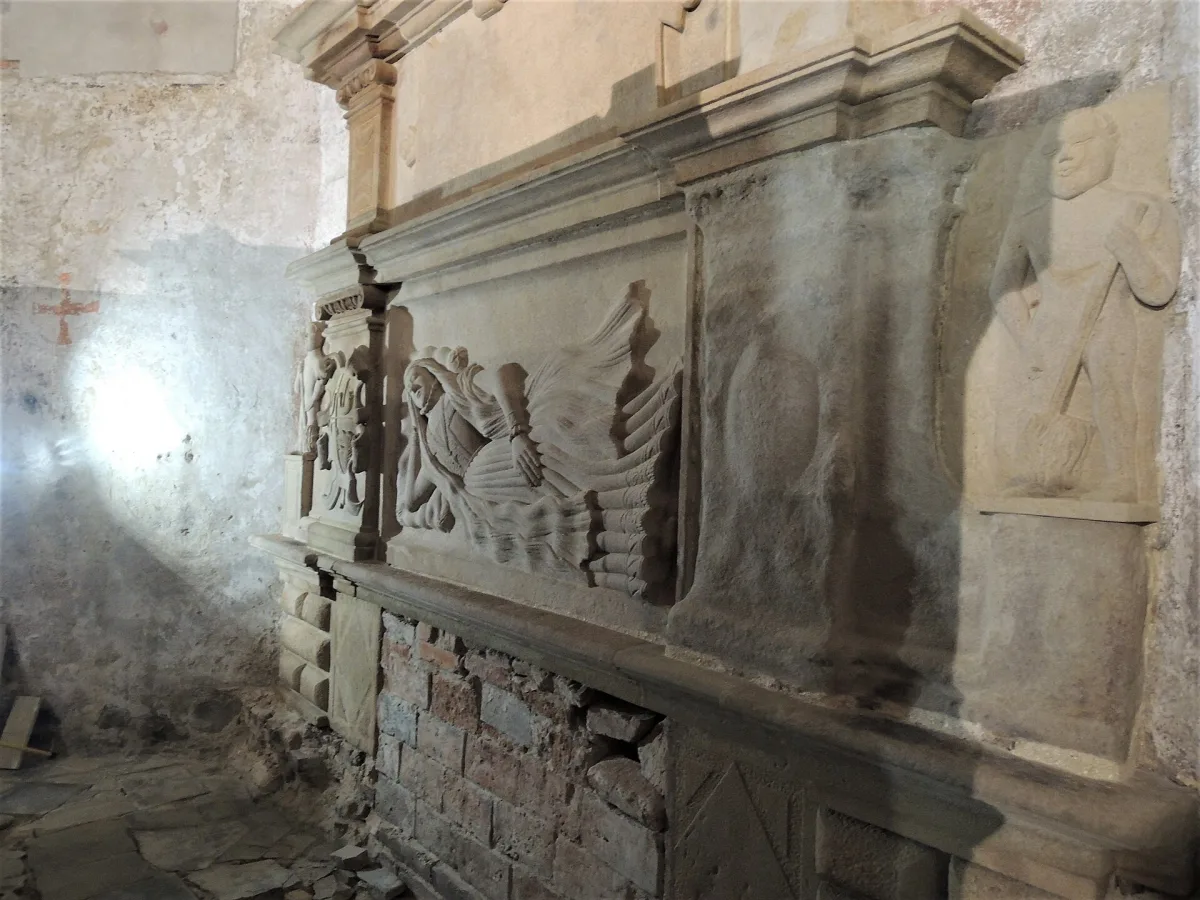
The past of the village is told by the Regional Museum in Bestwina, which since 1993 has collected mementoes of local history and ethnography, and in its coach house old carriages are displayed. A little under a kilometre further on, in the chancel of the church, is the Tomb of Stanisław and Jadwiga Myszkowski in Bestwina, a Renaissance cenotaph of the Voivode of Kraków, who owned the village. The list of traditional products itself is covered in a separate article.
Be the first! Add a comment.
You need to log in to add a comment.
Log in