
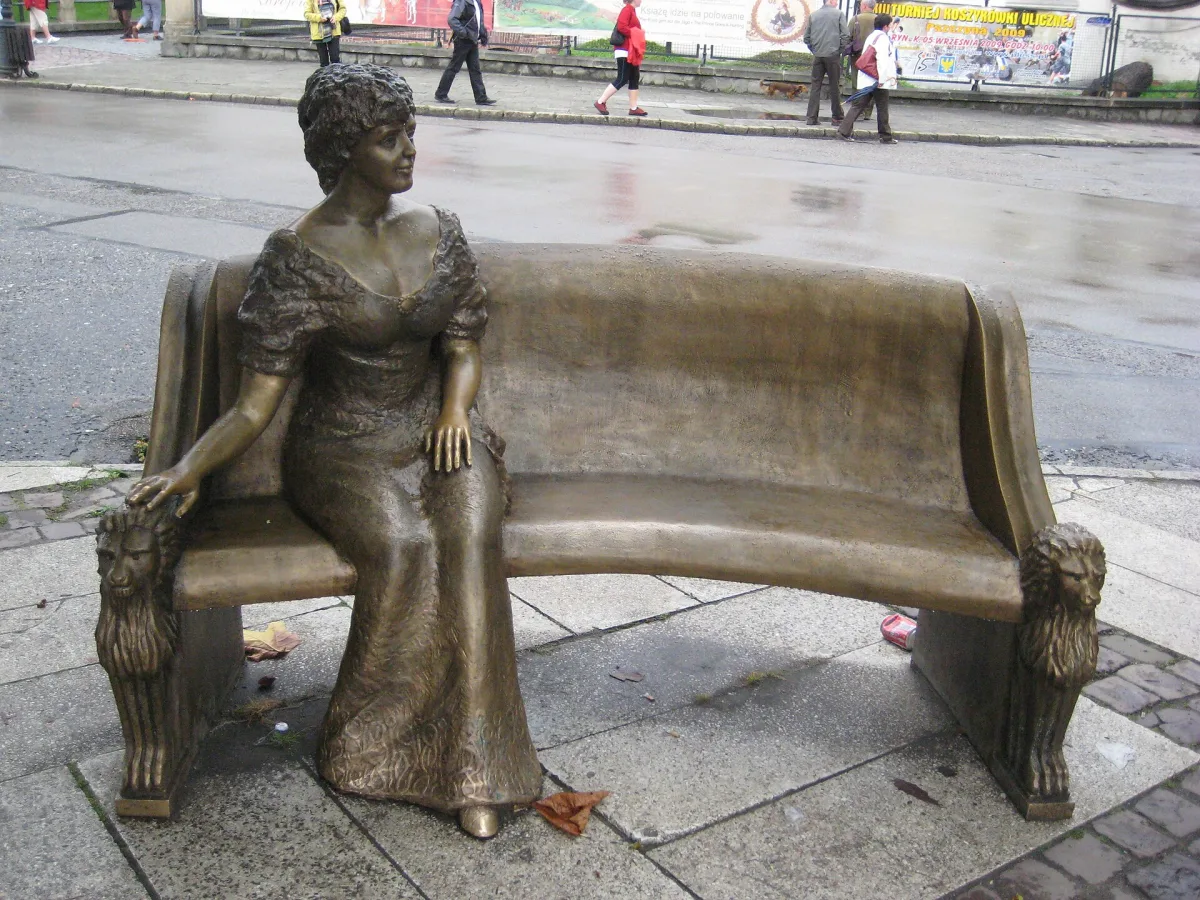
Maria Teresa Olivia Cornwallis-West was born in Wales and died in Wałbrzych as Princess of Pless and a Polish citizen. In Pszczyna she was known as Daisy. For over thirty years she was the wife of the owner of the Principality of Pless and the mistress of two residences: Pszczyna Castle in Upper Silesia and Książ Castle in Lower Silesia. This text describes her life, while another article on the portal covers the rebuilding of Pszczyna Castle.
From Ruthin to London and Silesia
Daisy was born on 28 June 1873 at Ruthin Castle in Denbighshire, Wales. The Cornwallis-West family came from the aristocracy but was in financial difficulties. Her childhood was spent largely in the care of nannies, and her first singing teacher was Paolo Tosti. For years she dreamed of a career as an opera singer.
In 1891 she met Hans Heinrich XV Hochberg, heir to the Principality of Pless and one of the richest aristocrats of the German Empire. The wedding took place on 8 December 1891 at St Margaret's Church in London. The witnesses included the Prince of Wales, later King Edward VII. In her diaries Daisy wrote years later that she had not realised she had been “bought”; this sentence comes from the 2014 edition of the diaries.
Książ and Pszczyna
After the wedding she lived at Książ, her father-in-law's residence, and she preferred it to Pszczyna. She soon found the rigid etiquette and the ever-present servants tiresome. In her diaries she wrote that a German Christmas was nothing like an English one, so she later had festive treats brought from England and prepared them in Pszczyna with an English maid. She also tried to introduce English sanitary and hygiene customs, which, as she herself noted, aroused resentment among those around her.
The diaries contain a story about a ghost in one of the rooms of Książ Castle. Daisy was said to have seen a figure repeatedly trying to light the fire in the fireplace, and after she moved to another room the apparition was said to have disappeared. This is the princess's own story, not a documented fact.
In Pszczyna she paid particular attention to the hunting lodge in Promnice. In December 1901 Pszczyna Castle hosted Emperor Wilhelm II at a reception at which the emperor was said to have shot two European bison with a single bullet. The princess travelled widely in Europe, visited Egypt, India and Russia, and in 1913 made a journey to South America with her brother.
Charity and mediation
Daisy was involved in social work, mainly in Lower Silesia. She organised charity concerts in which she sang herself, set up stations providing pasteurised milk for infants, supported a school for disabled children in Wałbrzych and lace-making schools in Jelenia Góra. She also worked to clean up the Pełcznica river, which led to the construction of a sewer system and a sewage treatment plant in Wałbrzych in 1907-1912.
Before the First World War she tried to act as an intermediary between England and Germany. She knew Edward VII and his nephew Wilhelm II. In 1906 she arranged meetings at Książ between English diplomats and the emperor, among them Winston Churchill. After the outbreak of war she served as a Red Cross nurse, including on hospital trains. Her English origins led the press to accuse her of espionage. These stories were fictitious, and her husband brought lawsuits to restore her honour.
Divorce and the diaries
The marriage broke down during the war. The divorce was confirmed in December 1922: sources give the date as 4 or 12 December. In the same year Daisy took Polish citizenship, which she kept until her death. Her worsening financial situation led her to publish her diaries. The first volume appeared in London in 1928 and went through six editions within a year. The German edition, which was censored, caused a scandal and deepened her isolation. Further volumes followed in 1931 and 1936. Today the diaries are regarded as an important source of knowledge about the Edwardian era and Wilhelm II's Germany.
Legends also grew up around the princess. The story of a curse on her long string of pearls was probably invented by the author of a popular 1989 booklet, and later authors repeated it as truth. It is not confirmed historically.
Last years and remembrance in Pszczyna
From 1935 Daisy lived at Książ, and from the spring of 1941 in a villa in Wałbrzych. By then she was gravely ill. She died in June 1943: sources give 29 or 24 June. She was buried in the family mausoleum at Książ. According to one account, the mausoleum was plundered in 1945, and her remains were said to have been moved to a Protestant cemetery, which was closed down in the 1970s and 1980s.
In Pszczyna she is remembered by the Princess Daisy bench on the Market Square, unveiled on 1 May 2009. Its author is the Pszczyna artist Joachim Krakowczyk. The diaries from the first years of the marriage were deposited in the Castle Museum in Pszczyna by the princess's grandson Bolko VI.
Be the first! Add a comment.
You need to log in to add a comment.
Log in