
Nearly a hundred years separate the three Gliwice sites, and together they show well how the city changed from the 19th century to the post-war period: an industrialist's residence, a waterway for industry and a technical university. Each of them has its own address in Gliwice that can be seen today.
Villa Caro: an industrialist's house from 1882-1885
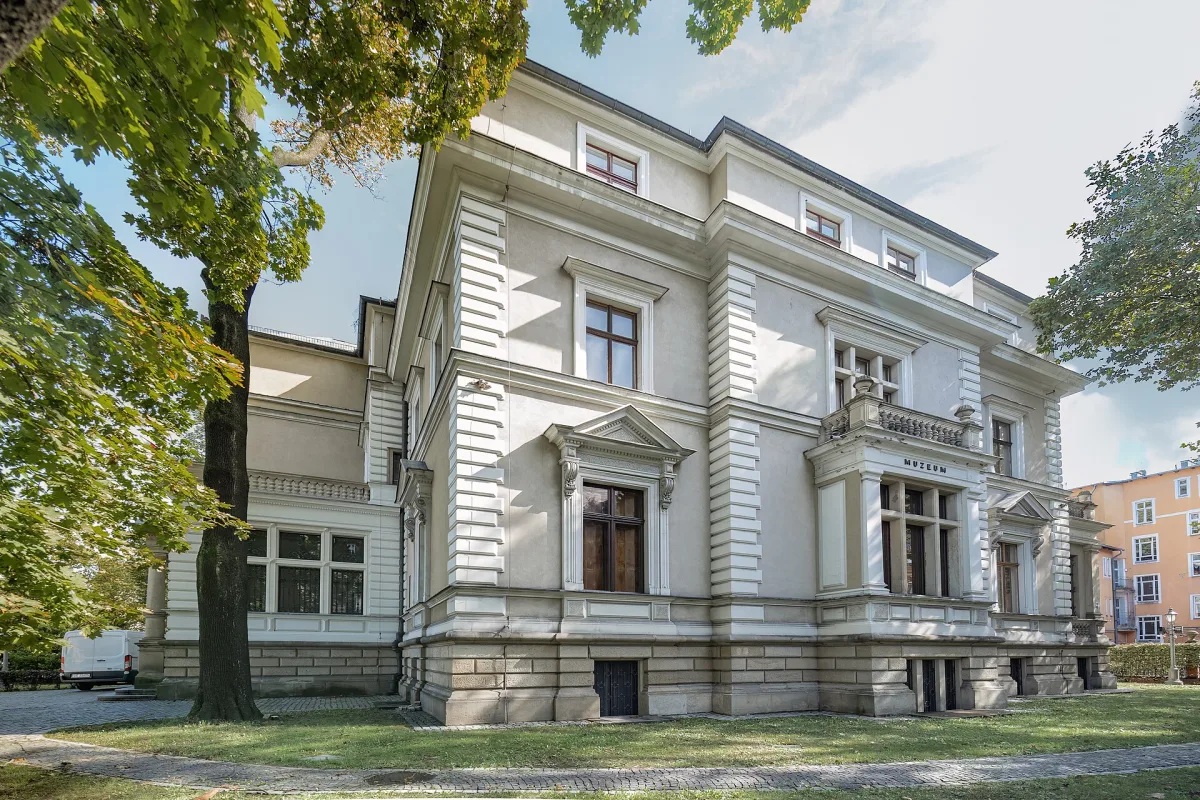
On Dolnych Wałów Street stands Villa Caro, built in 1882-1885 for the industrialist Oscar Caro. Caro came from a Wrocław family of merchants and industrialists. His father Robert founded the Hermina ironworks in Łabędy near Gliwice in 1848, and after his father's death in 1875 Oscar took over the Upper Silesian part of the family business. In 1887 he brought about the merger of the Łabędy ironworks with the firm Heinrich Kern & Co and the Baildon ironworks in Katowice, and he himself headed the resulting concern, which later also took in the ironworks in Rybnik, as its general director.
He bought the plot in 1882 from his brother-in-law and partner Heinrich Kern. Around the villa a garden was laid out with irregular paths and a pond, and at its edge a stable and a coach house. The year of completion of the building, 1885, is confirmed by a date drawing discovered above the inner portal in the main entrance stairwell. The villa has a form close to a 19th-century vision of Italian Renaissance architecture.
The sources describe differently who designed it. According to some descriptions the first design was probably prepared by the Berlin firm Ihne & Stegmüller, the author of the final version is not known, and it was probably the Gliwice master builder Salomon Lubowski, Oscar's father-in-law. According to other descriptions the designer and patron was outright Lubowski, and the villa was a wedding present for the young couple.
The dates of his move out also differ. According to some sources, Caro lived in the villa until 1909 and remained its owner until 1916. According to others, he moved from Gliwice to Jelenia Góra as early as 1905. From 1924 the building housed an industrial and construction company, and the second floor was added then. In 1934 the city took over the villa as the seat of the Oberschlesische Museum, and in 1945 it was taken over by the Museum in Gliwice, of which it is today the main seat.
The interiors have mostly kept their original decor: decorated ceilings, wood panelling, parquet floors and joinery. In front of the building, on a plinth, stands the sculpture Watching Lion. The villa is counted among the few surviving urban residences of wealthy Upper Silesian industrialists.
The Gliwice Canal: a new waterway in place of the old one
Its predecessor was the Kłodnica Canal, built in 1792-1812, which linked the developing industry of Upper Silesia with the Oder. It was meant to serve, among other things, for transporting cast iron from the Royal Iron Foundry in Gliwice. Its importance had been declining since the mid-19th century, because the railway had become a competitor.
The new Gliwice Canal runs from Kędzierzyn-Koźle, from the 98th kilometre of the Oder, to the harbour basin in Gliwice. It is 40.6 km long, and the difference in water levels, 43.6 m, is overcome by six locks. Two of them, Dzierżno and Kłodnica, have a drop of more than 10 m each. In Kędzierzyn-Koźle the canal crosses the Kłodnica river on two levels: the river flows beneath it in a so-called siphon, which is one of three such crossings with a navigable canal in Poland.
The sources give the construction dates inconsistently. The entry on the canal itself speaks of 1935-1939, an official opening on 8 December 1939 and a start of operation in 1941, while the entry on Gliwice gives 1934-1939. The dates of the end of the old canal also differ: 1936 in the entry on Gliwice, 1937 in the entry on the new waterway. Port Gliwice was built at the same time as the canal, although the land had been incorporated into the city as early as 1924, and in 1939 a transhipment port with a railway station operated here.
In that same year of 1939 Gliwice entered history for another reason: on 31 August a staged attack on the radio station took place here, which served as a pretext for the invasion of Poland. This matter requires a separate, factual treatment and is not the subject of this text.
The Silesian University of Technology: a university built on Lviv staff
A technical university in Silesia had been discussed as early as the 1920s, and in Katowice, on Krasińskiego Street, a building for the Silesian Technical Scientific Institutes was opened in 1931. The university of technology was established only by a decree of 24 May 1945, with its seat in Katowice and four faculties: Electrical, Metallurgical, Civil Engineering and Mechanical. It was organised by Prof. Władysław Kuczewski.
The first lectures for about 1,200 students began on 1 June 1945 in Kraków, because the faculties had been transferred from the Kraków Mining Academy. The building in Katowice turned out to be too small for four faculties and there was no room there for an academic district, so Gliwice was chosen. The reasons were free buildings left by educational institutions, housing for staff and students, plenty of greenery and the support of the city authorities. On 21 June 1945 the city and the university signed an agreement on an academic district. The first inauguration in Gliwice took place on 29 October 1945 in the building at Strzody 21, and 2,750 people were then studying in semesters one to seven. The final location in Gliwice was confirmed by a decree of 20 March 1946.
Lviv in this story is above all about people. Many professors of the Lviv Polytechnic were then in Kraków, and Kuczewski persuaded outstanding chemists from that university to move to Silesia. The university was based on Lviv academic staff. The city was changing at the same time, because expellees from Lviv and the South-Eastern Borderlands made up 45 per cent of the new residents.
For Gliwice this meant a new chapter: former schools, for example the buildings known as the Red and Grey Chemistry, became faculties. Today the tradition of the university is told, among other places, by the Museum of Deposit Geology of the Silesian University of Technology, operating since 1961.
Be the first! Add a comment.
You need to log in to add a comment.
Log in