
Brine found instead of coal
Today's Jastrzębie-Zdrój is associated with coal mines, but its first career was completely different. The development of the town began with a borehole of 1859. The owner of Jastrzębie Dolne, Emil von Schlieben, was then looking for coal and struck an iodine-bromine brine. Hard coal appeared in the history of this place only more than a hundred years later.
In 1861 Jastrzębie Dolne was bought by Count Felix von Königsdorff, who began building therapeutic facilities. The first bathing facilities appeared, the Spa Casino of 1862, later the Spa House, and the Baths of the same year, later the Hydrotherapy Institute. The count also changed the name of the place to Bad Königsdorff-Jastrzemb. The name remained in force until 1922, that is until the end of German administration.
The Zdrój spa before the war
In 1869 the spa was taken over by the company Actien Commandit Gesellschaft, which modernised the facilities and built a bandstand and a wooden promenade. In 1890 Jastrzębie Dolne was bought by Juliusz Landau, who began to turn the sanatorium into a children's spa. In 1891 the first sanatorium complex with a chapel was built, followed by others: the Evangelical children's institution Betania and a Jewish children's institution. The spa was developed by Mikołaj Witczak, who bought Zdrój in 1896. During the First World War some of the sanatoria were turned into military hospitals.
After the area was joined to Poland in 1922 the spa flourished. Among other things the Marshal Piłsudski Sanatorium of 1928 was built, funded by the Silesian Voivodeship for war invalids and Silesian insurgents, as well as the Hutnik sanatorium, a swimming pool of 1938 and numerous guesthouses. In 1924 the municipality of Jastrzębie Zdrój was separated off, and the spa became part of it.
What is left of the spa
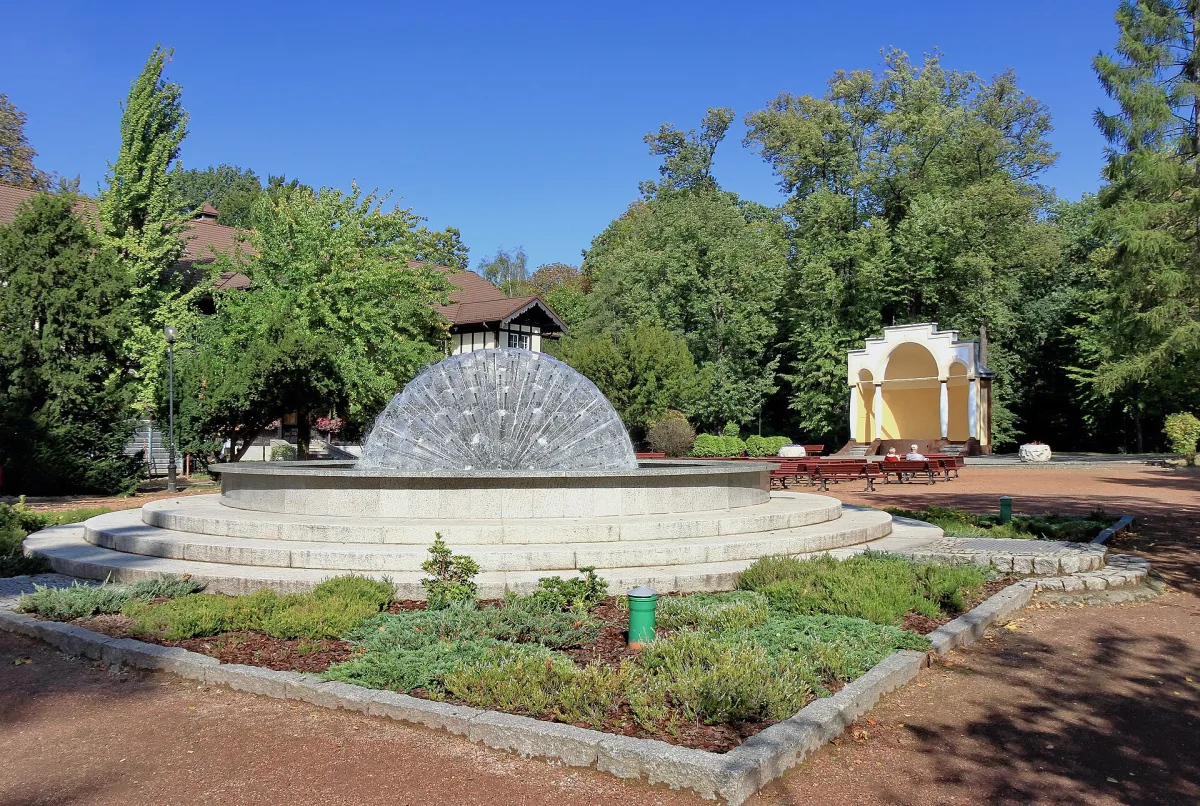
Traces of the former Zdrój are visible to this day, because it is a separate estate with parks and historic buildings. The largest is the Spa Park: eighteen hectares in the landscape style, entered in the heritage register in 1993. Species from different continents grow side by side in it, and among its furnishings is a bandstand of 1928. The Swiss-style Spa House was built in 1862 by Felix von Königsdorff. The pump room operated from 1872 in a music pavilion of 1861 and was demolished in 2011.
Not far away is the Church of the Sacred Heart of Jesus, set up in 1951 in the building of a children's sanatorium of 1891, known as Maria's Institution. Two smaller parks of the district are Dąbrówka, with three monumental trees, and the University Park by the former sanatorium of the Miners' Fraternity Fund of 1911. Since 1998 this building has housed an off-site faculty of the University of Silesia.
The end of the spa is marked by two dates. The spa establishments were closed down in 1994, and the town formally lost its spa status in 2007. Some buildings were demolished, others were given new functions, and in 2015 a brine inhalatorium was built in the former complex.
A town built around the mines
The turning point came in the second half of the 20th century, when hard coal deposits were discovered. The first mines began to be designed in 1954. The Jastrzębie mine was the first to open, in 1962, and alongside it the Przyjaźń and Zdrój estates were built. Jastrzębie-Zdrój received town rights on 30 June 1963. A dozen or so years later there were five mines within the town's boundaries: Jastrzębie, Moszczenica, Pniówek, Borynia and Zofiówka. Pniówek was separated from the town in 1992.
This layer of history is told by the Carbonarium exhibition in the former miners' bathhouse in Moszczenica. On the Przyjaźń estate stands also the oldest church in the town: the wooden Church of St Barbara and St Joseph, built in the 17th century in Jedłownik and moved to Jastrzębie in 1974, when a new miners' estate was growing.
3 September 1980: the agreement at the mine
The name of Jastrzębie entered the textbooks through a single document. The Jastrzębie Agreement was signed on 3 September 1980 at the Manifest Lipcowy mine, today Zofiówka. On the government side it was signed by the Government Commission headed by Aleksander Kopeć, and on the side of the strikers by the Presidium of the Inter-Factory Strike Committee, chaired by Jarosław Sienkiewicz. It was the document of 56 workplaces that formed the strike committee at the mine, and it is counted among the August Agreements.
To the twenty-one demands from the Coast the Jastrzębie committee added its own, concerning wages, social matters and the organisation of work. Among those accepted were, among other things, linking earnings to the growth of the cost of living, recognising pneumoconiosis as an occupational disease, a coal allowance for all mining employees and the abolition of the four-brigade work system in some mines. The main achievement of the agreements is considered to be winning free Saturdays for Polish workers in general.
The continuation of this story, from the strikes in the following months to the pacification of the mine in December 1981, is described in a separate article on the miners' strikes and martial law in Silesia. Here it is worth remembering one thing: a town that began as a spa with brine, within less than twenty years of its first mine, became the place where one of the most important documents of August 1980 was signed.
Be the first! Add a comment.
You need to log in to add a comment.
Log in