
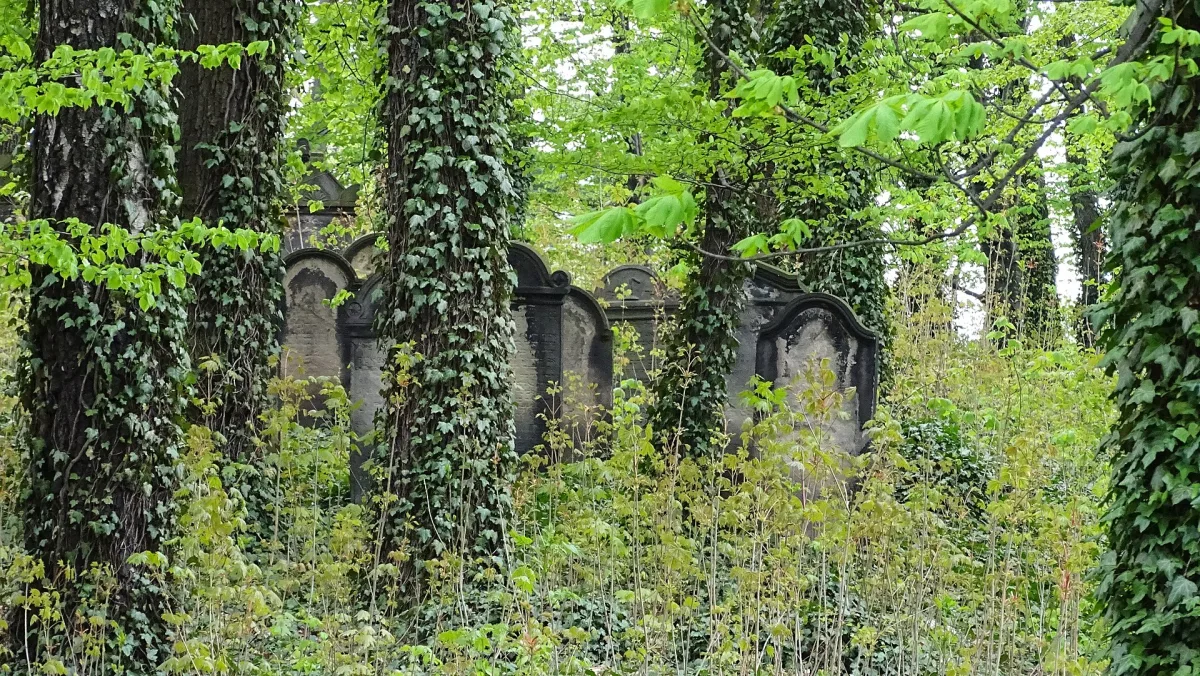
The cemetery in Mikołów as a shared necropolis
In the area of Pszczyna, Żory, Mikołów, Rybnik and Racibórz, Jewish communities founded their own cemeteries in the first half of the 19th century. Earlier, Mikołów was used. Members of the Pszczyna community buried their dead in Mikołów before 1814. The new Jewish cemetery in Mikołów also served followers of Judaism from Żory, and Mikołów is also listed among the places where Racibórz Jews were buried before 1817.
The Mikołów cemetery was probably founded in the 18th century, and the oldest surviving gravestone dates from 1726. In 1828 the site was enlarged. It covers 0.5 hectares according to one source and 1 hectare according to another. More than three hundred gravestones with inscriptions in Hebrew and German have survived, and the cemetery was entered in the heritage register in 1973.
In January 1945 the cemetery lay on the route of the death march of prisoners from the German Auschwitz-Birkenau camp. Prisoners who died of exhaustion or were killed by guards were buried in the cemetery. The number of those buried is uncertain: sources give a range from 50 to about 160 people. Soon afterwards the Germans shot 14 prisoners brought from Katowice by the eastern wall. Their bodies were also buried in the cemetery.
In the 1950s a part of the former necropolis was set apart and a monument to the victims of the death marches was erected there. The remaining part deteriorated: slabs were stolen, and matzevot were knocked over and broken. The site was tidied in 1988. The fence has no gate, so official visits were not possible. Information about access is worth checking with the town office. The card for the New Jewish Cemetery in Mikołów describes this place separately.
Pszczyna: a cemetery that survived the war
The Jewish cemetery in Pszczyna lies at the back of a plot on Katowicka Street. It was founded in 1814, and the first person buried was four-year-old Jettel, daughter of Rabbi Hirschel Guttmann, who died on 10 September 1814. It covers about 0.6 hectares and about 400 gravestones have survived there. The cemetery came through the war without destruction and is regarded as one of the best preserved Jewish necropolises in the Silesian Voivodeship.
In 1888 the site was enlarged, a brick fence with two wrought-iron gates was built, along with a Neo-Gothic funeral house designed by Ernst Betz. A 35-metre avenue of ash trees leads to it. The cemetery was entered in the heritage register in 2021 under number A/838/2021. Among those buried are Samuel Skutsch, the first Jewish chairman of the Town Council, and Heinrich Schiller, co-founder of the spa in Goczałkowice.
In Pszczyna itself there is also the former synagogue of 1835. During the war it was converted into a cinema, so the original appearance of the interior has not survived.
Żory: from a sports pitch to a lapidarium
The Jewish cemetery in Żory was founded in 1814, is the oldest necropolis in the town and lies on Cmentarna Street. It covers 0.58 hectares. The funeral house was destroyed in 1945, and the ruins were demolished in the 1960s. In the communist period the cemetery fell into ruin and was used among other things as a sports pitch.
The first inventory was made in 1985 and repeated in 1994. About 130 gravestones have survived, of which 45 are standing, and a group of 59 old trees is protected. In 2014 the damaged wall on the street side was taken down, and in 2024 the site was tidied. In the southern corner, on the site of the former funeral house, a lapidarium for fallen matzevot was set up, and boards about the history of the cemetery and the Jewish community of Żory were placed on the fence. Both the cemetery and the synagogue of 1830-1835, which was converted into a cinema after the war, have cards.
Rybnik: a square on the site of a cemetery
The Jewish cemetery in Rybnik existed from 1815. In 1931 it was closed on the order of the police because of sanitary shortcomings. At the turn of March and April 1940 the German occupier liquidated it: the matzevot were used to harden roads, and the site was turned into a square, which today bears the name of the H. Wieniawski green. According to the cemetery's card, the place functions as a public park, and any commemoration is worth checking with the museum or the town office.
Racibórz: the kirkut on Wilcza Góra
The Jewish cemetery in Racibórz lies on a hill called Wilcza Góra, by Głubczycka and Fojcika streets. The community bought the land in 1814 from Jan Hutny, and the first burials took place in 1817. The site was enlarged twice to 2.03 hectares. The last burials date from the turn of 1940 and 1941, and the last people buried were most probably Josef Bohn, who died on 7 March 1940, and Adela Fraenkel, who died on 10 February 1941.
In 1972-1973 decisions were made to liquidate the necropolis, and in 1973 it was finally closed down. Local stonemasons took the matzevot and reworked them into gravestones later placed in Catholic cemeteries. The oldest grave was the matzevah of Rosalia Wachsner from 1821. Today what remains is old tree stock and, in places, fragments of gravestones and stone bases. The card for the cemetery in Racibórz describes the state of preservation differently today, as several hundred gravestones, so before a visit it is worth checking the current state with the museum or the town office.
Rules for visiting
The former Jewish cemeteries are burial places. By tradition men usually cover their heads, one does not step on gravestones, and according to tradition pebbles are left on matzevot. Some cemeteries are locked, or, as in Mikołów, have no gate. Information on access is given by the administrator, most often the town office or the Jewish religious community. On the Sabbath and on Jewish holidays the cemeteries are usually closed. Before a visit one should check whether a given cemetery is accessible. The shared heritage of the region is also shown by the former synagogue in Wodzisław Śląski, converted in 1938 into the Insurgents' House.
Be the first! Add a comment.
You need to log in to add a comment.
Log in