

Kłobuck lies on the old route from Kraków through Częstochowa and Krzepice to Silesia and Greater Poland, on a borderland that for centuries determined the direction of its development. Three threads meet in its history: a medieval market settlement and parish, a starosty given to the Pauline monastery of Jasna Góra, and a Jewish community whose history ended in June 1942.
From Globsek to a royal town
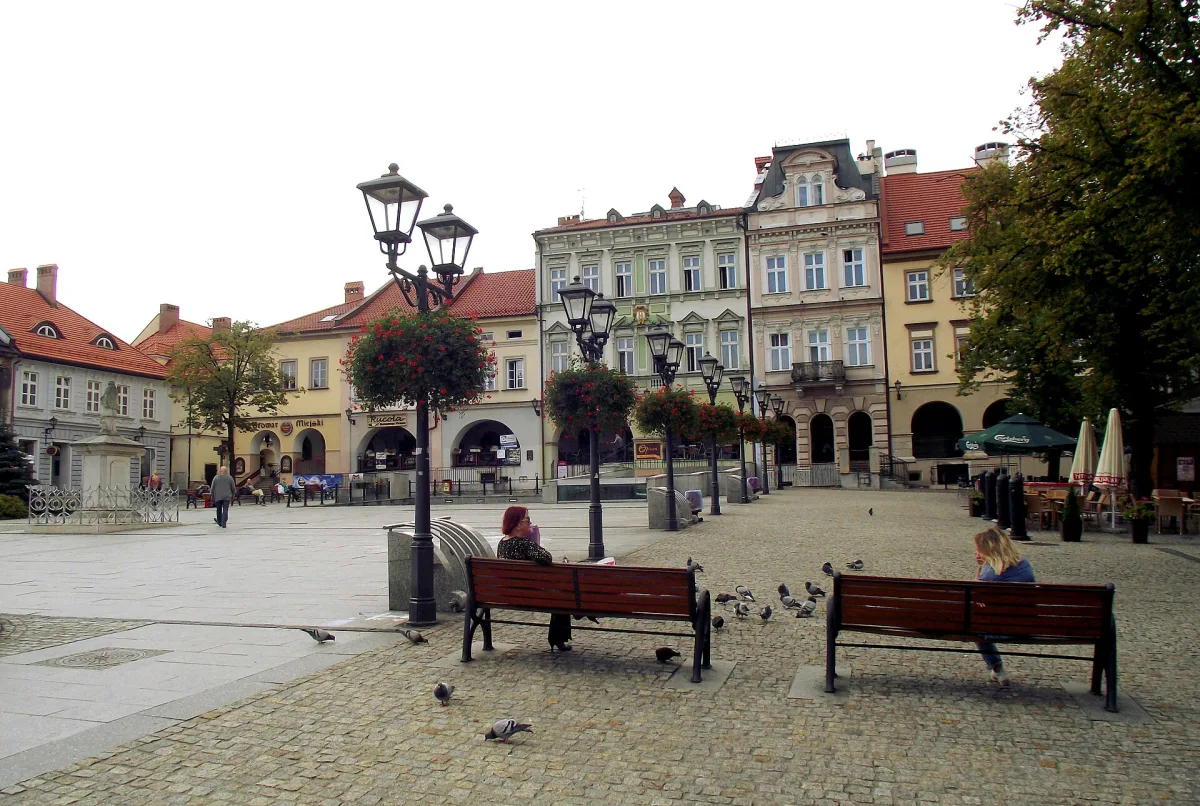
The name of the settlement appears in the sources in many spellings. The oldest known dates from 1257 and reads "Globsek". The first foundation of the town took place probably in 1244 and concerned a settlement known today as Kłobuck Stare Miasto, demoted before 1400. The royal town under Magdeburg law was founded by Casimir III the Great between 1339 and 1344. Kłobuck was a significant market settlement even before it received town rights, and fairs were held on the feast days of the church's patron saints: St Margaret on 13 July and probably St Martin on 11 November. The layout of the town is defined by a quadrangular market square with an irregular street grid.
In the 14th century the border between the Crown and Silesia was not stable. In 1370 Louis of Hungary granted Kłobuck, Krzepice and other border towns as a fief to Władysław of Opole, and in 1396 it returned to the Crown under Władysław Jagiełło. The town was surrounded by walls and ramparts, mentioned in the years 1448-1514. In 1457 it was invaded and burned by the troops of Duke John IV of Oświęcim, and in 1469 it burned almost to the ground after a fire was started by one of the blacksmiths.
The parish, Długosz and the monastery of 1476
The Church of St Martin and St Margaret was the seat of one of the largest parishes in medieval Poland, covering about 800 square kilometres. Jan Długosz states that the first brick church here was founded in 1144 by Piotr Dunin Włostowic, but this information is not confirmed by other sources. A mention of the church's rector from 1287 is certain. In the years 1434-1448 the parish priest was Jan Długosz himself, the chronicler of Polish history. In 1465 the church's extension began at his expense, and in 1476 Długosz founded a monastic complex of canons regular here. The church was connected to the monastery by a passage over a gate. In the heritage register the monastery is today listed as a presbytery. In the parish book of 1471 the so-called Kłobuck cisiojanus was recorded, one of few medieval Polish texts of this kind.
A non-castle starosty in the hands of the Paulines
Kłobuck first belonged to the Krzepice starosty. In 1658 the Warsaw Sejm separated a new Kłobuck starosty from part of it, made Kłobuck its seat and granted it in perpetuity to the Pauline monastery at Jasna Góra. The aim of this decision was to ensure the upkeep of the Jasna Góra fortress. After the Swedish Deluge the town declined, and in 1689 it was almost completely burned.
In the second partition, in 1793, Kłobuck found itself in the Prussian partition, and the Prussian authorities took the starosty from the Paulines and incorporated it into government estates. In 1870 the town was deprived of its town rights and regained them only in 1917. Linked to this period is the palace in Kłobuck in Stare Zagórze, built in 1795-1800 for the Prussian minister Christian von Haugwitz. It is a palace from the turn of the 18th and 19th centuries in the neo-Gothic style, entered in the heritage register together with its park.
The Jewish community and the ghetto in 1941-1942
In 1862 Kłobuck had 548 adherents of Judaism among 2,192 inhabitants. Before the Second World War Jews made up a large part of the town's population, about two thousand people. During the occupation Kłobuck was incorporated directly into the Third Reich, as part of Blachownia county in the Opole region.
In October 1941 the German occupier created a ghetto in Kłobuck. About 1,500 Jews were gathered in it. News of the planned liquidation spread on 21 June 1942. The ghetto was liquidated on 22 June 1942. Some of the people were driven to Krzepice, and from there deported to the German Nazi concentration and extermination camp Auschwitz-Birkenau. Also, 35 young women and one man were sent to a labour camp in Sosnowiec, and seven skilled workers with their families were left in the town. About a hundred people from Kłobuck survived the war, and the community was not rebuilt.
A reminder of the Jewish community is the Jewish cemetery on Sadowa Street, founded in the first half of the 19th century. During the occupation it was devastated, and one matzevah survives. The figures concerning the ghetto and its liquidation come from a single study, so they should be treated as estimates. The rules of access to the cemetery are set by its custodians.
Be the first! Add a comment.
You need to log in to add a comment.
Log in