
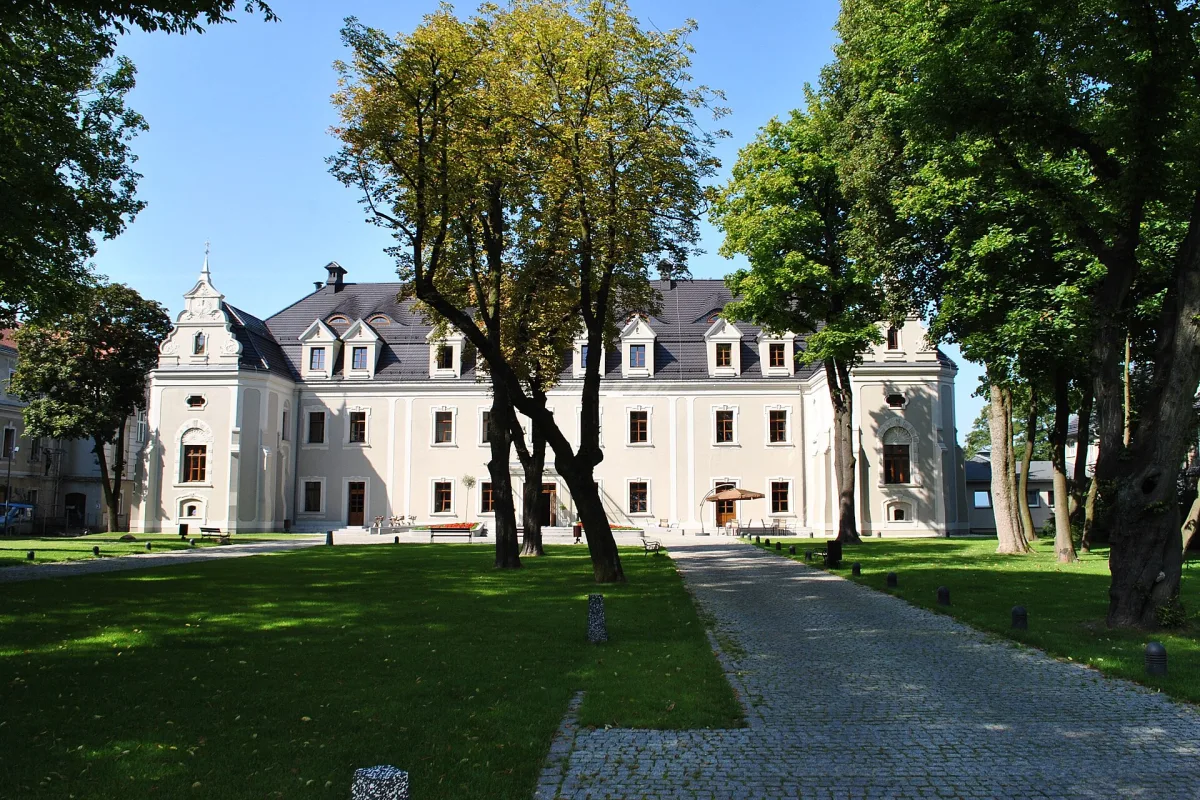
Lubliniec lies on the northern edge of the Silesian Voivodeship, among the Lubliniec Forests, and is the second-largest town in the northern part of the voivodeship after Częstochowa. Its history can be told through three threads: the castle of dukes and landowners, a Jasna Góra image that briefly found refuge here, and Edith Stein, whose mother's family came from the town.
Facts: from the founding to the castle
Lubliniec was probably founded in 1272 by Duke Władysław I of Opole. In 1277 the building of the town hall and the church of St Nicholas was said to have begun. The town received town rights under Flemish law in 1300, and in 1500 they were renewed as Magdeburg law. From the 14th century Lubliniec was the seat of Lubliniec County, one of the largest in the Duchy of Opole.
The date of the first mention of Lubliniec Castle is hard to establish. The website of the hotel that now occupies the castle gives the year 1379, another source gives 1397, and tradition links the founding of the town with 1270 or 1272. In both sources the castle is connected with Duke Władysław of Opole. In 1587 Jan Kochcicki bought it and rebuilt it as a family seat. After the great fire of the town in 1650, the castle was rebuilt as a Baroque residence, and the last rebuilding in the 18th century gave its façades a Neoclassical look. In the 19th century it housed the county court and the county office, and from 1893 a psychiatric hospital. After years as a ruin, it was taken over by the town in 2002, and in 2010 a hotel opened in the castle. It is a working hotel in a park, so access to the interiors depends on the rules of the venue.
On the same walk around the centre there is the Church of the Exaltation of the Holy Cross of 1505, founded by Duke John of Opole, and the Church of St Stanislaus Kostka of 1928-1931 next to the Oblate monastery.
The Jasna Góra image in Lubliniec Castle in 1655
In 1655 the icon of Our Lady of Jasna Góra, taken out of Jasna Góra just before the Swedish siege, was for a short period at the castle in Lubliniec. The image is said to have found refuge here for fear of Swedish requisition. We do not know the details: neither how long the image stayed here, nor where exactly it was kept. All that is known is that the castle was then a residence of the Cellary family, rebuilt after the fire.
Edith Stein and her grandparents' house
Edith Stein, in religion Teresa Benedicta of the Cross, was born in 1891 in Wrocław. Her mother, Auguste Stein née Courant, came from Lubliniec. Edith came here for holidays with her grandparents. The Courant family tenement house, built in 1857, has former shops on the ground floor and the grandparents' flat on the first floor. Today the first floor houses the Edith Stein Museum, opened on 28 February 2009. The multimedia exhibition tells of the saint's life and her death in the Auschwitz-Birkenau camp in 1942. A commemorative plaque hangs on the building, and on the Small Market Square stands a sculpture by Stanisław Kowalczyk from 2005.
In 2008, by a decree of the Holy See, Edith Stein was made patron saint of the town. The parish named after her in the Steblów district, established in 1991, runs the Church of St Edith Stein, a diocesan shrine since 8 December 2021. The Courant family is also recalled by the Jewish cemetery, established in 1845. Edith Stein's grandparents, Adelaide and Salomon Courant, are buried there. It is a burial place, so behaviour should be appropriate to the site.
The legend of the town's name
Historians derive the original name Lubin from the personal name Luba or Lubla. A legend recorded by Felix Triest in 1865 says otherwise: Duke Władysław of Opole, while hunting in these parts, is said to have remarked “I like it here, to build a church and a town” (in Polish, “lubi mi się tu kościół i miasto budować”). This is a folk etymology, not a finding by researchers, but it conveys well how the inhabitants explained the town's beginnings to themselves.
What else is nearby
If there is time left, on the Lublinica river lies the small Droniowice Reservoir, and in Pawonków municipality the Palaeontological Museum in Lisowice, with fossils about 210 million years old. Further south stands the palace in Koszęcin, the seat of the “Śląsk” Song and Dance Ensemble.
Be the first! Add a comment.
You need to log in to add a comment.
Log in