
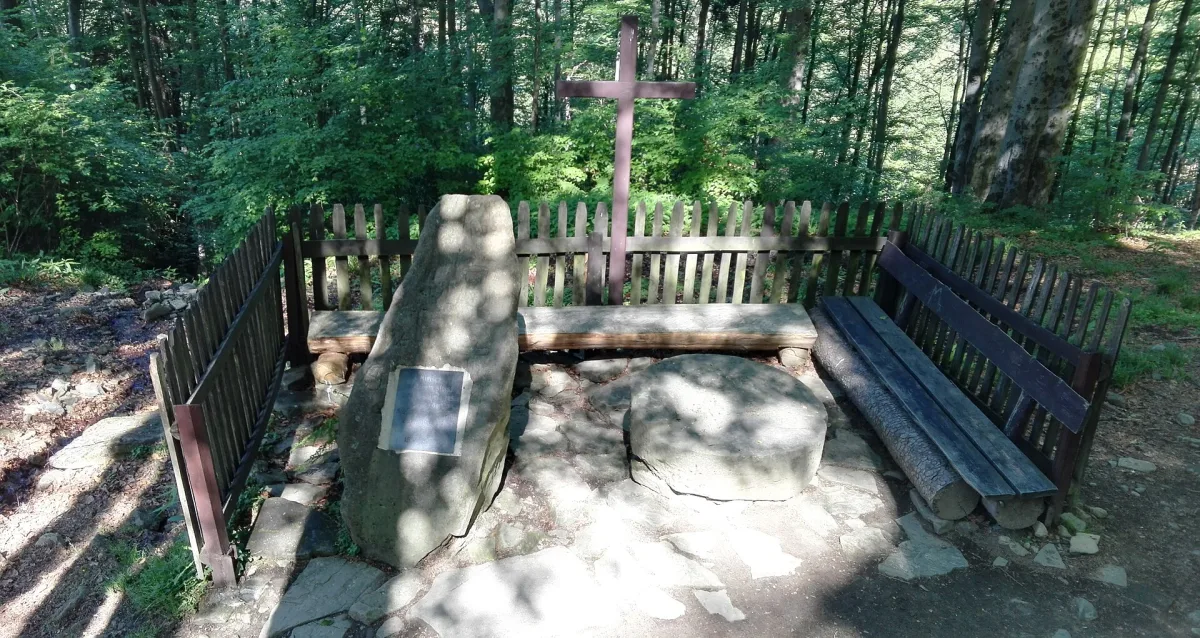
1654: churches taken away, services in the forest
In 1654 the so-called religious commission, acting on the orders of Emperor Ferdinand III, took all the churches away from the Protestants of Cieszyn Silesia. The Thirty Years' War had only just ended, so the local population, fearing reprisals, offered no resistance. Without churches the communities relied on the ministry of itinerant preachers, who came in secret mainly from Upper Hungary, but also from Lower Silesia and from the Kingdom of Poland.
Services were held in remote places, above all in the mountains, and the locations were often changed to avoid reprisals. This state of affairs lasted until roughly 1709. Thanks to oral tradition, the memory survives of nine such places in the Silesian Beskids and the Silesian-Moravian Beskids: six lie on the Polish side of the border, three on the Czech side. They are called “forest churches”.
The Stone on Równica
The best-known site is on the western slopes of Równica above Ustroń, at an altitude of about 700 m above sea level, in the area of the sources of the Gościeradowiec stream. A flat stone served here as an altar, which is why the people of Ustroń traditionally call it “ku Kamiyniu” (“to the Stone”). You will find a description of this place on its entry: The Stone on Równica.
In 1904, on the 250th anniversary of the beginning of the forest services, a spring next to it was enclosed and a plaque with the date 16.07.1904 was placed on it. In 1928 the site was entered in the heritage register, and a few years later the inscription “Place of Protestant services in the years 1654 to 1709” was added. In 1935 the inscription was partly damaged.
The place is not merely a memorial. In the interwar period Protestant youth gathered here, and from 1958 the end-of-year ceremonies of the Sunday school were held at the Stone. In 1961 annual services were inaugurated on the Gustav Adolf Fraternal Aid Day, held on the day on which Catholics celebrate Corpus Christi. They are attended by crowds of the faithful, also from distant parishes, and every two years, after the service, accompanying events take place in the area of the mountain hut on Równica. Right beside it runs the Main Beskid Trail, marked in red. A little under a kilometre further on is the Równica Mountain Park, a recreation site of a completely different character. At the Stone, silence and respect for prayer are expected.
Czantoria and other forest churches
Another such place is connected with Czantoria Wielka. One description of the mountain mentions the “Protestants' Stone” on the western slope, by the red trail to Nydek: a rock outcrop with a carved sign of the cross and a plaque commemorating Jerzy Trzanowski. A list of forest churches, in turn, describes Zakamień in Nydek on the southern slope of Czantoria. Services were held there in 1654-1709, a cross was carved on the rock serving as an altar, and a bilingual plaque dedicated to Trzanowski was unveiled in 1992. The two descriptions thus differ in which side of the mountain they indicate. It can be reached on marked trails from the mountain hut on Czantoria, from Nydek and from Spowiedzisko in Leszna Górna.
Jerzy Trzanowski (1592-1637), a pastor born in Cieszyn, is the author of the hymnal “Cithara sanctorum”, published in Levoča in 1636. A collection of more than 400 hymns in Czech, it went through at least 215 editions, and Trzanowski is called the “Slavic Luther”. The northern slopes of Czantoria itself are protected by the Czantoria nature reserve, through which the blue trail from Ustroń leads.
Other forest churches include “Spowiedzisko” at the foot of Czantoria Mała in Leszna Górna, where there used to be a spring in which children were most probably baptised, and “Szymków” in Wisła Bukowa. At Szymków services were held in 1654-1782, and the last, in 1782, was a service of thanksgiving for the religious freedom obtained. In Jaworze a stone amphitheatre with thirteen tiers was unveiled, which could hold 500 people. The only forest church lying low down, on the southern outskirts of Bielsko-Biała, is the stone altar table “Jan”, at which the Protestant parish has held services since 1996.
From the settlement to toleration: the first churches
The turning point came with the Treaty of Altranstädt, concluded on 1 September 1707 between the Lutheran King of Sweden Charles XII and the Catholic Emperor Joseph I. It obliged the emperor to return 121 churches to the Silesian Protestants, and an additional agreement of 1709 allowed six so-called Churches of Grace to be built, including one in Cieszyn. Permission to build the Jesus Church in Cieszyn was issued on 24 May 1709, and the foundation stone was laid on 13 October 1710. Of the six Churches of Grace, only this one has survived to the present day as a Protestant church. It is regarded as one of the largest Protestant churches in Poland, with 3,500 seats.
The next step was the Patent of Toleration of Emperor Joseph II of 13 October 1781. For Cieszyn Silesia it was announced in a separate gubernial circular of 30 March 1782, in different wording from that for the rest of Cisleithania. In Bielsko the foundation stone for a church was laid on 19 March 1782 on a site called Bielsko Zion. Construction lasted eight years, and in 1881 the Church of the Saviour was rebuilt in the neo-Gothic style to a design by Heinrich von Ferstel. It stands on Martin Luther Square. In the 17th century Bielsko was one of the strongest Protestant centres in Cieszyn Silesia. In Wisła the first wooden prayer house was ready in the autumn of 1782. In 1833 the Old Protestant Cemetery was founded in Bielsko; previously Protestants and Catholics had buried their dead together by the Holy Trinity church. Today the necropolis is closed to burials, and silence is expected in the cemetery.
Churches and chapels in mountain villages
Protestants were distributed unevenly in the Beskids. According to the Austrian census of 1900, in Ustroń they made up 56.6 per cent of residents, and in Istebna 5.6 per cent. It was there that the Protestant church in Istebna was built only in 1927-1930, to a design by Tadeusz Michejda. The foundation stone was consecrated by Bishop Juliusz Bursche in the presence of about 6,000 of the faithful, and the land was donated by Jakub Śliwka.
Smaller communities began more modestly. The first Protestant families came to Salmopol in Szczyrk in 1803 from Wisła. In 1897 a school was built there in which services were also held, and the present church in Salmopol was built in 1991-1995. In Bielsko-Biała, in the Kamienica district, a brick chapel was built in 1899 on the site of a wooden bell tower, today the Protestant church in Kamienica. The costs were co-financed by the Manhardt family, owners of a cloth factory.
More were built after the war: the chapel in Świętoszówka, consecrated on 23 September 1956, with an altar donated by Pastor Martin Niemöller of Darmstadt, and the Church of the Apostle Bartholomew in Brenna from 1985-1988, with 300 seats. At the Catechetical House in Wisła Jawornik there is a Protestant chapel, and Jawornik became an independent parish on 1 December 1994.
Be the first! Add a comment.
You need to log in to add a comment.
Log in