
Tarnowskie Góry grew out of ore mining, and to this day this can be read from the layout of its centre: from the shape of the market square, from the townhouses of wealthy gwarks (mine owners and miners), from the buildings where future mining officials were taught, and from the annual festival that recalls the old trade. This text follows those traces. We write separately about the mines themselves, the legend of the peasant Rybka and the spirit Skarbnik, so here we stay above ground.
Three dates, one town
The question of the town's beginnings has several answers. In 1526 the Duke of Opole and Racibórz, John II the Good, and Margrave George of Hohenzollern issued a charter of mining freedom, and in 1528 they proclaimed a supplementary mining code, known as the Ordunek Gorny. The date of the town charter is given in three versions: 1526, 1528 and 1562. According to research by Zdzisław Jedynak, the town charter and coat of arms were granted to the town on 25 July 1562 in Ansbach by Margrave George Frederick of Hohenzollern. The 1562 version is therefore based on archive documents, while 1526 marks rather the beginning of the mining settlement.
In the same century a school began here. The first educational institution known from the sources was a Protestant school founded in 1531, where lessons were given in Polish and German. During the Counter-Reformation it was turned into a Catholic school, and after Prussia took over Silesia in 1754 a Protestant school was opened in the town again. From then on schools of both denominations operated here, and from 1846 also a Jewish one.
A market square that grew with the mines
According to Dr Danuta Szlachcic-Dudzicz, the first town market was today's Gwarków Square (plac Gwarków). The buildings there were so dense, however, that the offices could not find room for their seats, so the market was moved north, and the rapid growth of the town meant that yet another was laid out, which is the main one to this day. In 1548 it was extended to the east. It housed the Mining Office, the court, the starost's office of the Bytom land and the town council.
The Market Square (Rynek) is trapezoid in shape, 108 metres long and 75 metres wide in the western part and 52 metres in the eastern. This irregularity is no accident: mining work went on even in the very centre of town, and the gwarks built houses next to shafts rather than according to a set plan. Eight streets lead down into the square.
Around the square stand townhouses that the heritage register lists under numbers 1 to 18. The oldest date from the 16th century. The western frontage is distinguished by arcaded townhouses, popularly called Laubes: the arcades at Rynek 17 and 18 and on Gliwicka street are one of the most recognisable elements of Tarnowskie Góry architecture. The houses with arcades acquired their present appearance at the beginning of the 19th century.
At Rynek 1 stands Sedlaczek House, the former seat of the starosts of the Bytom land. In 1805 it was bought by the Czech merchant Jan Sedlaczek, who a dozen or so years earlier, in 1786, had set up a wine bar there. According to tradition Polish kings stayed in it, and in 1683 John III Sobieski on his way to Vienna. Today the upper floor houses the Museum in Tarnowskie Góry, and during renovation in 1957 a Renaissance ceiling with polychrome decoration was discovered there.
The town hall is much younger. It was built in 1896-1898 to a design by the Berlin architect Hermann Guth. During construction the tower's spire burned down, and the building was put into use on 11 August 1898. The facade contrasts red clinker brick, Silesian granite and sandstone with coats of arms. On the square itself it is also worth finding the wooden well windlass from the 1950s, the monument of a lump of ore attributed to Rybka, and the sculpture of a gwarek unveiled in 2015. A cross from 1858 commemorates the founding of the town by John of Opole and George of Hohenzollern.
The mining school: from Cochler House to Gliwicka street
Mining education had its own history in Tarnowskie Góry. The mining school operated in 1803-1933 and was the first secondary vocational school in the town. Other sources develop this thread in more detail: the school, in existence since 1803 but in decline, was reactivated in 1839 on the initiative of the mining master Rudolf von Carnall.
It was then housed in rooms rented on the upper floor of Cochler House at Rynek 5. On the ground floor, from 1782, the town's oldest pharmacy operated, and the building was entered in the heritage register in 2020. The number of pupils grew from 14 to more than 45, so the school needed a larger building. The sources differ on the date of the move: they give 1855 or 1857, when the school took over the building at Gliwicka 25. It was housed there until 1892.
Carnall headed the school until 1844, when he was transferred to Bonn. The pupils bid him farewell with a gift: they ordered a porcelain service with twelve cups. The views on the cups show industrial plants of Tarnowskie Góry and its surroundings. Carnall's service has belonged since 1983 to the collections of the German Mining Museum in Bochum, but from 29 September 2018 to 31 March 2019 it was shown in the Tarnowskie Góry museum at an exhibition on views of the town on porcelain.
Traces of the old education are easy to find on a walk. The mining school building at Gliwicka 25 stands not far from Gwarków Square. On Freedom Square (plac Wolności) the building of the Realgymnasium was erected in 1874, today the Stanisław Staszic Second General Secondary School. The town's Protestant community, in turn, had its own necropolis: the former Protestant cemetery, founded on 19 August 1780, was closed down in 1967. Buried there were, among others, the privy mining councillor August de Boscamp-Lasopolski and Major General Arvid von Carnall. Today there is a small square with a monument in the form of a gate made of three granite blocks.
A multicultural town of gwarks
In Tarnowskie Góry Catholics, Protestants and Jews lived side by side. What remains of the Jewish community today is memory: a masonry synagogue in the Moorish style was opened on 1 September 1864, and in 1939 the Germans burned it down. The ruins were removed in 1943. On the site, by the market square, a monument in the form of a column with a Star of David has stood since 2006, and in 2021, during renovation of the square, the brick foundations of the building were discovered. Information about it is collected on the entry for the synagogue in Tarnowskie Góry.
The Gwarks' Festival
The name derives from gwarks, that is, miners extracting silver-bearing galena. Gwarki Tarnogórskie is a recurring cultural and historical event, held since 1957 in the first half of September. It runs from Friday, and sometimes from Thursday, to Sunday. Breaks occurred in 1982-1983 because of martial law, in 1989 and in 2020 because of the pandemic.
The initiator was the Society of Friends of the History and Monuments of the Tarnowskie Góry Land, which on 4 August 1957 announced in the local weekly “Gwarek” the organisation of an event referring to the privilege granted to the town in 1599. It is worth noting that the same year, 1957, saw the start of the weekly “Gwarek”, which is still published in Tarnowskie Góry today. The festival also celebrates the passage of John III Sobieski through the town on 20-22 August 1683, when the gwarks welcomed him very ceremonially.
The most important item in the programme is the procession on the last day. In it, people in costume take the roles of historical and legendary figures: the peasant Rybka, the town's founders John II the Good and George of Hohenzollern, Friedrich Wilhelm von Reden, Rudolf von Carnall, Polish kings, poets, and also Silesian insurgents. The procession consists of a historical, a regional and a youth section and other participants. In May 2024 the Gwarks' Procession was entered on the national list of intangible cultural heritage. According to the entry for Freedom Square, the procession sets off from there.
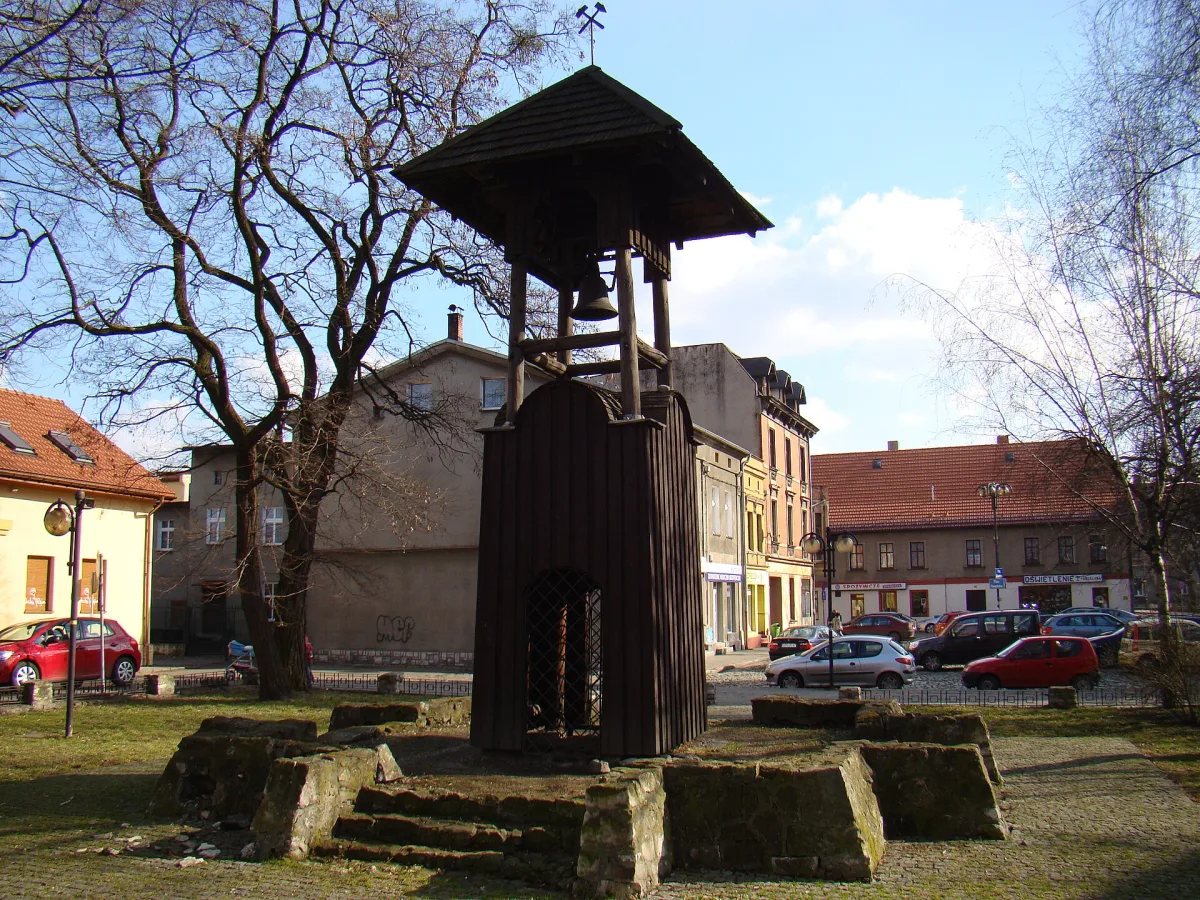
The mining atmosphere is also kept up by the wooden Gwarks' Belfry on Gwarków Square, moved here in 1955 from a former dolomite mine. Because of the poor condition of the structure, a full replica was made in the second half of the 1980s. The sculpture of a gwarek was set up in 1958 for the festival on the front of the then People's Council building.
From the market square underground
It is not far from the market square to the underground. From the centre you can walk to the Silver Mine in Tarnowskie Góry and the Royal Frederick Mine, where you can see the work that gave the town its townhouses, its school and its festival.
Be the first! Add a comment.
You need to log in to add a comment.
Log in