
We know the beginnings of mining in Tarnowskie Góry from two kinds of accounts: from the legend of a peasant who ploughed up a lump of silver-bearing ore, and from documents that began to regulate extraction in the 16th century. It is worth telling one from the other, because the legend is well known, while what turned a mining settlement into a town is connected rather with regulations than with a miraculous find. The spirit Skarbnik, who accompanies Rybka in the stories, has a separate article in the section of curiosities.
The peasant Rybka and the lump of ore
According to the legend, the first lump of silver-bearing ore near today's Tarnowskie Góry was ploughed up by the peasant Rybka, around 1490. The year 1490 is therefore a date from tradition, not from a document.
The memory of this event survives in the Market Square, where there is a monument to the lump of ore attributed to Rybka. Rybka is also a regular character in the procession of the Tarnowskie Góry Gwarki festival.
Roździeński as a witness
The oldest record we know about Rybka comes from the poem Officina ferraria by Walenty Roździeński, published in Kraków in 1612. The author was born around 1560 in Roździeń, today part of Katowice, into a family with many generations of ironworking tradition. He took his surname from an inherited forge, which in ironworking Silesia was then a common practice. He was a manager of ironworks and the owner of a forge, and at the same time a poet.
The poem has a passage that speaks of silver ore: "Srebrny kruszec w Bytomiu, na górach wnet nastał, Iny zasię od kruszca w mili zalanego, znaleziony przez chłopa Rybkę niejakiego" (in the original 17th-century Polish). Let us note two things. First, the poet writes about Bytom, not Tarnowskie Góry, which is a reminder that the Tarnowskie Góry mines then lay in the Bytom land and not in a separate centre. Second, more than a hundred years passed between the supposed discovery and the printing of the poem, so it is a late record, written down from tradition, not the account of an eyewitness.
Officina ferraria is valuable for another reason. It is regarded as the first work of its kind in Polish: it combines factual information about ironworking and mining with the rules of poetics, and describes the history of iron working and the daily work of miners, ironworkers and smiths. The author knew it from his own experience. After the author's death the poem fell into oblivion, and the only surviving copy of the first edition was found only in 1929 in Gniezno.
Mining freedom and the Ordunek Gorny
The beginning of Tarnowskie Góry mining as an organised branch of the economy is marked by regulations. In 1526 the then owners of these lands, John II the Good, Duke of Opole and Racibórz, and Margrave George of Ansbach, granted their estates a privilege supporting mining, that is an act of mining freedom. In 1528 they issued a supplementary act, the so-called Ordunek Gorny (Mining Ordinance).
From 31 October 1528 the first officials began to keep the accounts of Tarnowskie Góry mining, and the first mine books are dated from 1529, when the Tarnowskie Góry Mining Office received its own seal and coat of arms, on 9 March 1529. In 1528-1562 the office was housed in the Florczak House on today's Gliwicka Street, regarded as the oldest masonry building in the emerging town.
From a mining settlement to a town
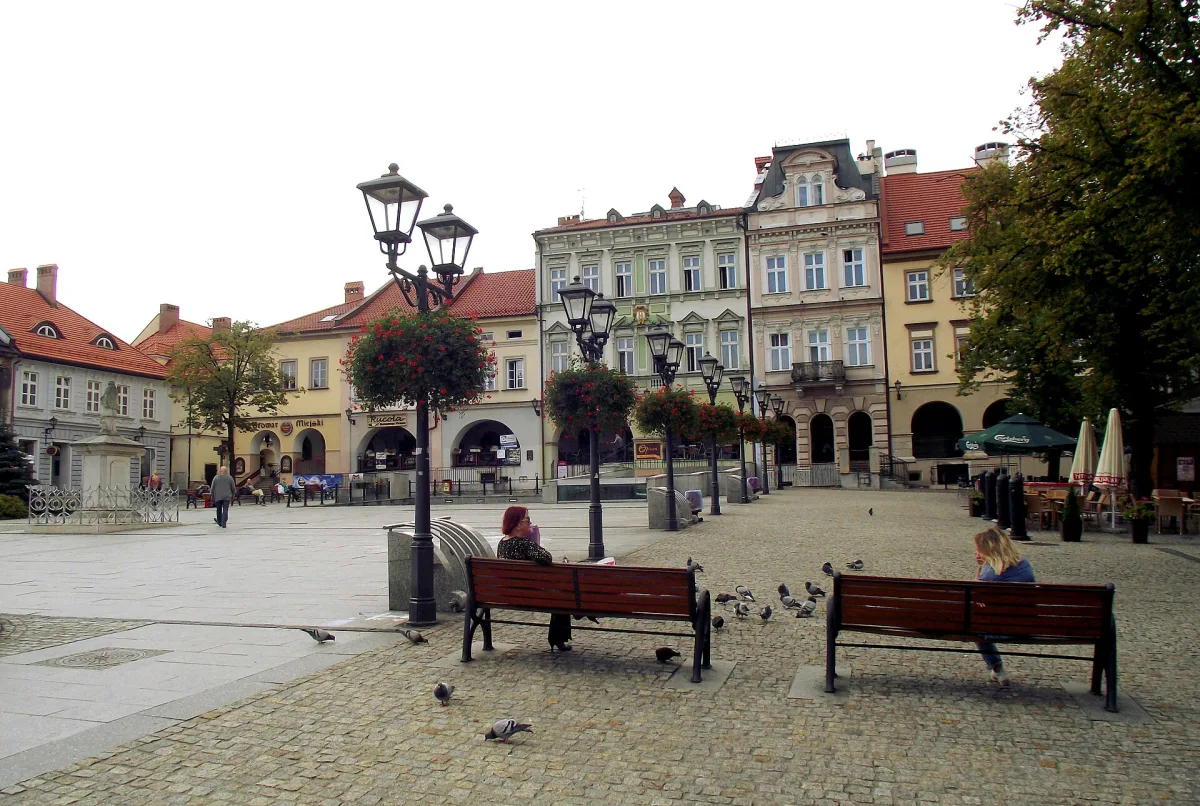
It was a time of rapid development of silver-bearing ore mining and of the mining settlement, gradually transformed into a town in which trade and crafts also developed. In the second half of the 16th century many tenement houses were built that stand to this day. The Market Square, where the Mining Office, the court, the starost's office of the Bytom land and the town council were located, was surrounded by the houses of the wealthiest townspeople, the gwarks (mine owners). Their tenements were built next to the shafts, without a fixed plan, which is still visible today in the irregular trapezoid of the square. The first market square was today's Plac Gwarków, and the building known as Sedlaczek's House now holds the municipal museum.
The date of the granting of town rights is a matter of attention in the sources. According to the research of Zdzisław Jedynak, town rights and a coat of arms were granted to Tarnowskie Góry on 25 July 1562 in Ansbach by Margrave George Frederick of Hohenzollern. The acts of 1526 and 1528 therefore concerned mining, not town rights. In the coat of arms, beside the eagle's wing from the arms of John II the Good, appears half of the black eagle of the Hohenzollerns, and the hammers, the pick and the iron symbolise mining.
What remains of it
Mining gave the town its name, its street layout and its identity. The next turning point came only in 1784, when lead ores were found near the Rudolphine shaft, and from the Fryderyk mine grew the underground route that can be visited today. The park around the shaft where they were found is today Kunszt Park. Mining tools, maps and old prints from the region's collections are shown by the Museum in Tarnowskie Góry, and the town's traces of that era can be seen on the Market Square (Rynek) and on Plac Gwarków.
Be the first! Add a comment.
You need to log in to add a comment.
Log in